A Systematic Review to Assess Gender Diversity in Authorship Within the Orthopaedic Surgery Literature
Bryn O. Zomar, Tarini Boparai, Erin You, Kendra Jackson, Natalie South, Emily K. Schaeffer

TL;DR
This study examines the representation of women in authorship roles in orthopaedic surgery research over 20 years, finding some improvement but persistent gender imbalances.
Contribution
The study provides a systematic review of gender diversity trends in orthopaedic research authorship over two decades.
Findings
Women represented 12.4% of first authors, 8.1% of last authors, and 10.5% of corresponding authors.
The proportion of women in first and corresponding author roles increased over time, but not in last author roles.
Gender representation varied by orthopaedic subspecialty, with the highest in general orthopaedics and the lowest in sports medicine.
Abstract
Gender diversity trends in orthopaedic research are dynamic. While an increase of women in orthopaedics has been observed, gender imbalances continue to exist, especially in academic leadership and research roles. The purpose of our study was to assess the representation of women in authorship roles over a 20-year period. We conducted a systematic review of clinical research studies published in The Journal of Bone and Joint Surgery and The Bone and Joint Journal between 1996–2000 and 2016–2020. First, corresponding and last author gender was determined using a combination of automated name analysis and manual searches. We performed chi-squared tests to assess differences in the proportion of women in each authorship position across time periods, journals, and orthopaedic subspecialties. Women represented 12.4% of first authors, 8.1% of last authors and 10.5% of corresponding authors.…
Genes, proteins, chemicals, diseases, species, mutations and cell lines named across the full text — each resolved to its canonical identifier and authoritative record.
Click any figure to enlarge with its caption.
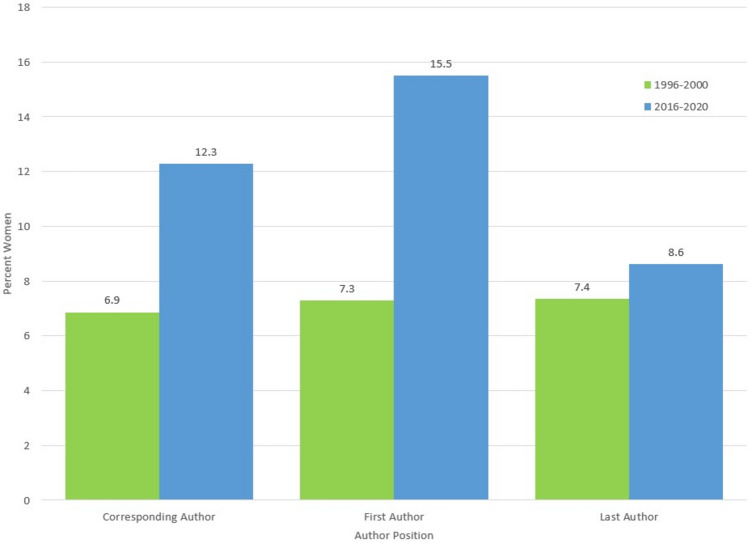 Figure 1
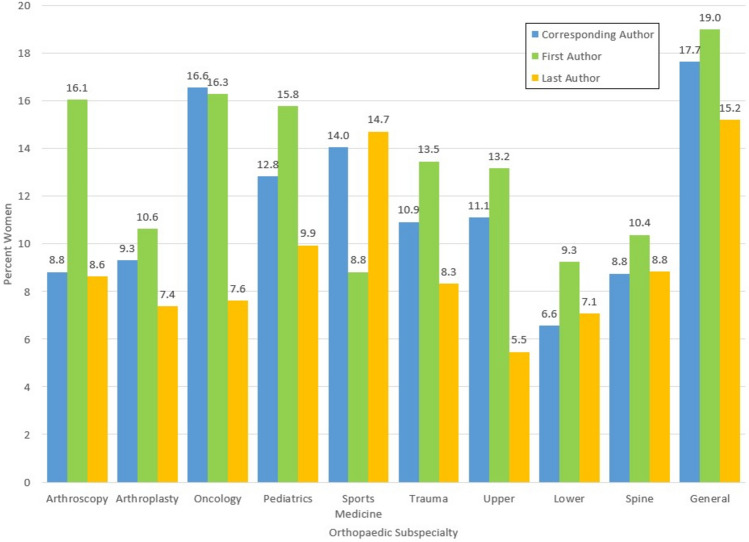 Figure 2
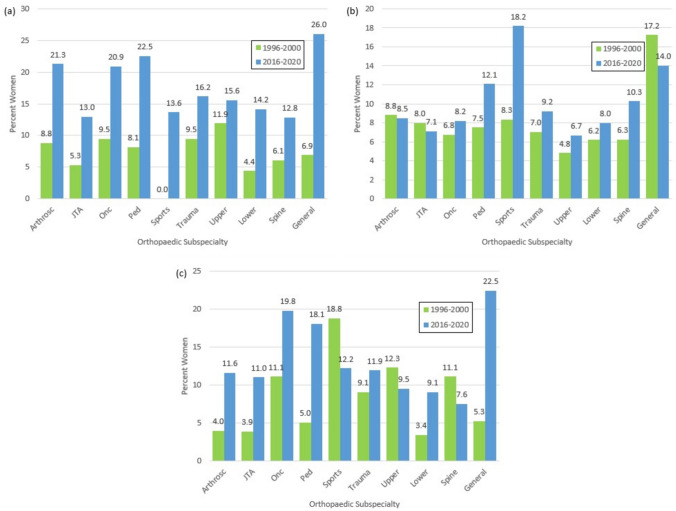 Figure 3
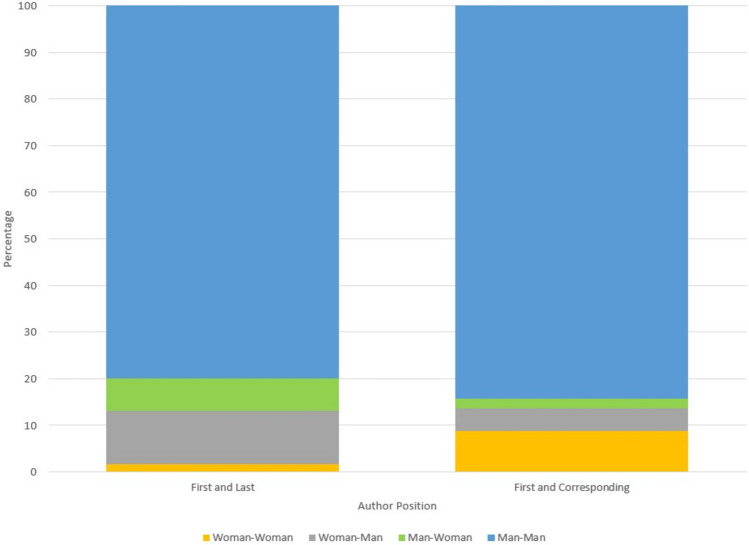 Figure 4
Peer Reviews
No public reviews on file for this paper yet. If you reviewed it on a platform where reviews are public (OpenReview, ICLR, NeurIPS, ICML), you can paste yours below so the community can read it here.
Videos
No videos yet. Explain this paper in a talk, walkthrough, or lecture? Add one.
Taxonomy
TopicsDiversity and Career in Medicine · Medical Education and Admissions · Sex and Gender in Healthcare
Introduction
Equity, diversity, and inclusion (EDI) are increasingly recognized as essential principles in medical research, yet disparities in authorship representation persist. Orthopaedics has been identified as one of the least diverse medical specialties, with a particularly low representation of women and other minority groups in both clinical and academic settings [1]. Despite the growing presence of women in orthopaedics, it remains a primarily male-dominated field, with a continued pattern of gender imbalances in academic leadership positions [2]. Previous studies have highlighted persistent disparities in authorship within orthopaedic literature, consistently showing that women remain underrepresented as first and senior authors [3]. This underrepresentation carries broader implications for orthopaedic research and limits the diversity of perspectives that drive innovation and clinical advancements.
Authorship trends and research collaboration patterns can reflect systemic inequities within the field. Although recent studies have documented the persistent gender gap in medical research, there remains a lack of comprehensive analyses that track these trends over time, specifically in orthopaedic surgery. While some studies have examined gender disparities in general medicine, research on authorship trends in orthopaedic journals remains limited, making it difficult to assess the extent of the gender gap in this field [4].
The primary aim of this bibliometric analysis study was to assess gender diversity in orthopaedic authorship in two prominent orthopaedic journals over a 20-year time span.
Methods
To assess the involvement of women in authorship positions in the orthopaedic literature, we conducted a systematic review of studies published in two leading orthopaedic journals: the Bone and Joint Journal (BJJ) (formerly known as the Journal of Bone and Joint Surgery, British volume), and the Journal of Bone and Joint Surgery (JBJS) (formerly known as the Journal of Bone and Joint Surgery, American volume).
Studies eligible for inclusion were those published in either journal between 1996–2000 and 2016–2020. We included clinical research studies, such as randomized controlled trials, cohort studies, case–control studies, and chart reviews. Studies published outside the designated time frames were excluded, as were non-clinical publications such as editorials, memorandums, letters to the editor, commentaries, reviews, etc. We also excluded case reports. Further, any study published online but not yet printed in the final volume of the journal within the specified date range was also excluded. Finally, studies involving animals, cadavers, or simulation studies were also excluded.
Eligible publications were reviewed, and relevant bibliographic data was extracted using REDCap [5, 6]. We collected the year of publication, journal name, study title, first and last name for first, last and corresponding authors. The position of the corresponding author on the byline was also noted. If a study had a single listed author, they were designated as the first author and no last author was noted. Each study was also classified by subspecialty: Arthroscopy, Arthroplasty, Trauma, Oncology, Sports, Pediatrics, Spine, Lower Extremity, Upper Extremity or General Orthopaedics. Lower extremity included all studies related to the hip, knee, foot and ankle that did not fall under any of the other subspecialty categories, similar to upper extremity which included all studies related to shoulder, elbow, hand and wrist. We categorized studies under general orthopaedics if they did not fall under any of the other specified subspecialty categories.
We also collected the gender of the first, last and corresponding authors. Gender was determined using the protocol described in Squire et al. and Fisher et al., adapted from the methodology in Feramisco et al. [7–9]. To assess authors’ genders, we used Geoff Peters’ Baby Name Guesser (https://www.gpeters.com/names/baby-names.php), a website that assigns a gender and gender ratio to first names. If the gender ratio was 3.0 or higher, the assigned gender was presumed to be correct. For names with a ratio below 3.0, a manual search was conducted to identify gender-specific information about the author. If the search was inconclusive or if a first name could not be identified, the gender was recorded as unknown.
We performed a series of chi-squared tests to assess whether the proportion of women in each authorship position, first, last or corresponding, differed significantly across several factors. We compared between the time periods, between the journals, and across the orthopaedic subspecialties. Within each journal and each subspecialty, we also assessed whether the proportion of women in each authorship position differed over time. All analyses excluded when gender was unknown. Comparisons were deemed to be significant at a level of p = 0.05.
Results
Our search returned a total of 6011 papers, of which 3137 met our eligibility criteria. A total of 1720 (54.8%) papers were published in BJJ and 1417 (45.2%) were published in JBJS (Table 1). The total number of papers published increased by 62.7% between the time periods with 1209 (38.5%) published between 1996–2000 and 1928 (61.5%) between 2016 and 2020. We were unable to determine the gender for a combined 4.1% of reported corresponding, first and last authors.Table 1. Article distribution by journal and publication yearYear publishedJournalBJJJBJS1996–20006585512016–20201062866
Overall, 12.4% of first authors were women and the proportion significantly differed between 1996–2000 and 2016–2020 (7.3% vs. 15.6%, p < 0.001) (Table 2; Fig. 1). The same trend was also significant when comparing the time periods separately for each journal (p < 0.001 and p < 0.001 respectively). The proportion of women reported as first authors also differed significantly when comparing across the orthopaedic subspecialties (p = 0.019) with general orthopaedics reporting the highest proportion of women as first authors (19.0%) and sports medicine the lowest (8.1%) (Fig. 2). When comparing the time periods for each subspecialty individually, the proportion of women reported as first authors was significantly different for arthroplasty (p < 0.001), oncology (p = 0.029), pediatrics (p = 0.001), trauma (p = 0.033), lower extremity (p = 0.013) and general orthopaedics (p = 0.033) (Fig. 3a).Table 2. Distribution of the gender of authors in the first author positionFirst author genderp valueFemale%Male%Unknown%TotalOverall38812.37262383.611264.023137Years 1996–2000887.33104686.52756.201209**<0.001** 2016–202030015.56157781.79512.651928Journal BJJ20211.74142983.08895.1717200.372 JBJS18613.13119484.26372.611417 BJJ 1996–2000487.2954783.13639.57658**<0.001** 2016–202015414.5088283.05262.451062 JBJS 1996–2000407.2649990.56122.18551**<0.001** 2016–202014616.8669580.25252.89866Subspecialties Arthroscopy1316.056580.2533.70810.019 Arthroplasty13310.63108186.41372.961251 Oncology3016.3014578.8094.89184 Pediatrics5415.7926677.78226.42342 Sports Medicine68.136088.2422.9468 Trauma9113.4655381.80324.73676 Upper Extremity1713.1810682.1764.65129 Lower Extremity219.2519987.6773.08227 Spine1915.6315578.1396.25183 General1518.996379.7511.2779 Arthroscopy 1996–200038.822985.2925.88340.150 2016–20201021.283676.6012.1347 Arthroplasty 1996–2000205.2833688.65236.07379**<0.001** 2016–202011312.9674585.44141.61872 Oncology 1996–200079.466587.8422.70740.029 2016–20202320.918072.7376.26110 Pediatrics 1996–2000138.1313181.881610.001600.001 2016–20204122.5313574.1863.30182 Sports Medicine 1996–2000002395.8314.17240.060 2016–2020613.643784.0912.2744 Trauma 1996–2000269.4922883.21207.302740.033 2016–20206516.1732580.85122.99402 Upper Extremity 1996–20001011.907083.3344.76840.563 2016–2020715.563680.0024.4445 Lower Extremity 1996–200054.3910491.2354.391140.013 2016–20201614.169584.0721.77113 Spine 1996–200046.065989.3934.55660.145 2016–20201512.829682.0565.13117 General 1996–200026.902793.1000290.033 2016–20201326.003672.0012.0050Bold values indicate statistically significant p-values (p < 0.05)Fig. 1. Percentage of women as corresponding, first and last authors over time Fig. 2. Percentage of women as corresponding, first and last authors in each of the orthopaedic subspecialtiesFig. 3Percentage of women as a first, b last, and c corresponding authors over time in each of the orthopaedic subspecialties. Arthrosc = Arthroscopy; JTA = Arthroplasty; Onc = Oncology; Ped = Pediatrics; Sports = Sports Medicine
In total, 8.1% of last authors were women (Table 3). There was no difference in the proportion of women compared between the time periods (p = 0.572) (Fig. 1), however there was a difference when comparing between the journals (p = 0.027). When looking at each journal independently and comparing across the time periods, there was a significant difference for JBJS (p = 0.035) but not for BJJ (p = 0.196). There was no difference in the proportion of women reported as last author when comparing across the orthopaedic subspecialties (p = 0.149) (Fig. 2) or when comparing between the time periods within each subspecialty (p > 0.05) (Figs. 3b).Table 3. Distribution of the gender of authors in the last author positionLast author genderp valueWoman%Man%Unknown%TotalOverall2548.13271586.911554.963124Years 1996–2000887.3598982.5512010.1011980.572 2016–20201668.62172689.62341.771926Journal BJJ1196.97146886.001207.0317070.027 JBJS1359.53124788.00352.471417 BJJ 1996–2000477.2649476.3510616.386470.196 2016–2020726.7997491.89141.321060 JBJS 1996–2000417.4449589.84152.725510.035 2016–20209410.8575286.84202.31866Subspecialties Arthroscopy78.647187.6533.70810.149 Arthroplasty927.39110788.92463.691245 Oncology147.6116288.0484.35184 Pediatrics349.9428583.33236.73342 Sports Medicine1014.715479.4145.8868 Trauma568.3257585.44426.24673 Upper Extremity75.4711388.2886.25128 Lower Extremity167.0819787.17135.75226 Spine168.8415585.64105.52181 General1215.196683.6411.2779 Arthroscopy 1996–200038.822882.3538.82340.860 2016–202048.514391.4900.0047 Arthroplasty 1996–2000308.0030982.40369.603750.337 2016–2020627.1379891.49101.15870 Oncology 1996–200056.766486.4956.76740.780 2016–202098.189889.0932.73110 Pediatrics 1996–2000127.5012678.752213.751600.321 2016–20202212.0915987.3610.55182 Sports Medicine 1996–200028.331979.17312.50240.348 2016–2020818.183579.5512.2744 Trauma 1996–2000197.0121980.813312.182710.540 2016–2020379.2035688.5692.24402 Upper Extremity 1996–200044.827590.3644.82830.617 2016–202036.673884.4448.8945 Lower Extremity 1996–200076.199382.301311.501130.790 2016–202098.9610492.0400113 Spine 1996–200046.255687.5046.25640.375 2016–20201210.269984.6265.13117 General 1996–2000517.242379.3113.45290.651 2016–2020714.004386.000050Bold values indicate statistically significant p-values (p < 0.05)
At least one corresponding author was indicated in 86.5% of papers and more often in those published between 2016–2020 (94.7%) than 1996–2000 (73.5%) (Table 4). Overall, 10.5% of corresponding authors were women and the proportion differed significantly between the time periods (p < 0.001) (Fig. 1). The difference was also significant when looking at each journal individually (p = 0.005 and p = 0.006 respectively). There was also a difference in the proportion of women corresponding authors across the subspecialties (p = 0.024) with general orthopaedics reporting the highest proportion of women as corresponding authors (17.7%) and lower extremity the lowest (6.6%) (Fig. 2). When comparing between the time periods, there was a significant difference when looking at specific orthopaedic subspecialties including arthroplasty (p = 0.002) and pediatrics (p = 0.006) (Fig. 3c).Table 4. Distribution of the gender of authors indicated as the corresponding authorCorresponding author genderp valueWoman%Man%Unknown%TotalOverall28510.50234386.33863.172714Years 1996–2000616.8677787.40515.74889**<0.001** 2016–202022412.27156685.81351.921825Journal BJJ1569.83137286.45593.7215870.217 JBJS12911.4597186.16272.401127 BJJ 1996–2000466.9956385.56497.456580.005 2016–202011011.8480987.08101.08929 JBJS 1996–2000156.4921492.6420.872310.006 2016–202011412.7275784.49252.79896Subspecialties Arthroscopy68.826189.7111.47680.024 Arthroplasty1009.3094988.28262.421075 Oncology2816.5713579.8863.55169 Pediatrics3812.8424783.45113.72296 Sports Medicine814.044680.7035.2657 Trauma6510.9250184.20294.87595 Upper Extremity1111.118888.890099 Lower Extremity136.5718291.9231.52198 Spine148.7513986.8874.38160 General1217.655580.8811.4768 Arthroscopy 1996–200014.002392.0014.00250.305 2016–2020511.633888.370043 Arthroplasty 1996–2000103.8823490.70145.432580.001 2016–20209011.0271587.52121.47817 Oncology 1996–2000711.115587.3011.59630.118 2016–20202119.818075.4754.72106 Pediatrics 1996–200065.0410487.3997.561190.002 2016–20203218.0814380.7921.13177 Sports Medicine 1996–2000318.751168.75212.50160.418 2016–2020512.203585.7512.4441 Trauma 1996–2000199.0917081.34209.572090.450 2016–20204611.9233185.7592.33386 Upper Extremity 1996–2000712.285087.7200570.666 2016–202049.523890.480042 Lower Extremity 1996–200033.418293.1833.41880.123 2016–2020109.0910090.9100110 Spine 1996–2000611.114685.1923.70540.462 2016–202087.559387.7454.72106 General 1996–200015.261894.7400190.089 2016–20201122.453775.5112.0449Bold values indicate statistically significant p-values (p < 0.05)
Of the 2894 papers which had more than one author listed, and gender was able to be determined, 46 (1.6%) had a woman as both the first and last author (Fig. 4). And for papers which had a corresponding author listed, 227 (8.8%) had a woman as both the first and corresponding author.Fig. 4. Combinations of gender of first and last or first and corresponding authors
Discussion
Our study demonstrates that women’s representation in the authorship of orthopaedic publications has improved over time, however, a substantial gender gap remains. Across the analyzed time periods and journals, men continue to dominate authorship, with women accounting for only an average of 10% of authors. This unequal gender distribution highlights the persistent underrepresentation of women in orthopaedic research authorship.
Our analyses found women comprise only 10.5% of corresponding authors, 12.4% of first authors and 8.2% of last authors, compared to 86.3%, 83.7% and 86.9% of men, respectively. A study by Brown et al. that examined women’s authorship in six major orthopaedic journals from 1987 to 2017, found that while women’s authorship has risen over time, this increase has been notably slower than the parallel rise in the number of women entering the profession [3]. Interestingly, when comparing our findings with workforce demographics, where women represent roughly 4.6% of orthopaedic surgeons globally [10], representation of women in all authorship positions was actually higher than might be expected. Although women remain underrepresented in academic orthopaedics, the authorship rates we found may suggest that women are more prolific in publishing research than their counterparts. While this could explain the higher-than-expected authorship proportions, it was not an area directly examined in our analysis.
When comparing between the time periods, 1996–2000 and 2016–2020, we observed a significant increase in women’s representation in authorship, particularly in the corresponding and first author positions. In contrast, the last author position, often indicative of seniority and leadership within research teams [11–13], did not see a significant improvement in women’s representation. This trend aligns with findings from other studies [14, 15]. The rise in women’s involvement in authorship is encouraging and may be attributed to the growing number of women entering the orthopaedic surgery profession. However, the slower growth in last author positions likely reflects barriers to academic progression, as achieving senior roles typically requires additional years of experience, mentorship, and institutional support [16–18]. This disparity is further corroborated by data showing that women in surgical faculty positions remain disproportionately concentrated in lower academic ranks [19, 20]. Although women constitute 17.8% of the academic faculty in orthopaedic surgery in the US, only 8.7% hold professorships, with the majority occupying the lower rank of instructor [20]. Furthermore, as of the 2015–2016 academic year, only one woman had attained the position of orthopaedic surgery department chair [20]. In the UK, while representation of women in orthopaedic surgery positions has continued to increase, in 2020, only 25% of trainees and 7% of consultants were women [21].
Our analysis revealed that the proportion of women in the first author position differed significantly across the orthopaedic subspecialties. Notably, pediatric orthopaedics had one of the highest proportion of female first authors, while sports medicine had the lowest. This pattern aligns with previous research indicating that pediatric orthopaedics is a relatively more gender diverse subspecialty [22, 23], whereas sports medicine continues to have lower female representation [24–26]. In contrast to the first author position, we did not find a difference across the subspecialties for senior author position (last). This is rather surprising given that previous research has demonstrated that female leadership within pediatric orthopaedics is also comparatively higher than other subspecialties, with women leading 13.3% of pediatric orthopaedic fellowship programs in 2021 [27]. In contrast, sports medicine has the lowest female representation in leadership, with women heading just 2.2% of fellowship programs in the same year [27].
This study has several limitations. Although only 4% of authors’ gender was ultimately unknown, a lack of available information to determine the gender of authors presented a significant challenge during data collection. This issue was especially prominent in papers published during the 1996–2000 time period. During searches to identify these authors, details such as first name, position or affiliation were often publicly unavailable or difficult to find. This is not surprising as there was limited digitization and thus, less linkage of author information during this time. Additionally, while the JBJS typically includes authors’ first names in the headings of their publications, the BJJ continues to publish only authors’ first initials, further complicating the ability to accurately assess gender. While we followed established guidelines from previous research to determine author gender [7–9], there may have been misclassifications in gender, particularly for authors with non-traditional first names. Gender determination by name alone can be inaccurate, as it ultimately depends on the researcher’s or author’s self-identification. Nevertheless, this approach remains the best available option until journals begin mandating the inclusion of authors’ demographic information and making it publicly accessible. Moreover, our analysis focused only on those indicated as the corresponding author and those in the first and last author positions. We did not include the remaining middle authors in our analyses, many of whom are likely women, however the author positions we did include generally represent those who contribute the majority of the work for each publication. Another limitation was the inclusion of only two journals in this analysis. It’s possible that more sub-specialty focused journals may show different trends in authorship and therefore more research that delves specifically into each subspecialty is warranted.
Our study highlights the importance of increasing mentorship and leadership opportunities for women in orthopaedics to facilitate their advancement into leadership roles and ultimately senior authorship position. Institutions and funding bodies should prioritize initiatives that support women at early and mid-career stages, to help overcome the barriers that currently hinder their progression to senior positions. Notably, research within the field of orthopaedics has shown that women benefit significantly from same-gender mentorship [28], underscoring the need to expand and foster mentorship programs led by senior women in the field to increase women’s representation. By creating a more inclusive and supportive environment, we can ensure that women’s contributions to orthopaedic research continues to grow, ultimately leading to a more diverse and equitable field. Over time, we hope to see a continued increase in female author contribution to the orthopaedic literature in proportion to the rise in participation of women in the orthopedic surgery specialty.
The reference list from the paper itself. Each links out to its DOI / PubMed record.
- 1British Orthopaedic Trainee’s Association. (2020). Available at https://www.bota.org.uk/women-in-surgery