Additions to the Entoloma (Agaricales, Entolomataceae) from China: Description of five species with one new to science

Abstract
Genes, proteins, chemicals, diseases, species, mutations and cell lines named across the full text — each resolved to its canonical identifier and authoritative record.
Click any figure to enlarge with its caption.
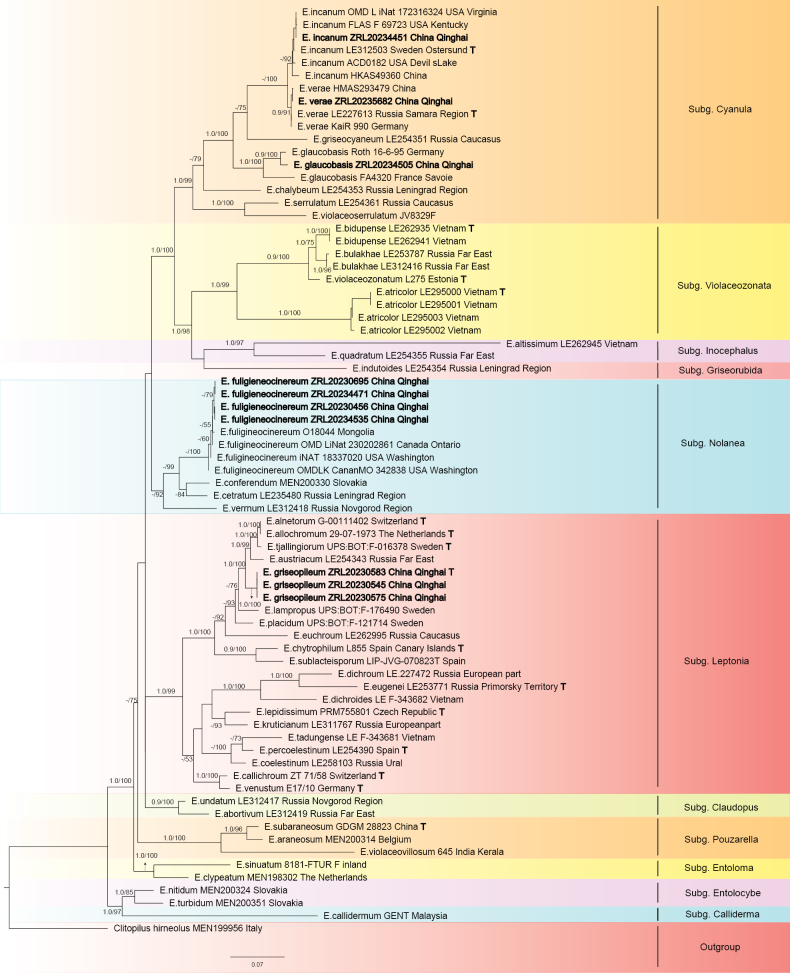 Figure 1
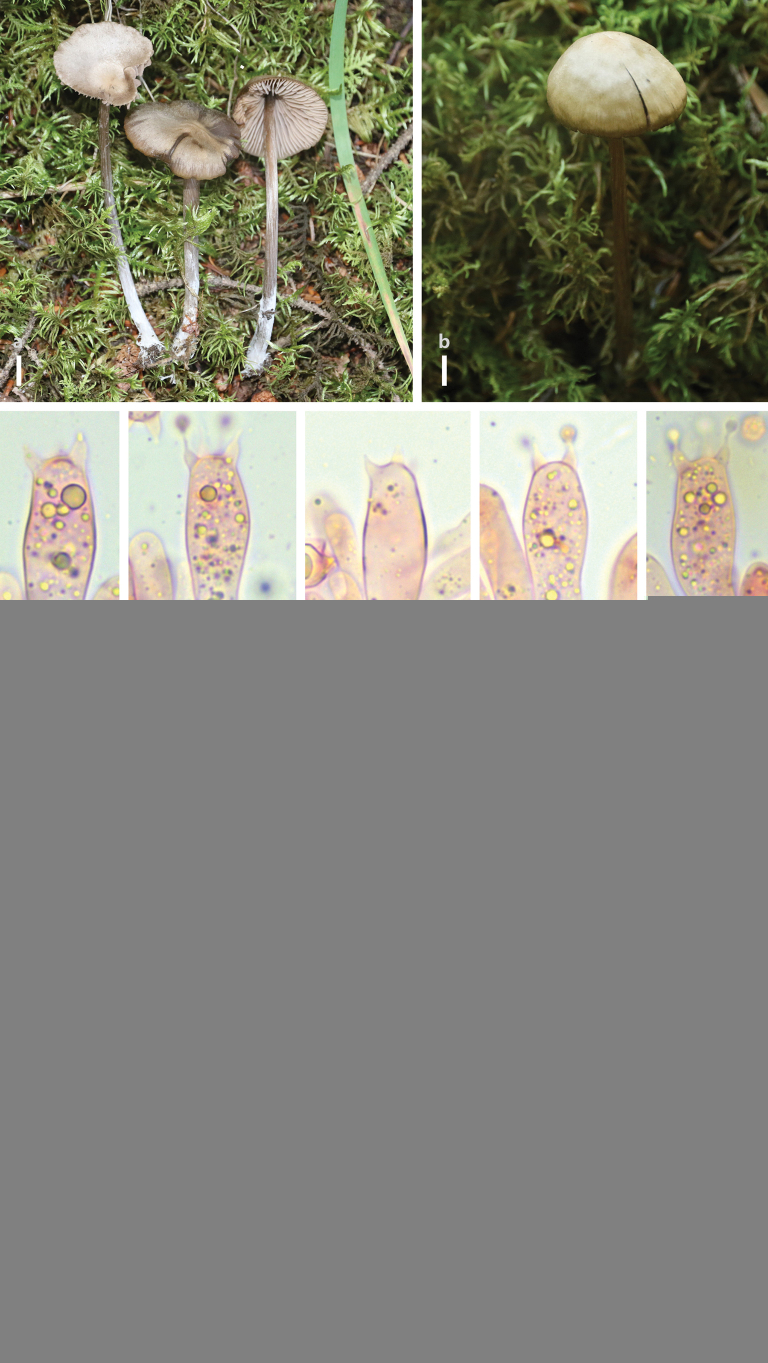 Figure 2
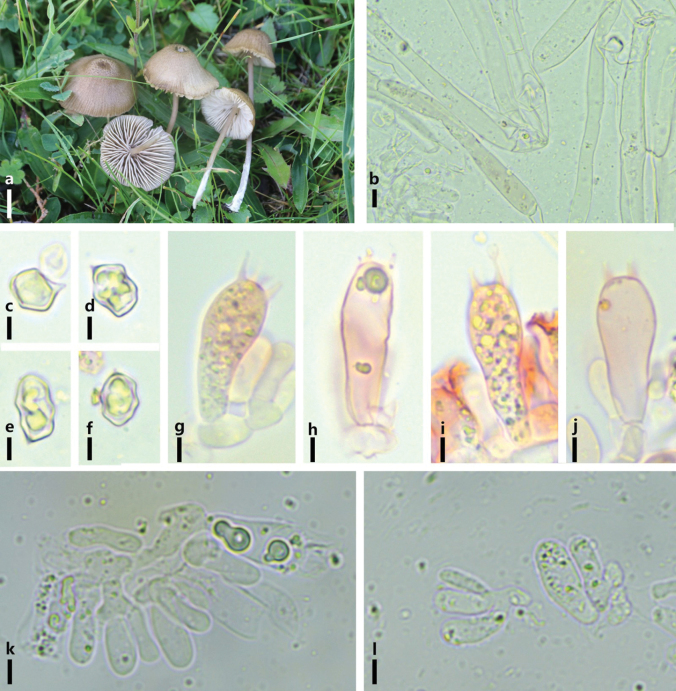 Figure 3
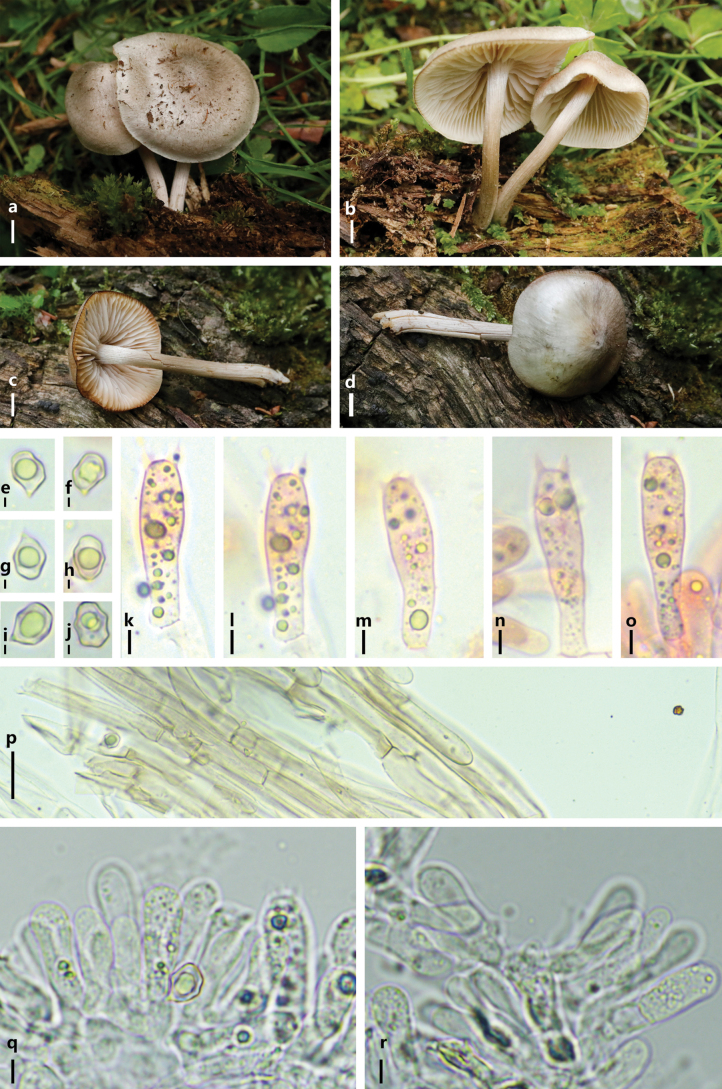 Figure 4
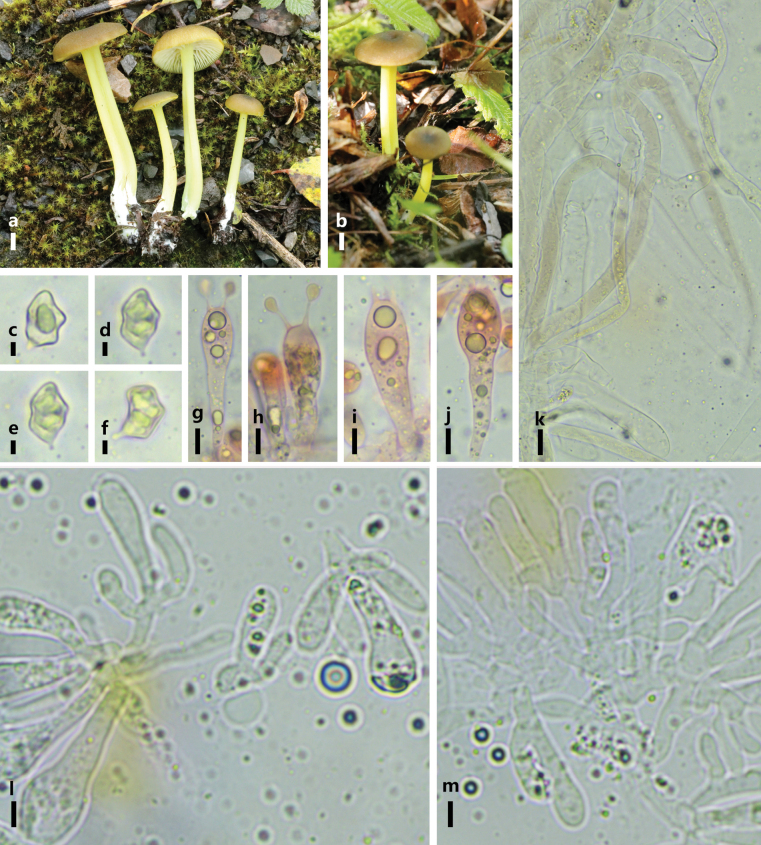 Figure 5
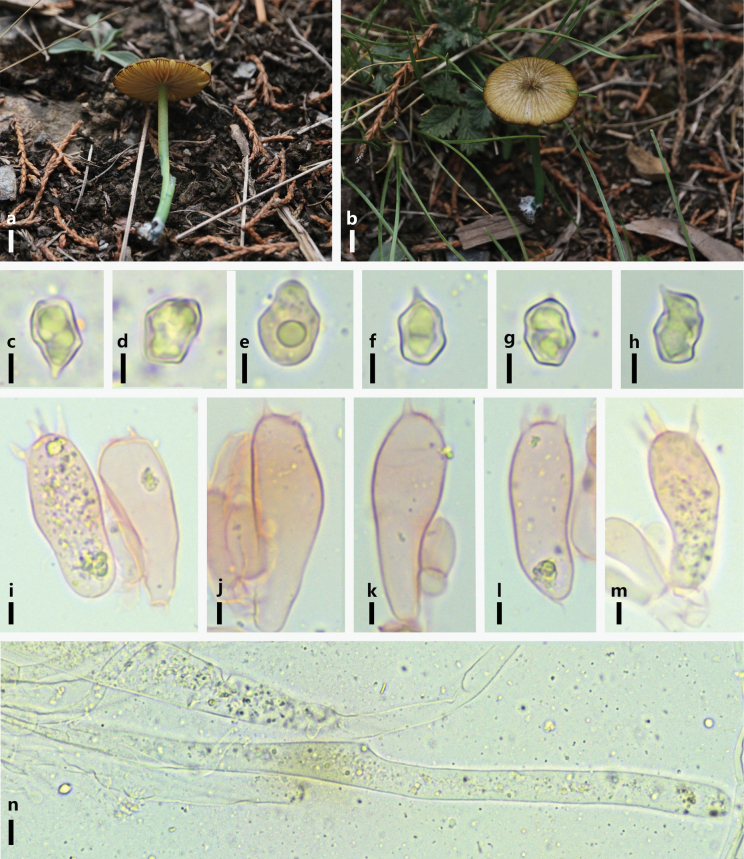 Figure 6
Peer Reviews
No public reviews on file for this paper yet. If you reviewed it on a platform where reviews are public (OpenReview, ICLR, NeurIPS, ICML), you can paste yours below so the community can read it here.
Videos
No videos yet. Explain this paper in a talk, walkthrough, or lecture? Add one.
Taxonomy
TopicsMycorrhizal Fungi and Plant Interactions · Fungal Biology and Applications · Plant Pathogens and Fungal Diseases
Introduction
Entoloma (Fr.) P. Kumm., typified by E. sinuatum (Bull.) P. Kumm., is one of the top three genera in species diversity of Agaricomycotina. It is estimated that there are more than 1800 species of Entoloma worldwide (He et al. 2019a). The general morphological characteristics of Entolomaare:basidiomes agaricoid, secotioid or gasteroid; agaricoid habit variable as tricholomatoid, mycenoid, collybioid, clitocyboid, omphalioid or pleurotoid; pink spore print or pinkish brown, lamellae almost free, adnexed to adnate, adnate-emarginate or adnate-decurrent, spores angular in all views which is entirely covered with facets delineated by ridges; clamp-connections often absent; cheilocystidia rare; pileipellis variable (cutis, trichoderm, hymeniderm) with diverse pigmentation(Noordeloos 1981; Largent 1986). Most species of this genus are saprotrophic, but there are also some mycorrhizal or weakly parasitic taxa. For example, members of sections Entoloma and Rhodopolia are ectomycorrhizal, and Rosaceae-associated members of section Nolanidea are considered weakly parasitic (Agerer and Waller 1993; Tedersoo et al. 2010).
A robust molecular-based taxonomic system for Entoloma is not established yet. Traditional taxonomic studies divided Entoloma into 13 subgenera based on morphological characteristics, such as basidiome forms, pileipellis, basidiospores, cystidia, and clamp connections (Noordeloos and Gates 2012a; Kaygusuz et al. 2024). Another opinion treated these subgenera as genera (Aime et al. 2010, Karstedt et al. 2020; Niveiro et al. 2021). Entoloma constitutes the dominant species diversity within Entolomataceae. The first comprehensive molecular phylogenetic study of Entolomataceae indicated there are two main clades of Entoloma, basal and crown clades. The basal clade is equal to Prunuloides clade and crown clade is composed of Rhodopoloid clade, Inocephalus-Cyanula clade, and Nolanea-Claudopus. Subgenus Leptonia is found to be polyphyletic and distributed in two different subclades in the crown clade (Co-David et al. 2009).
In the past decades, most taxonomic studies of Entoloma are focused on American and European areas while species diversity of Entoloma in China is relatively poorly known. In recent years, species diversity of Entoloma in China has been explored.There are many new species of Entoloma introduced from China based on morphological and molecular data (He et al. 2012, 2013, 2015, 2019b; Chen et al. 2024, 2025). The Qilian Mountains, located between Qinghai and Gansu provinces in northwest China, is a critical biodiversity corridor connecting northern and southern China. During our macrofungi diversity surveys in Qilian Mountains, several notable samples of Entoloma were collected. In this study, based on morphological and multigene phylogenetic analyses, we identified and documented five Entoloma species including one new to science in subgenus Leptonia.
Materials and methods
Morphological examination
Specimens were collected during the rainy season (July to August). Photographs were taken immediately in the field. Basidiomes were wrapped in aluminium foil or put in plastic boxes separately. Macro morphological characteristics and habit information were recorded when specimens were fresh. Every specimen was dried in an electrical food drier at 40 °C, then kept in a plastic ziplock bag and deposited in Herbarium MycologicumAcademiaeSinicae (HMAS). Anatomical and cytological characteristics were observed using dry specimens under the light microscope (SOPTOP EX33). Observed characteristics included basidiospores, basidia, cystidia and pileipellis. At least 20 measurements were made for each characteristic. Measurements were analyzed and recorded as X = the mean of length by width ± SD, Q = the quotient of basidiospore length to width, and Q_m_ = the mean of Q values ± SD. All the protocols of morphological study followed Largent’s methodology (Largent 1986).
DNA extraction and PCR
Genomic DNA of each specimen was extracted by abroad-spectrum plant Rapid Genomic DNA Kitfollowed the manufacturer’s protocol. Three genes were applied in the phylogenetic analyses viz. internal transcribed spacer (ITS), large ribosomal subunit (LSU), and mitochondrial ribosomal small subunit (mtSSU). The primers for each gene are ITS4/ITS5, LR5/LROR, and NS1/NS4, respectively. The PCR programs are followed describe in He et al. (2017). The PCR products were sequenced in Sangon Biotech (Shanghai) Co., Ltd. Both directions were sequenced to ensure accuracy of each gene.
Phylogenetic analyses
Information of reference and new generated sequences were listed in Suppl. material 1. New generated sequences were checked in Geneious Prime v.2025.0.3. Alignments were made using Muscle for each gene separately (Edgar 2004), then adjusted by hand to remove the ambiguous region. The dataset was made for genus Entoloma. The Entolomadataset includes 72ITS, 53LSU, and 43mtSSU. Maximum likelihood (ML) analysis and bootstrap values calculation were performed in raxmlGUI 1.5b1 with GTRGAMMA model with 1000 replicates (Silvestro and Michalak 2012). ModelFinder v2.2.0 (Kalyaanamoorthy et al. 2017) was used to select the best-fit partition model (Edge-linked) using AIC criterion. In the Entoloma dataset, Best-fit model according to AIC are GTR+F+I+G4 for ITS, GTR+F+I+G4 for LSU, and GTR+F+I+G4 for mtSSU. Bayesian Inference (BI) analysis was performed by MrBayes 3.1.2. Ten million generations were run for six Markov chains and sampled every 1000^th^ generation. Burn-ins was determined in Tracer v1.6 with effective sample sizes (ESS) higher than 200 (http://tree.bio.ed.ac.uk/software/tracer). Remaining trees were used to calculate Bayesian posterior probabilities (PP). Maximum likelihood (ML) analysis and bootstrap values calculation were performed in raxmlGUI 1.5b1 with GTRGAMMA model with 1000 replicates (Silvestro and Michalak 2012). Phylogenetic trees were presented in Fig. 1.
Maximum likelihood tree of Entoloma based on ITS, LSU, and mtSSU genes, rooted with Clitopilus hirneolus. Bayesian posterior probability (PP) values ≥ 90% or Bootstrap support (BS) values ≥ 50% are indicated at the internodes (PP/BS). New samples are in bold.The type strains cited indicated by a bold “T”.
Phylogenetic results
The ML tree of Entoloma is presented in Fig. 1. There are 75 samples involved representing 48 species of Entoloma and one outgroup species Clitopilus hirneolus. These 48 species represent twelve subgenera of Entoloma. Samples collected from Qilian Mountains distributed in three subgenera, viz. subg. Cyanula, subg. Nolanea, subg. Leptonia. In the Cyanula clade, three samples from Qilian Mountains clustered in E. incanum, E. verae,and E. glaucobasis clades with full bootstrap values. Four samples clustered in E. fuligineocinereum clade in subg. Nolanea with full bootstrap and PP values. Three samples clustered in Entoloma and sister to the E. tallingiorum with the statistical values PP/BS = 1.0/99.Three Qinghai samples clustered together and sister to the clade composed by E. austriacum, E. alnetorum,and E. tjallingiorum with the statistical values PP/BS = 1.0/100.
Taxonomy
Entoloma
fuligineocinereum
Taxon classificationFungiAgaricalesEntolomataceae
Mešić & Tkalčec, Phytotaxa 289(3): 297 (2016)
FF3425BA-8FA7-57D6-A4B4-9AC406A4C2E1
Basionym.
Nolanea latifolia Kauffman, Pap. Mich. Acad. Sci. 5: 140, 1926 [1925].
Description.
Pileus is 23.0–32.2 mm in diameter, convex or broadly convex, occasionally umbonate on the disc, margin entire, occasionally straight; dry orhygrophanous, smooth, background gray or dark brown. Lamellae up to 3 mm broad, adnate or slightly sinuate, light brown, brown, getting dark near the pileus edge, eroded,veined. Stipe 72.4–80.2 × 3.2–3.8 mm, concolor with the pileus, paler toward base, cylindrical,equal, surface dry, smooth, silky, occasionally with the white fibrils or punctate near the pileus.
Basidiospores 8.6–11.6 × 8.1–9.8 μm [x̄ =9.6 ± 0.7 × 8.7 ± 0.4 μm, Q = 1.0–1.2, Q_m_ = 1.1 ± 0.1, n = 20], subglobose-angular, asymmetrical, with 5–7 side. Basidia 40.7–47.9 × 11.2–13.2 μm, 4-spored. Cheilocystidia absent. Pileipellis a cutis with a transition to a plagiotrichoderm and a trichoderm of cylindrical to slightly inflated hyphae14.2–28.9 μm wide, with lightmembranous brown pigment. Clamp connections absent. Lamellae edge is fertile.
Entoloma fuligineocinereum. a, b. Basidiomes in the field; c–g. Basidia; h, i. Basidiospores; j. Pileipellis hyphae; k, l. Lamellae edge. Scale bars: 5 mm (a, b); 5 μm (c–g); 10 μm (h–I); 40 μm (j); 5 μm (k, l).
Notes.
Our samples clustered with samples from Northern America and Mongolia of E. fuligineocinereum in the phylogenetic tree (Fig. 1). Morphologically, the morphological characteristics of our samples differs slightly from the previous descriptions. Basidiomes color of our samples is paler than those described in Largent (1971). In addition, our Chinese samples present slightly larger basidiospores compared with the holotype (7.5–9 × 7–8.5 μm, x̄ = 8.3 × 7.7 μm, Largent 1971).
Specimen examined.
China • Qinghai province, Qilian Mountain National Park, Sigou, Donghaikou, 9 July 2023, MQ He, ZRL20230456 (HMAS300882) • Qinghai Province, Haibei Tibetan Autonomous Prefecture, Qilian County, Binggoulinhai, 15 July 2023, MQ He, ZRL20230695 (HMAS300880) • Qinghai Province, Tongren City, ZamaoKasuhu, 23 August 2023, MQ He, ZRL20234471 (HMAS300879) • Qinghai Province, Huangnan Tibetan Autonomous Prefecture, Maixiu Forest Farm, 22 August 2023, MQ He, ZRL20234535 (HMAS300881).
Entoloma
glaucobasis
Taxon classificationFungiAgaricalesEntolomataceae
Huijsman ex Noordel., Persoonia 12(4): 260 (1985)
F9449AB8-3839-5AF0-BEA2-E945440F03F8
Description.
Pileus 29–33.4 mm in diameter, campanulate, occasionally with a broad umbo, disc depressed or deeply indented, margin entire, straight, slightly uplifted; surfacedry, background gray or light brown, covered with brown fibrillose scales in triangular shape, scales denser and darker at the disc. Lamellae up to 4 mm broad, adnate to decurrent, subdistant, white, light pink, entire, veined. Stipe 48.1–59.6 × 2.3–2.5 cm, light brown, concolor with the pileus, surface dry, smooth, base white with hypha.
Basidiospores 9.3–12.0 × 6.7–9.2 μm [x̄ =10.7 ± 0.7 × 8.1 ± 0.6 μm, Q = 1.2–1.6, Q_m_ = 1.3 ± 0.1, n = 20], heterodiametric, with 5–7 angles in side-view. Basidia 28.5–38.6 × 9.8–13.6 μm, 4-spored. Cheilocystidia basidia-like, 13.2–19.8 × 3.7–7.4 μm.Pileipellis a cutis with a transition to a plagiotrichoderm and a trichoderm of cylindrical to slightly inflated hyphae 8.2–17.9 μm wide, hyaline, membranous light brown. Clamp connections absent. Lamellae edge is heterogeneous.
Entoloma glaucobasis. a. Basidiomes in the field; b. Pileipellis hyphae; c–f. Basidiospores; g–j. Basidia; k–i. Cheilocystidia. Scale bars: 5 mm (a); 10 μm (b); 5 μm (c–f); 5 μm (g–j); 5 μm (k, l).
Notes.
A sample from Qilian Mountain clustered two European samples of E. glaucobasisin the phylogenetic tree (Fig. 1). This species is originally described from Germany. Our sample generally coincides with the original description of E. glaucobasis. Difference is that the cheilocystidia is basidia-like in our sample while is clavate or vesicular according to the original description (Noordeloos 1985).
Specimen examined.
China • Qinghai Province, Huangnan Tibetan Autonomous Prefecture, Maixiu Forest Farm, 22 August 2023, MQ He, ZRL20234505 (HMAS300878).
Entoloma
griseopileum
Taxon classificationFungiAgaricalesEntolomataceae
M.Q. He & X. Liu sp. nov.
6F3D9D09-B798-5DCF-B01B-B4B8E632C88A
Fungal Names: FN 572836
Etymology.
the epithet “griseo” means gray, the name refers to the grayish pileus.
Holotype.
China • Qinghai Province Mutual Aid County, Beishan National Forest Park,Langshidang, 10 July 2023, MQ He,ZRL20230583 (HMAS300884).
Diagnosis.
This species is characterized by its gray basidiomes and fibrillose pileus.
Original description.
Pileus is 26–32 mm in diameter, broadly convex, umbonate on the disc, margin slightly decurved when young, getting straight or slightly uplifted when mature; surface dry, fibrillose, background gray, fibrils light brown, denser and darker on the disc. Lamellae up to 3 mm broad, adnate or slightly sinuate, eroded, white, slightly pink, getting brown or dark brown near the pileus edge. Stipe 33.53–42.20 × 3.2–3.5 mm, concolor with the pileus, darker toward base, cylindrical,equal,surface dry, smooth, silky, occasionally with the same fibrils as on pileus.
Entoloma griseopileum. a–d. Basidiomes in the field; e–j. Basidiospores; k–o. Basidia; p. Pileipellis hyphae; q–r. Lamellae edge. Scale bars: 5 mm (a–d); 2 μm (e–j); 5 μm (k–o); 10 μm (p); 5 μm (q–r).
Basidiospores 6.8–10.1 × 5.9–7.7 μm [x̄ =8.9 ± 0.7 × 6.7 ± 0.4 μm, Q = 1.0–1.6, Q_m_ = 1.3 ± 0.1, n = 20], heterodiametric, with 5–7 angles in side-view. Basidia 31.8–40.6 × 9.3–13.8 μm, 4-spored. Cheilocystidia absent. Pileipellis a cutis with a transition to a plagiotrichoderm and a trichoderm of cylindrical to slightly inflated hyphae 4.6–11.1 μm wide, with membranous brown pigment. Clamp connections absent. Lamellae edge is fertile.
Habitat.
Wood-inhabiting.
Notes.
Morphologically, E. griseopileum resembles E. bisporigerum in the field which also can be found in northern China (Li et al. 2015). Both species have grayish small basidiomes (pileus smaller than 4cm in diameter). But under microscope, E. bisporigerum can be distinguished from E. griseopileum by its larger basidiospores (11.5–13.5 × 7.5–9 μm). Furthermore, E. bisporigerum grows on soil, while E. griseopileum grows on wood.
Other specimens examined.
China • Qinghai Province, Beishan National Forest Park, Langshidang, 10 July 2023, MQ He, ZRL20230545 (HMAS300885), ZRL20230575 (HMAS300883).
Entoloma
incanum
Taxon classificationFungiAgaricalesEntolomataceae
(Fr.) Hesler,Beih. Nova Hedwigia 23: 147 (1967)
102F6687-305C-5753-835F-DD1938894CA0
Description.
Pileus is 22.9–26.0 mm in diameter, broadly convex, disc depressed to deeply indented, margin entire;surfacesmooth or slightly with white fibrils, brown, yellowish brown, darker at the disc, getting paler or yellower towards the edge. Lamellae up to 3 mm broad, adnate to decurrent, subdistant, white, light yellow,entire,veined. Stipe 53.6 × 6.6 mm, yellow, or light greenish yellow, hollow,compressed, surface dry, smooth, base white with hypha.
Basidiospores 9.8–13.6 × 6.3–8.4 μm [x̄ =11.6 ± 1.1 × 7.4 ± 0.6 μm, Q = 1.3–2.0, Q_m_ = 1.6 ± 0.2, n = 20], heterodiametric, with 6–8 angles in side-view. Basidia 40.3–60.8 × 10.2–15.9 μm, 4-spored. Cheilocystidia absent. Pileipellis a cutis with a transition to a plagiotrichoderm and a trichoderm of cylindrical to slightly inflated hyphae 6.0–15.5 μm wide, with membranous light brown pigment. Clamp connections absent. Lamellae edge is fertile.
Entoloma incanum. a, b. Basidiomes in the field; c–f. Basidiospores; g–j. Basidia; k. Pileipellis hyphae; i–m. Lamellae edge. Scale bars: 5 mm (a, b); 2 μm (c–f); 10 μm (g–j); 20 μm (k); 2 μm (l, m).
Notes.
Our Chinese samples clustered with northern America samples of E. incanum in the phylogenetic tree with full statistical values (Fig. 1). Entoloma incanum is a remarkable species in the field due to its greenish-brown or yellowish-brown basidiomes with a bright stipe in green or yellow. Our samples present a relatively browner pileus than American samples (Kuo 2013).
Specimen examined.
China • Qinghai Province, Tongren City, Zhamao Village, 23 August 2023, MQ He, ZRL20234451 (HMAS300876).
Entoloma
verae
Taxon classificationFungiAgaricalesEntolomataceae
O.V. Morozova, Noordel., Reschke, F. Salzmann & Dima, Persoonia 47: 307 (2021)
FBD55E7A-5B19-53B1-A1F8-00542E55FD20
Description.
Pileus 21.4 mm in diameter, plane, disc deeply indented, margin entire, surfacedry, with distinct radial dark brown fibrils on pale background,sometimes cracked when dry or old, pileus edge dark brown. Lamellae up to 4 mm broad, adnate to decurrent, subdistant, yellowish white and light pink,entire,veined. Stipe 36.4 × 2.2 cm, green, yellowish green,equal, surface dry, with yellow tiny fibrils, base white with hypha, staining bright greenish blue when bruised.
Entoloma verae. a, b. Basidiomes in the field; c–h. Basidiospores; i–m. Basidia; n. Pileipellis hyphae. Scale bars: 5 mm (a, b); 5 μm (c–h); 5 μm (i–m); 10 μm (n).
Basidiospores 8.9–12.5 × 5.8–8.0 μm [x̄ = 10.9 ± 0.9 × 7.2 ± 0.5 μm, Q = 1.2–1.8, Q_m_ = 1.5 ± 0.1, n = 20], heterodiametric, with 6–7 angles in side-view. Basidia 31.6–43.4 × 12.4–17.4 μm, 4-spored. Cheilocystidia not observed. Pileipellis a cutis with a cylindrical to slightly inflated hyphae 4.5–14.5 μm wide, hyaline. Membranous pigment. Clamp connections absent.
Notes.
Our sample clustered with European samples including the type of E. verae in the phylogenetic tree with full statistical values. Morphological characteristics of our sample generally coincides with the original description. Small differences are pileus color and basidiospore size. The pileus of our sample is darker and the basidiospore is smaller compared to the original description (Crous et al. 2021).
Specimen examined.
China • Qinghai province, Haidong City, Tu Autonomous County of Huzhu, Ganchan Temple, 26 August 2023, MQ He, ZRL20235682 (HMAS300877).
Conclusions
In this study, five Entoloma species were documented from China. These include one new species, E. griseopileumin subg. Leptonia. The new species is characterized by its gray basidiomes, fibrillose pileus, and wood-decaying habit. The other four known species are E. glaucobasis, E. incanum, and E. verae in subg. Cyanula, and E. fuligineocinereum in subg. Nolanea. All five species are found in the Qilian Mountains. The macrofungal diversity of this region has been explored in recent years, and many new species, for example, from Agaricus, Cystoderma, and Lyophyllum, have been found and documented (Zhang et al. 2017; Li et al. 2021; Wei et al. 2023). We assumed that there would be continuous descriptions of species from this region as it is part of the Qinghai-Xizang Plateau and is a critical biodiversity corridor connecting northern and southern China.
Supplementary Material
XML Treatment for Entoloma fuligineocinereum
XML Treatment for Entoloma glaucobasis
XML Treatment for Entoloma griseopileum
XML Treatment for Entoloma incanum
XML Treatment for Entoloma verae
The reference list from the paper itself. Each links out to its DOI / PubMed record.
- 1Agerer R Waller K (1993) Mycorrhizae of Entoloma saepium: Parasitism or symbiosis? Mycorrhiza 3: 145–154. 10.1007/BF 00203608 · doi ↗
- 2Aime F Johnson SW Ridge JD Hill A (2010) The routine may be stable but the advantage is not: Competitive implications of key employee mobility.Strategic Management Journal 31(1): 75–87. 10.1002/smj.809 · doi ↗
- 3Chen LG Ding L Chen H Zeng H Zeng ZH Wang SN Yan JQ (2024) Seven New Species of Entoloma Subgenus Cubospora (Entolomataceae, Agaricales) from Subtropical Regions of China.Journal of Fungi (Basel, Switzerland)10(8): 594. 10.3390/jof 1008059439194919 PMC 11355251 · doi ↗ · pubmed ↗
- 4Chen LG Chen H Ding L Xu YQ Zeng H Wang SN Yan JQ (2025) Four new species of Entoloma subgenus Cyanula (Entolomataceae, Agaricales) from subtropical regions of China. Myco Keys 116: 303. 10.3897/mycokeys.116.145568 PMC 1205651540337074 · doi ↗ · pubmed ↗
- 5Co-David D Langeveld D Noordeloos ME (2009) Molecular phylogeny and spore evolution of Entolomataceae. Persoonia-Molecular Phylogeny and Evolution of Fungi 23(1): 147–176. 10.3767/003158509 X 480944 PMC 280273220198166 · doi ↗ · pubmed ↗
- 6Crous PW Osieck ER JurjevićŽBoers Jvan Iperen AL Starink-Willemse M Dima B Balashov S Bulgakov TS Johnston PR Morozova OV Pinruan U Sommai S Alvarado P Decock CA Lebel T Mc Mullan-Fisher S Moreno G Shivas RG Zhao L Abdollahzadeh J Abrinbana M Ageev DV Akhmetova G Alexandrova AV Altés A Amaral AGG Angelini C Antonín V Arenas F Asselman P Badali F Baghela A Bañares A Barreto RW Baseia IG Bellanger JM Berraf-Tebbal A Biketova AY Bukharova NV Burgess TI Cabero JCâmara MPS Cano-Lira JF Ceryngier P Chávez R Cowan D Ade Lima AF Oliveira RL Denman S Dang QN Dovana F Duarte IG Eichmeier A Erhard A Esteve-Rave · doi ↗ · pubmed ↗
- 7Edgar RC (2004) MUSCLE: Multiple sequence alignment with high accuracy and high throughput.Nucleic Acids Research 32(5): 1792–1797. 10.1093/nar/gkh 34015034147 PMC 390337 · doi ↗ · pubmed ↗
- 8He XL Li TH Shen YH (2012) Four new species of Entolomas.l. (Agaricales) from southern China.Mycological Progress 11(4): 915–925. 10.1007/s 11557-012-0807-0 · doi ↗