Unseen Impacts: Rural Adolescents’ Self-Perception and Mental Health in the Age of Dermatology-Related Social Media
Katheryn Bell, Elham Zayed, Ellen Ireland, Eric Reyes

TL;DR
This study explores how dermatology-related social media affects rural adolescents' self-image and mental health, finding both negative and positive impacts.
Contribution
The study reveals gender disparities in social media's psychological effects and highlights the dual role of dermatology content in rural communities.
Findings
Female students were significantly more likely to follow skincare influencers compared to males.
Over one-third of rural respondents discovered new communities or interests through dermatology-related social media.
Dermatology content inspired interest in healthcare careers for 30.6% of respondents.
Abstract
Background: Adolescence represents a pivotal period in the development of self-image, with skin appearance playing a central role in self-confidence and peer acceptance. In rural communities with limited access to dermatologic care, adolescents frequently turn to social media platforms such as TikTok, Instagram, and YouTube for skin-related information. These platforms often promote idealized beauty standards and unverified treatments, potentially influencing self-perception and psychological well-being. To investigate these potential impacts, the objective of this survey-based cross-sectional study was to evaluate the psychological impact of dermatology-related social media exposure on self-image, emotional health, and professional aspirations among adolescents in a rural setting. Materials and methods: A cross-sectional survey was administered to 206/294 high school students…
Genes, proteins, chemicals, diseases, species, mutations and cell lines named across the full text — each resolved to its canonical identifier and authoritative record.
Click any figure to enlarge with its caption.
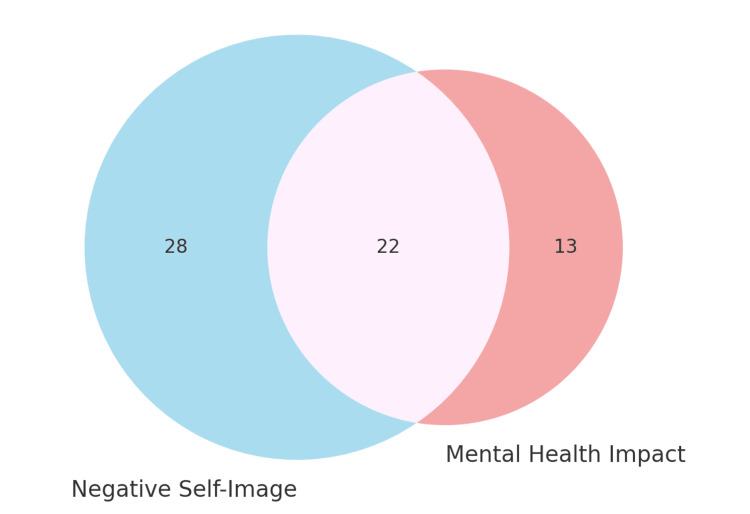 Figure 1
| Characteristic | N = 2061 |
| Age (yrs) | |
| Under 14 | 1 (0.5%) |
| 14-15 | 77 (37%) |
| 16-17 | 97 (47%) |
| 18-19 | 30 (15%) |
| 20 or older | 1 (0.5%) |
| Gender | |
| Female | 152 (74%) |
| Male | 47 (23%) |
| Non-binary/third gender | 5 (2.4%) |
| Prefer not to say | 2 (1.0%) |
| Grade level | |
| Freshman | 62 (30%) |
| Sophomore | 51 (25%) |
| Junior | 54 (26%) |
| Senior | 38 (18%) |
| Other | 1 (0.5%) |
| Question | Response | Frequency |
| How have these skin-related videos impacted your self-esteem, body image, or overall well-being? (can choose more than one) | I do not watch skin-related videos | 58 (28.2%) |
|
| 36 (17.5%) | |
|
| 36 (17.5%) | |
|
| 34 (16.5%) | |
|
| 33 (16%) | |
|
| 29 (14.1%) | |
|
| 36 (17.5%) | |
|
| 44 (21.4%) | |
| Did these videos alter your mental health? | I do not watch skin-related videos | 54 (26.2%) |
|
| 122 (59.2%) | |
|
| 28 (13.6%) | |
|
| 14 (6.8%) | |
| Have these videos led you to focus more on your perceived flaws? | I do not watch skin-related videos | 43 (20.9%) |
| No | 59 (28.6%) | |
| Unsure | 30 (14.6%) | |
| Yes | 74 (35.9%) | |
| Do you feel like you've developed an unhealthy perspective on your body or appearance after watching these videos? | I do not watch skin-related videos | 42 (20.4%) |
| No | 97 (47.1%) | |
| Unsure | 24 (11.7%) | |
| Yes | 43 (20.9%) |
Peer Reviews
No public reviews on file for this paper yet. If you reviewed it on a platform where reviews are public (OpenReview, ICLR, NeurIPS, ICML), you can paste yours below so the community can read it here.
Videos
No videos yet. Explain this paper in a talk, walkthrough, or lecture? Add one.
Taxonomy
TopicsSocial Media in Health Education · Impact of Technology on Adolescents · Body Image and Dysmorphia Studies
Introduction
Adolescence is a pivotal stage for self-image development, and skin appearance often plays a central role in shaping peer relationships and self-esteem [1,2]. Social media platforms such as TikTok and Instagram amplify dermatology-related content, often presenting filtered, idealized skin images alongside influencer-endorsed treatments that may lack scientific credibility [1-3]. For adolescents in rural areas, who often have limited access to dermatologic care, these digital sources may become primary references for skincare information [4]. Prior studies have documented associations between social media and body dissatisfaction, yet little is known about the specific psychological impact of dermatologic content among rural adolescents. This study investigates that gap, examining how engagement with online skincare content influences self-perception and emotional health.
Materials and methods
A voluntary cross-sectional survey (n = 206/294; response rate: 70.1%) was conducted in February 2025 with rural Indiana high school students ages 13-20. Eligibility was based on current enrollment status at the high school. Participants were invited to participate through classroom and school-wide intercom announcements to participate in the voluntary study, as well as emails to the students and their parents. Parents were contacted via email for student consent attainment. Data was collected through a 19-item custom Qualtrics survey assessing demographics, social media use, sources of dermatology information, and psychological impact, with answers stored on password-protected computers. Participants were informed that the survey included sensitive items (e.g., on mental health, body image, and appearance concerns) and were encouraged to stop the survey if uncomfortable with any question. No surveys were discontinued midway.
A custom survey was developed specifically for this rural targeted population, as no existing validated instruments addressed the targeted constructs. The survey was reviewed by two dermatologists, two rural-focused PhD researchers, and the school principal for clarity and appropriateness, and adjustments were made when indicated. Formal pilot testing and psychometric validation were not conducted; items were refined based on expert feedback. The lack of formal validation is acknowledged as a limitation of the study. Plans are in place to formally validate this survey in the future. Inclusion required current enrollment at the rural Indiana high school and at least one instance of self-reported prior engagement with social media; exclusion criteria were no social media use. The study was approved by the Indiana University Institutional Review Board (approval number: #25625). Parents provided written consent if students were under 18 years old, and students provided assent. Surveys required full completion before submission. Statistical analyses used descriptive statistics and chi-square tests in R version 4.4.3 (R Foundation for Statistical Computing, Vienna, Austria), with p < 0.05 considered statistically significant. Chi-square tests of independence were used when examining the relationship between distinct categorical characteristics. McNemar’s test was used to determine whether participants are equally likely to select one option over another in a “select all that apply” question.
Results
Most participants were female (152, 74%) and under age 18 (175, 84%), as seen in Table 1. We have strong evidence (𝜒_2_^2 ^= 57.8, p < 0.001) that women engage with skin-related content on social media more often than men. We also note that overall, more students stated that they engaged with skin-related content on social media but did not follow creators (83, 40.3%) than those who stated they followed creators (61, 29.6%). One individual reported an age of 20 or greater, and one individual reported an age under 14; they were still included in the analysis, as they met the initial criteria for enrollment at this high school and at least one prior engagement with social media.
Among those who watched such content (n = 148), 37.8% (n = 56) selected only positive effects, such as increased confidence, improved self-esteem, or embracing their unique features, while 31.1% (n = 46) selected only negative impacts, such as feeling more self-critical, comparing themselves to others, or feeling less confident in their appearance, as seen in Table 2. Notably, 4.1% (n = 6) reported both positive and negative impacts. This duality shows that dermatologic content can be both empowering and distressing, often concomitantly. Mixed responses reflect the emotional complexity of aesthetic media, and overlooking them may underestimate how a single video can evoke both validation and insecurity. In contrast, of those who indicated they watched skin-related videos, only 35 (22.6%) indicated they felt the videos had any impact on their mental health, which varies quite considerably from the group that stated either positive or negative (68.9%) effects from consuming skincare content. This gap suggests that students may recognize changes in their self-image, both positive and negative, without perceiving them as changes in mental health, as shown in Figure 1.
Overlap of negative self-image and mental health impactVenn diagram showing adolescents reporting negative self-image (n = 28), mental health impact (n = 13), and both (n = 22) from dermatology-related social media.
Discussion
The majority of respondents, 45% (n = 74), reported that skin-related videos made them focus more on their perceived flaws, while 18% (n = 30) were unsure. In contrast, most students, 59% (n = 97), indicated that these videos did not give them an unhealthy perspective on their body or appearance, suggesting that many do not equate an increased focus on perceived flaws with developing a negative body image.
This dissociation may reflect developmental limitations in recognizing internal distress or stigma-related barriers, particularly in rural settings, to reporting emotional struggles [5,6]. These findings align with previous research showing adolescents exposed to appearance-focused media often experience reduced body satisfaction without labeling these feelings as anxiety or depression [3]. With most respondents being female (n = 152, 73.8%), the gender gap in psychological response is particularly striking. Female students were significantly more likely than males to report negative self-image effects (χ_2_² = 7.01, p = 0.0081, p < 0.05). These findings align with prior studies suggesting that adolescent females are more attuned to appearance-based media and are more likely to seek skincare advice online [7-11].
Additionally, non-binary students demonstrated elevated vulnerability, with three of five reporting negative self-image effects from skin-related content online. This pattern suggests adolescent girls and gender-diverse youth may be especially vulnerable to appearance-based comparison and emotional distress, particularly in rural areas where stigma and access to mental health and dermatology care remain barriers [5,7,8]. These findings highlight the need for nuanced language and early screening tools when evaluating media-related psychological outcomes, as self-image concerns may signal emerging mental health risk [12,13].
Importantly, the impact of dermatologic content was not universally negative. Over half (n = 104, 50.6%) acknowledged that such content offered both educational value and potential harm. Additionally, 30.6% (n = 63) reported that viewing dermatology-related social media sparked interest in healthcare careers, including dermatology, medicine, and skincare. Similar studies have noted that social media can serve as a supportive space for exploring identity and connecting with others who share similar dermatologic challenges [13-15]. Similarly, just over one-third of rural respondents (n = 75, 36.4%) reported discovering a new community or interest they would not otherwise have encountered-reflecting a particularly meaningful integration into the lives of rural, underserved populations. Our findings highlight the complex role of digital media: while it can contribute to body dissatisfaction and appearance-related anxiety, it also provides opportunities for education, inspiration, connection, and career exploration.
Our findings show that concern for misinformation on social media remains high in rural teens, with 58.7% (n = 120) expressing worry about the spread of misinformation; however, 23.3% (n = 48) believe it causes more good than harm. Although concerns about misinformation remain pervasive across unregulated platforms, social media has also been recognized for its potential to strengthen the physician-patient relationship [16-18]. In line with our findings that exposure to dermatology content may inspire interest in healthcare careers, online engagement can also encourage self-advocacy by prompting patients to bring new questions and ideas to clinical encounters [16-18]. A substantial portion (n = 84, 40.8%) of rural adolescents report discussing skincare products and influencers with their peers, underscoring the importance of grounding these conversations in accurate, evidence-based information to counter misinformation and support healthier choices. Social media also serves as a frequent source of information about diagnoses, symptom triggers, and treatment options before or after clinical encounters, which can foster more informed discussions, strengthen patient engagement, and ultimately enhance the quality of clinical interactions [4,12,13,16].
This study has several limitations. The sample was drawn from a single rural high school, which limits generalizability to other settings. Additionally, the cohort’s demographics, predominantly female and under 18, further constrain representativeness. The lack of formal validation of the survey is a general limitation; however, the survey was reviewed by two dermatologists, two rural-focused PhD researchers, and the school principal for clarity and procured revisions. Dermatologic diagnoses were collected, but baseline mental health and socioeconomic status were not measured, representing potential confounders. However, the dermatologic diagnoses were not statistically controlled for in multivariate models, which may limit the ability to fully isolate the independent effects of social media exposure on self-perception. Future studies with larger sample sizes could incorporate regression-based approaches to adjust for these variables. No adjustments for multiple comparisons were made, as only a small number of chi-square analyses were conducted, and potentially confounding variables such as socioeconomic status and baseline mental health were not collected.
Additionally, data were self-reported, introducing recall and social desirability bias, and some students were inconsistent when reporting exposure to skin-related content, which may cause classification error. Because participants were from the same school community, peer influence and shared networks may have shaped their responses, potentially reducing the independence of the observations. Lastly, the cross-sectional design precludes causal inference between exposure to dermatology-related social media and psychological outcomes. Future studies with multi-site recruitment, longitudinal follow-up, and objective measures are needed to enhance validity.
Conclusions
Dermatology-related social media content has a nuanced influence on rural adolescents. Many reported heightened focus on self-image without recognizing broader effects on mental health, underscoring a disconnect between appearance concerns and emotional awareness. Female and gender-diverse students appeared especially vulnerable, highlighting the need for adolescent-centered media literacy efforts. At the same time, students identified educational value and even career inspiration through these platforms. By engaging as content creators, health professionals can help provide inclusive, evidence-based messaging that supports healthy self-image, realistic expectations, and meaningful patient engagement during a formative stage of development.
The reference list from the paper itself. Each links out to its DOI / PubMed record.
- 1Social comparisons on social media: the impact of Facebook on young women's body image concerns and mood Body Image Fardouly J Diedrichs PC Vartanian LR Halliwell E 38451320152561542510.1016/j.bodyim.2014.12.002 · doi ↗ · pubmed ↗
- 2Net Girls: the Internet, Facebook, and body image concern in adolescent girls Int J Eat Disord Tiggemann M Slater A 6306334620132371245610.1002/eat.22141 · doi ↗ · pubmed ↗
- 3Social media effects on young women's body image concerns: Theoretical perspectives and an agenda for research Sex Roles Perloff RM 363377712014
- 4Dangers and opportunities for social media in medicine Clin Obstet Gynecol George DR Rovniak LS Kraschnewski JL 4534625620132390337510.1097/GRF.0b 013e 318297 dc 38PMC 3863578 · doi ↗ · pubmed ↗
- 5Perceived barriers and facilitators to mental health help-seeking in young people: a systematic review BMC Psychiatry Gulliver A Griffiths KM Christensen H 1131020102119279510.1186/1471-244X-10-113PMC 3022639 · doi ↗ · pubmed ↗
- 6Being treated differently: stigma experiences with family, peers, and school staff among adolescents with mental health disorders Soc Sci Med Moses T 9859937020102012276810.1016/j.socscimed.2009.12.022 · doi ↗ · pubmed ↗
- 7Body image among girls in Indonesia: associations with disordered eating behaviors, life engagement, desire for cosmetic surgery and psychosocial influences Int J Environ Res Public Health Garbett KM Craddock N Saraswati LA Diedrichs PC 63942020233751062510.3390/ijerph 20146394 PMC 10378758 · doi ↗ · pubmed ↗
- 8The perfect storm: a developmental-sociocultural framework for the role of social media in adolescent girls’ body image concerns and mental health Clin Child Fam Psychol Rev Choukas-Bradley S Roberts SR Maheux AJ Nesi J 6817012520223584150110.1007/s 10567-022-00404-5PMC 9287711 · doi ↗ · pubmed ↗