Building a Safe and Transparent Workflow for Large Language Model (LLM)-Assisted Clinical Trials and Prediction Models: A Technical Report
João Frutuoso

TL;DR
This paper introduces a seven-step workflow to safely and transparently use large language models in clinical trials and prediction models, ensuring accountability and scientific standards.
Contribution
The novel contribution is a structured, auditable workflow with checklists aligned to international guidelines for integrating LLMs into clinical research.
Findings
The workflow includes steps like governance, literature review, model evaluation, and privacy safeguards to ensure transparency.
Reusable checklists map study types to reporting guidelines like CONSORT-AI and TRIPOD+AI.
The framework mitigates risks like biased outputs and fabricated citations while maintaining human oversight.
Abstract
The use of large language models (LLMs) in clinical trials and prediction models is expanding rapidly, offering opportunities for efficiency but also raising concerns about privacy, fairness, accuracy, and accountability. This technical report proposes a structured workflow to support research teams in adopting LLMs while preserving scientific standards and public trust. The workflow is organized into seven sequential steps: (i) scope definition and governance, (ii) retrieval-augmented literature review, (iii) model evaluation and benchmarking, (iv) documentation and audit trail, (v) expert quality gates, (vi) manuscript disclosure, and (vii) privacy and security safeguards. To facilitate adoption, we provide reusable checklists that map study types to relevant international reporting guidelines, including Consolidated Standards of Reporting Trials - Artificial Intelligence…
Genes, proteins, chemicals, diseases, species, mutations and cell lines named across the full text — each resolved to its canonical identifier and authoritative record.
Click any figure to enlarge with its caption.
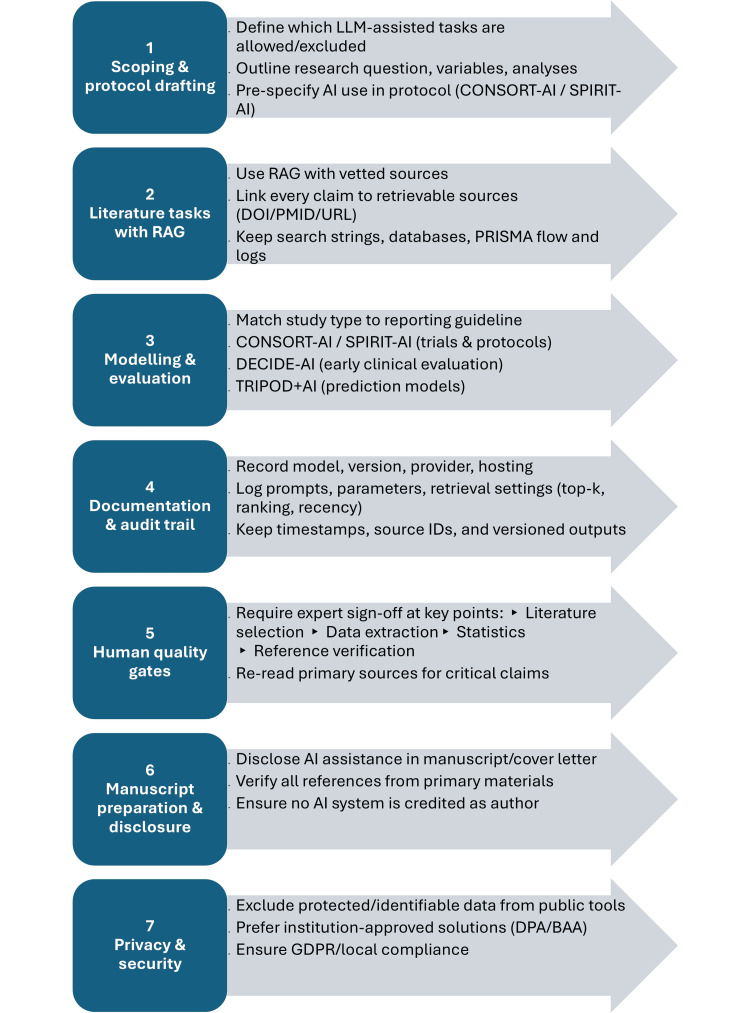 Figure 1
| Framework | Scope | Key focus areas | Relevance for LLM-assisted research |
| CONSORT-AI (2020) | RCTs involving AI interventions | Trial design, intervention description, participant flow, handling of AI outputs, reproducibility | Ensures that any RCT using LLMs (e.g., clinical decision support tools) transparently specifies model version, training data context, and oversight mechanisms |
| SPIRIT-AI (2020) | Protocols for interventional trials with AI | Pre-specification of AI intervention details, governance, human oversight, monitoring of safety | Provides structure for trial protocols involving LLM-based tools, requiring upfront definition of model role, risks, and contingency plans |
| DECIDE-AI (2021) | Early-phase, live clinical evaluation of AI-enabled systems | Usability, human factors, workflow integration, real-world safety | Relevant when piloting LLMs for bedside tasks (e.g., clinical note drafting, adverse event detection), focusing on clinician interaction and safety monitoring |
| TRIPOD+AI (2023, in development from TRIPOD+AI) | Prediction model development and validation | Transparent description of data, predictors, outcomes, model performance, validation | Applicable for LLM-based prognostic/predictive models, requiring disclosure of training/testing datasets and performance benchmarking |
| PRISMA 2020 (with AI considerations) | Systematic reviews and meta-analyses | Search strategies, inclusion/exclusion criteria, reproducibility of evidence synthesis | Relevant when LLMs are used for literature screening or evidence synthesis; mandates clear documentation of how automation was applied |
| Checklist item | What to document (audit trail) | Pass criteria (Y/N/NA) |
| Define LLM-assisted tasks | List of allowed tasks (e.g., outlining, editing, RAG summarization) and explicit exclusions | Tasks enumerated; exclusions stated |
| Data sensitivity screening | Data classification (patient PII/PHI/other sensitive), de-identification status | High-risk data kept off public tools |
| Legal/ethical basis | Ethics review need (Y/N), legal basis (e.g., GDPR Art. 6/9 if applicable) | Basis recorded; approvals filed |
| Institutional approval and agreements | DPA/BAA or institutional approval for chosen tool/provider | Agreements in place before use |
| Model identity and version | Model/provider, version/date, hosting, and data residency | Fully recorded |
| Access control | Who can access the tool/corpus; authentication method | Named users; role-based access |
| Prompt hygiene | Policy to prohibit entry of protected/identifiable data into public tools | Policy documented and communicated |
| Disclosure plan | Where/how AI use will be disclosed (methods/acknowledgments/cover letter) | Location defined |
| Roles and responsibilities | Human owners for literature, data extraction, statistics, references | Named individuals assigned |
| Bias/fairness plan | Pre-specified subgroups and fairness checks | Subgroups defined |
| Security posture | Statement of security controls (encryption at rest/in transit, audit logging) | Controls described |
| Source restrictions | Approved sources/corpora for RAG (licensed, open, institutional) | Approved sources list/allow-list defined |
| Pre-registration (if applicable) | Registry/OSF/PROSPERO/SPIRIT-AI details | Identifier recorded |
| Exit/opt-out (if applicable) | Process to remove specific data from pipelines | Documented |
| Checklist item | What to document (audit trail) | Pass criteria (Y/N/NA) |
| Approved corpora | List of vetted sources (databases, repositories) | Approved sources list/allow-list used |
| Search strategies | Full query strings, databases, dates, limits | Strategies saved/exported |
| Retrieval settings | Retrieval top-k, ranking, filters, recency bounds | Parameters recorded |
| De-duplication and quality | De-duplication method and source quality screening criteria | Methods recorded |
| Citation integrity | Every claim linked to retrievable primary sources (DOI/PMID/URL) | Links verified |
| Prompt and context logs | Prompts, retrieved contexts, outputs, timestamps, source IDs | Logs retained |
| Version control | Output versions with change history | Version control in place |
| Dual verification | Two-person check for critical claims/quantitative results | Sign-off recorded |
| PRISMA tracking (if review) | Screening log, inclusion/exclusion reasons, PRISMA flow | Complete |
| De-identification check | Confirm no protected/identifiable data in prompts/contexts | Confirmed |
| Error log | Known failure modes, hallucinations, corrective actions | Log maintained |
| Reproducible environment | Random seeds/hyperparameters (if modelling), tool versions | Environment captured |
| Requirement | Applies to | Evidence to retain (audit trail) |
| Map to appropriate guideline | All studies | Rationale for selecting CONSORT-AI, SPIRIT-AI, DECIDE-AI, TRIPOD+AI, PRISMA 2020 |
| Study registration/protocol | Interventional AI; systematic reviews | Trial/PROSPERO/OSF numbers; protocol version |
| Population and setting clarity | All studies | Clear eligibility, setting, timeframe |
| Outcomes and metrics pre-specification | All studies | Primary/secondary outcomes; performance metrics |
| Model description | Prediction models | Model family, features, training data summary |
| Validation strategy | Prediction models | Internal/external validation details |
| Calibration and uncertainty | Prediction models | Calibration plots; CI/PI reporting |
| Human factors and safety | Early clinical evaluation | Usability tasks, workflow fit, risk controls |
| Randomization and blinding | Interventional AI | Randomization, blinding, allocation concealment |
| Fairness/subgroup analyses | All with human data | Pre-specified subgroups; disparity metrics |
| Harms and error analysis | All studies | Adverse events; error taxonomies |
| Data governance and privacy | All with data | GDPR compliance statement; data sharing limits |
| Transparency of AI use | All manuscripts | Location of AI use disclosure in paper |
| Reproducibility | All | Code/data availability (when applicable); retrieval logs |
| Limitations | All | Limitations and generalizability |
Peer Reviews
No public reviews on file for this paper yet. If you reviewed it on a platform where reviews are public (OpenReview, ICLR, NeurIPS, ICML), you can paste yours below so the community can read it here.
Videos
No videos yet. Explain this paper in a talk, walkthrough, or lecture? Add one.
Taxonomy
TopicsArtificial Intelligence in Healthcare and Education · Radiomics and Machine Learning in Medical Imaging · Explainable Artificial Intelligence (XAI)
Introduction
Large language models (LLMs) are rapidly entering medical research workflows and, in health contexts, require careful governance to safeguard rigor and public trust [1-3]. Global normative frameworks from the United Nations Educational, Scientific and Cultural Organisation (UNESCO) and the Organisation for Economic Co-operation and Development (OECD) outline principles of transparency, accountability, and risk management that are directly applicable to research settings [2,3].
Editorial policies have converged on shared expectations. The International Committee of Medical Journal Editors (ICMJE) requires transparent disclosure of artificial intelligence (AI) assistance and reaffirms that humans remain accountable for the work; the World Association of Medical Editors (WAME) provides operational recommendations for responsible use of generative AI in manuscripts; and the Committee on Publication Ethics (COPE) clarifies that AI systems cannot be credited as authors [4-6]. These positions have practical implications for how research teams plan, document, and report any AI-assisted activity.
Specialized reporting guidance has also emerged across study types. Interventional trials and their protocols are covered by the Consolidated Standards of Reporting Trials - Artificial Intelligence (CONSORT-AI) and the Standard Protocol Items: Recommendations for Interventional Trials - Artificial Intelligence (SPIRIT-AI), which specify intervention details, oversight, and safeguards [7,8]. Early, live clinical evaluation of AI-enabled decision support is addressed by Developmental and Exploratory Clinical Investigations of Decision-Support Systems Driven by Artificial Intelligence (DECIDE-AI), capturing usability, human factors, and safety [9]. For prediction models and systematic reviews, the Transparent Reporting of a Multivariable Prediction Model for Individual Prognosis or Diagnosis - Artificial Intelligence (TRIPOD+AI) and the Preferred Reporting Items for Systematic Reviews and Meta-Analyses 2020 (PRISMA 2020) set expectations for transparent development, validation, and evidence synthesis [10,11]. Recent commentaries in Nature Medicine and other journals have highlighted that while these frameworks are essential, they remain fragmented and insufficient without practical workflows for day-to-day implementation [12].
Despite advances, recurrent risks persist. Models trained on skewed data can amplify inequities, and weak oversight may lead to unintended consequences or over-reliance on automation [13,14]. Editorials have additionally warned that general-purpose chatbots can fabricate content and citations if used without safeguards, undermining transparency and reproducibility [15-17]. To strengthen factual grounding, retrieval-augmented generation (RAG) limits generation to rights-cleared, authoritative sources, and recent medicine-specific benchmarks suggest measurable accuracy gains when retrieval is well designed [18,19].
This technical report translates the above expectations into a practical, auditable workflow for day-to-day research use. We provide a seven-step process covering governance, literature/retrieval, documentation, human quality gates, and privacy; three reusable checklists that map study types to appropriate reporting guidance; and a figure-grade summary to facilitate implementation and audit.
Technical report
Table 1 summarizes the major frameworks most relevant to LLM-assisted clinical trials and prediction models, including their scope, focus areas, and applicability. Our proposed workflow is designed to integrate and operationalize these guidelines, translating their high-level recommendations into a reproducible, auditable, seven-step process for research teams.
Governance and scope
Define which tasks are appropriate for LLM assistance (e.g., outlining, language refinement, and retrieval-augmented generation (RAG)-based summarization) and which are excluded; record this in a governance note and in Table 2. For interventional trials and their protocols, align reporting with CONSORT-AI and SPIRIT-AI so that intervention details, oversight, and safeguards are pre-specified [7,8]. For early, live clinical evaluation of AI-enabled decision support, use DECIDE-AI to capture usability, human factors, and safety elements [9]. For clinical prediction models and systematic reviews, follow TRIPOD+AI and PRISMA 2020 across development/validation and evidence synthesis, respectively [10,11]. Recent commentaries in Nature Medicine have highlighted that while these frameworks are essential, they remain fragmented and insufficient without practical workflows for day-to-day implementation [12].
Beyond reporting standards, anticipate fairness risks: skewed training data can exacerbate inequities, and weak oversight may foster over-reliance or fabricated content, undermining transparency and reproducibility [13-16]. In addition, some authors rely on “black box” deep research approaches, where neither the provenance of outputs nor the model’s internal logic is accessible. Such practices heighten concerns over reproducibility and accountability, underscoring the importance of explicit governance and transparent audit trails.
To strengthen factual grounding, pair generation with retrieval-augmented workflows restricted to rights-cleared, authoritative sources; recent medicine-specific evaluations, such as the MIRAGE benchmark (Benchmarking Retrieval-Augmented Generation for Medicine), suggest accuracy gains when retrieval is well designed [18,19].
Where health data are involved, enforce strict privacy boundaries: keep protected/identifiable information off public tools, prefer institution-approved solutions under appropriate agreements, and document the legal basis, as in the General Data Protection Regulation (GDPR) and any required approvals (see Table 2) [1,20].
Practical workflow
A practical workflow for the process is illustrated in Figure 1.
Seven-step workflow for LLM-assisted clinical trials and prediction models.Derived from reporting guidance for trials, protocols, and early evaluation (CONSORT-AI, SPIRIT-AI, and DECIDE-AI) [7-9] and from RAG literature (MIRAGE) [18,19].AI: artificial intelligence, BAA: business associate agreement, DOI: Digital Object Identifier, DPA: data processing agreement, GDPR: General Data Protection Regulation, ID: identifier, LLM: large language model, PMID: PubMed Identifier, PRISMA: Preferred Reporting Items for Systematic Reviews and Meta-Analyses, RAG: retrieval-augmented generation, top-k: number of highest-ranked retrieved items considered in a RAG pipeline, URL: Uniform Resource Locator; SPIRIT-AI: Standard Protocol Items: Recommendations for Interventional Trials - Artificial Intelligence, TRIPOD+AI: Transparent Reporting of a Multivariable Prediction Model for Individual Prognosis or Diagnosis - Artificial Intelligence; CONSORT-AI: Consolidated Standards of Reporting Trials - Artificial Intelligence, DECIDE-AI: Developmental and Exploratory Clinical Investigations of Decision - Support Systems Driven by Artificial IntelligenceImage Credits: Authors
Step 1 - Scoping and Protocol Drafting
Outline the research question, variables, and planned analyses; decide which LLM-assisted tasks are allowed and which are excluded; and pre-specify AI use in the protocol (CONSORT-AI/SPIRIT-AI for trials and protocols) [7,8]. Require manual verification for any claim drafted with LLM support.
Step 2 - Literature Tasks With RAG
Implement retrieval-augmented workflows so every claim links to retrievable primary sources (DOI (Digital Object Identifier)/PMID (PubMed Identifier)/URL (Uniform Resource Locator)). Maintain full search strings, databases, dates/limits, de-duplication criteria, and a PRISMA flow with screening logs (see Table 3) [11].
Step 3 - Modelling and Evaluation
Match the study type to the appropriate guidance: CONSORT-AI/SPIRIT-AI for AI-enabled interventions; DECIDE-AI for early, live clinical evaluation of decision support; TRIPOD+AI for clinical prediction model development/validation (see Table 4) [7-10]. Record performance metrics, calibration/uncertainty, and pre-specified subgroup/fairness analyses [13-16].
Step 4 - Documentation and Audit Trail
Record model/provider, version/date, hosting, and data residency; prompts, parameters, retrieval settings (top-k, ranking, and recency), and timestamps/source IDs; and keep versioned outputs. This enables reproducibility and post-hoc auditing [18].
Step 5 - Human Quality Gates
Require expert sign-off at key checkpoints: literature selection, data extraction, statistics, and reference verification. For high-impact claims (e.g., primary outcomes), mandate targeted re-reads of the primary sources before submission [10,11].
Step 6 - Manuscript Preparation and Disclosure
Disclose how and where AI was used (methods/acknowledgments/cover letter), verify all references against primary materials, and ensure no AI system is credited as an author, consistent with ICMJE/WAME/COPE [4-6].
Step 7 - Privacy and Security
Keep protected/identifiable information off public tools; prefer institution-approved solutions under the right agreements (e.g., data processing agreement (DPA)/business associate agreement (BAA); document the legal basis (e.g., GDPR) and any required approvals; and align with local institutional policy [1,20].
Discussion
This technical report proposes a pragmatic workflow to integrate LLMs into clinical trials and prediction models while preserving scientific rigor. In practice, many failure modes trace back to weak grounding and insufficient documentation. To our knowledge, this is the first workflow that translates multiple international guidelines (CONSORT-AI, SPIRIT-AI, DECIDE-AI, TRIPOD+AI, and PRISMA 2020) into a unified, auditable process for daily clinical trials and prediction models (see Table 1 for a comparative overview). By pairing generation with retrieval from rights-cleared, authoritative sources (RAG) and inserting human “quality gates” at predefined checkpoints (Table 2 and Table 3), the workflow aims to mitigate hallucinations and fabricated citations and to ensure that claims are anchored to retrievable primary materials [12,14].
Several risks require explicit attention. Upstream, governance demands that teams define the intended use of LLM assistance and pre-specify subgroup analyses and performance metrics aligned with study design. Downstream, prospective evaluation and targeted re-reads of critical sources reduce the chance that biased or unstable signals survive to publication [10,11]. Beyond measurement error, unintended consequences of automation can arise when oversight is weak; explicit roles, responsibilities, and documented sign-off help counter over-reliance on automated outputs [13,14]. A further concern is the spread of so-called black box deep research approaches, where neither the provenance of outputs nor the internal reasoning of models is transparent. Such practices threaten reproducibility and accountability, underscoring the importance of audit trails, disclosure statements, and alignment with reporting standards.
The workflow is intentionally mapped to existing editorial and reporting expectations. ICMJE, WAME, and COPE converge on transparency about AI assistance and on human accountability; our disclosure pattern and non-authorship stance operationalize those norms inside the manuscript record and cover letter [4-6]. Privacy safeguards are likewise embedded: protected or identifiable information is kept off public tools, institution-approved solutions are preferred under appropriate agreements such as the DPA/BAA, and the legal basis (GDPR) is documented in the audit trail and protocol [1,20].
This work should be viewed in continuity with earlier reporting frameworks: whereas CONSORT-AI, SPIRIT-AI, TRIPOD+AI, PRISMA 2020, and DECIDE-AI each target specific study types, our contribution lies in extending them into a reproducible, auditable workflow for day-to-day practice. Rather than proposing a new standard, this manuscript consolidates and operationalizes dispersed recommendations, turning them into actionable steps. In that sense, it is not a protocol but a technical report that builds on existing guidance and makes it practically usable.
Strengths include alignment with widely adopted guidance across trials, protocols, early clinical evaluation, prediction models, and systematic reviews; reusable checklists (Table 2 and Table 3) that translate policy into concrete actions; and an auditable record of prompts, versions, and retrieval contexts that supports reproducibility. Limitations are that we did not benchmark performance empirically across tasks or models, and effectiveness depends on institutional adoption (access control, approved corpora, and staff time) and on the coverage/quality of the source repositories used for retrieval. Practical applicability would be further strengthened by case studies; future work should, therefore, pilot the workflow in real-world projects, such as systematic reviews, early-phase clinical trials, and clinical prediction model development, to quantify error reduction, time savings, and user acceptance [12,18].
Conclusions
The use of LLMs in clinical trials and prediction models can be very useful, but only when supported by clear rules and proper documentation. In this report, we suggest a seven-step workflow that follows international standards and current editorial policies. It relies on checking the original sources, keeping a record of what was done, review by experienced researchers, and strict rules for handling data. By doing this, common problems such as biased outputs or made-up references can be spotted early, and the risk of treating machine text as final conclusions is reduced. The purpose is not to replace human judgment. Instead, the process is meant to save time while keeping results reproducible and trustworthy. Because the steps are modular, groups can adjust the workflow to suit their own projects.
The reference list from the paper itself. Each links out to its DOI / PubMed record.
- 1World Health Organization. Ethics and governance of artificial intelligence for health: guidance on large multi-modal models 8 2025 2025 https://www.who.int/publications/i/item/9789240084759
- 2UNESCO recommendation on the ethics of artificial intelligence 8 2025 2021 https://unesdoc.unesco.org/ark:/48223/pf 0000381137
- 3AI in health huge potential, huge risks Paris: OECD 8 2025 2024 https://www.oecd.org/en/publications/ai-in-health_2f 709270-en.html
- 4Recommendations for the conduct, reporting, editing, and publication of scholarly work in medical journals 8 2025 2025 https://www.icmje.org/recommendations 25558501 · pubmed ↗
- 5Chatbots, generative AI, and scholarly manuscripts: WAME recommendations on chatbots and generative artificial intelligence in relation to scholarly publications Curr Med Res Opin Zielinski C Winker MA Aggarwal R 11134020243811225610.1080/03007995.2023.2286102 · doi ↗ · pubmed ↗
- 6Authorship and AI tools 13 Feb 8 2025 Committee on Publication Ethics(COPE 2023 https://publicationethics.org/guidance/cope-position/authorship-and-ai-tools
- 7Reporting guidelines for clinical trial reports for interventions involving artificial intelligence: the CONSORT-AI Extension BMJ Liu X Rivera SC Moher D Calvert MJ Denniston AK 0370202010.1136/bmj.m 3164 PMC 749078432909959 · doi ↗ · pubmed ↗
- 8Guidelines for clinical trial protocols for interventions involving artificial intelligence: the SPIRIT-AI extension Nat Med Cruz Rivera S Liu X Chan AW Denniston AK Calvert MJ 135113632620203290828410.1038/s 41591-020-1037-7PMC 7598944 · doi ↗ · pubmed ↗