The mitogenome of the crab Grapsus adscensionis (Osbeck, 1765)
Cátia Alves, Manuel Curto, Lara Baptista, Thapasya Vijayan, Livia Sinigaglia, Patrícia Madeira, António Santos, Harald Meimberg, Manuel Lopes-Lima, Sérgio P. Ávila

TL;DR
This paper reports the first complete mitochondrial genome of the crab Grapsus adscensionis, providing new genetic data for evolutionary studies.
Contribution
The study presents the first sequenced and annotated mitogenome of Grapsus adscensionis, the third for the genus.
Findings
The mitogenome is 15,553 bp long and includes 13 protein-coding genes, 22 tRNAs, two rRNAs, and a control region.
It shows a strong AT bias and gene arrangement consistent with other brachyuran crabs.
The data contribute to understanding evolutionary relationships among brachyuran crabs.
Abstract
The mitochondrial genome of Grapsus adscensionis (Osbeck, 1765), a rocky shore crab distributed across the Macaronesian archipelagos and the eastern Atlantic, was sequenced and annotated for the first time. The circular mitogenome is 15,553 bp in length and comprises 13 protein-coding genes (PCGs), 22 tRNAs, two rRNAs, and a non-coding control region. It exhibits a strong AT bias, with negative AT- and GC-skews. Gene arrangement and composition are consistent with other brachyuran crabs. These findings provide novel molecular data for the species, representing the third mitogenome published for the genus Grapsus, and contribute to a better understanding of brachyuran evolutionary relationships.
Genes, proteins, chemicals, diseases, species, mutations and cell lines named across the full text — each resolved to its canonical identifier and authoritative record.
Click any figure to enlarge with its caption.
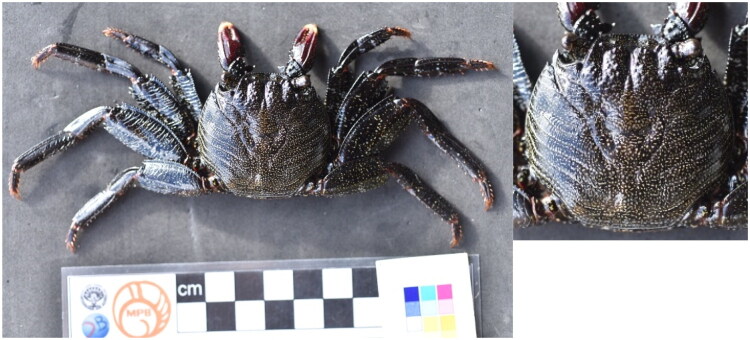 Figure 1
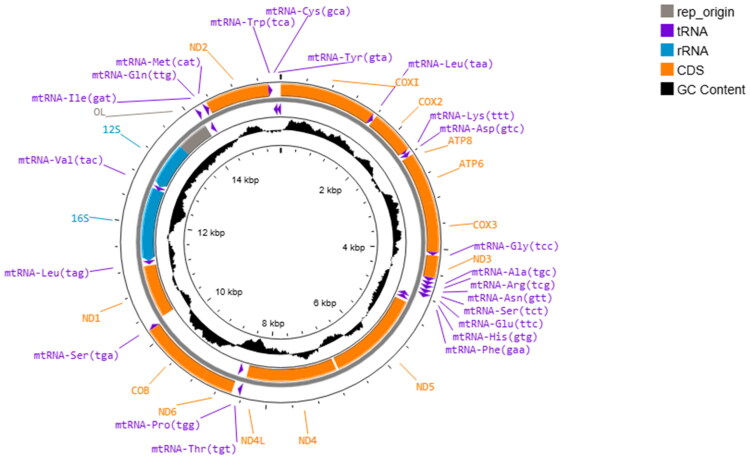 Figure 2
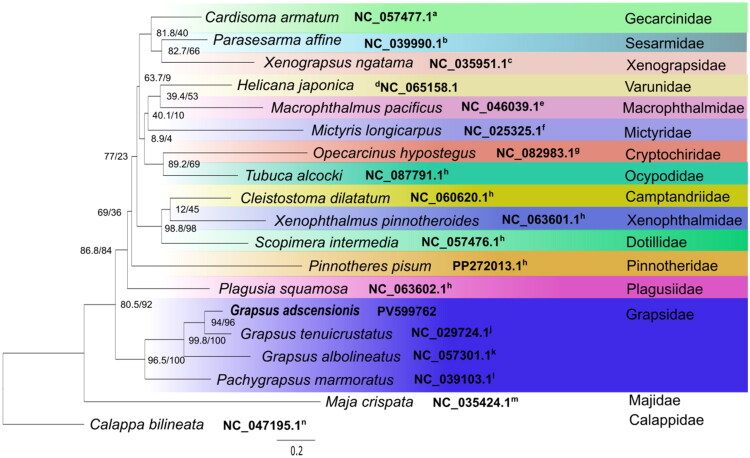 Figure 3
- —National Funds through Fundação para a Ciência e a Tecnologia (FCT)
- —Direção Regional da Ciência e Tecnologia, Governo Regional dos Açores
- —FEDER funds, through the Operational Program for Competitiveness Factors – COMPETE
- —Regional Government of the Azores
- —European Union’s Horizon
Peer Reviews
No public reviews on file for this paper yet. If you reviewed it on a platform where reviews are public (OpenReview, ICLR, NeurIPS, ICML), you can paste yours below so the community can read it here.
Videos
No videos yet. Explain this paper in a talk, walkthrough, or lecture? Add one.
Taxonomy
TopicsGenomics and Phylogenetic Studies · Crustacean biology and ecology · Invertebrate Immune Response Mechanisms
Introduction
Grapsus adscensionis (Osbeck, 1765) is a rocky shore crab widely distributed throughout the Macaronesian archipelagos. It is also reported from the islands of Ascension and Saint Helena, and it occurs as well along parts of the eastern Atlantic coastline (Araújo and Calado 2003; Freire et al. 2021). This species is ecologically significant, occupying intertidal habitats where it plays a role in nutrient cycling and shoreline ecosystem dynamics (Ramírez and Haroun 2014). Despite its ecological relevance, no complete mitochondrial genome has been published to date for the species. Therefore, the present study provides the first complete and annotated mitochondrial genome of G. adscensionis. This genomic resource will support future comparative genomic and phylogenetic studies and help clarify evolutionary patterns within Grapsidae.
Materials and methods
A low-coverage Illumina MiSeq (San Diego, CA) run was performed for one individual of G. adscensionis (Figure 1; specimen voucher DBUA-CRU-312 deposited in the collection of the Department of Biology of the University of the Azores – https://www.uac.pt; contact person Sérgio Ávila – [email protected]) hand-captured at the intertidal of Pico Island (38.392537, −28.254605) in August 2021. The leg sample was preserved in ethanol 96% until DNA extraction following a SDS-based buffer tissue protocol, detailed in the Supplementary Materials. Library preparation and shotgun sequencing were carried out using an Illumina MiSeq (San Diego, CA) paired-end (PE) 300 bp run as a service provided by the Genomics Service Unit at Ludwig-Maximilian University Munich, Munich, Germany. The mitogenome was deposited in GenBank (https://www.ncbi.nlm.nih.gov/genbank/) under the accession number PV599762. The assemblage was done using Geneious Prime 2023.1.1 (read coverage depth map available as Figure S1); gene annotation was performed with MITOS2 (Bernt et al. 2013) and tRNA annotation with ARWEN v1.2 (Laslett and Canbäck 2008). Genome illustration was obtained with Proksee (Grant et al. 2023). The 13 coding proteins of the mitogenome (PCGs) of 19 crabs from the Thoracotremata group and two outgroups from Heterotremata: Maja crispata Risso, 1827 and Calappa bilineata Ng, Lai & Aungtonya, 2002 were included to assess the phylogenetic relationship among Brachyura. When data were available in GenBank, a single representative species per family was selected, except for the Grapsus genus. Phylogenetic tree reconstruction was performed in IQ-TREE 2 (Minh et al. 2020) using the maximum-likelihood (ML) method, with 1000 bootstrap replicates to assess node support (Felsenstein 1985). This was conducted under the TPM2u + F + I + G4 model of molecular evolution.
Photograph of G. adscensionis collected at Pico Island (photograph taken by Cátia Alves for this work). This species differs from the only congeneric species in the Atlantic Ocean, Grapsus grapsus (Linnaeus, 1758), by its rounder shape and dotted ornamentation of the cephalothorax (Freire et al. 2021).
Results
The mitogenome of G. adscensionis is a closed circular molecule with 15,553 bp in size (Figure 2), consistent with the mitochondrial genome organization of other decapod species. The nucleotide composition was skewed (A: 32.3%, T: 33.3%, G: 12%, and C: 22.4%), with a strong AT bias. The AT-skew (−0.015) and GC-skew (≈−0.303) for the whole mitogenome are both negative, indicating a higher occurrence of Ts and Cs rather than As and Gs, respectively. This genome includes 13 PCGs (cox1–3, nad1–6, nad4L, cob, atp6, and atp8), two rRNA genes (12S and 16S), 22 tRNA genes, and a major non-coding region known as the CR (Table S1). Of the 37 annotated genes, only 14 are encoded in the light strand. Three types of start codons were observed throughout PCGs (Table S1).
Map of the mitogenome of G. adscensionis. Clockwise (outer circle) and counterclockwise (inner circle) transcribed genes are a part of the heavy DNA strand (+) and light DNA strand (−), respectively. The GC contents are displayed in the center.
The phylogenetic tree (Figure 3) supports the monophyly of Grapsidae with high bootstrap values, while placing the Plagusiidae family as the closest family. Within the Grapsus clade, G. adscensionis and G. tenuicrustatus (Herbst, 1783) are more closely related to each other than to G. albolineatus Latreille in Milbert, 1812.
Phylogenetic tree inferred from the nucleotide sequences of 13 PCGs of the mitogenome using ML estimation. Node labels refer to SH-aLRT support (%)/ultrafast bootstrap support (%). Sequences references: aWang et al. (2021), bWang, Wang, et al. (2018), cYang et al. (2008), dKim et al. (2023), eWang et al. (2020), fTan et al. (2016), gXu et al. (2023), hUnpublished, PV599762, jSung et al. (2016), kWang et al. (2022), lTan et al. (2018), and outgroup (mBasso et al. (2017) and nLu et al. (2020)).
Discussion and conclusions
In this work, the complete mitogenome of G. adscensionis was sequenced for the first time, and the phylogenetic relationships among Brachyura specimens were analyzed, providing insights into their evolutionary history and genetic divergence. The consistency of the annotations with other decapod mitogenomes, together with the phylogenetic placement in agreement with previous studies, supports the high quality of this mitogenome.
The phylogenetic tree (Figure 3), supports the monophyly of Grapsidae with high bootstrap values, with the Plagusiidae family appearing as the closest family. The close relationship between G. adscensionis and G. tenuicrustatus in comparison to G. albolineatus, may be implying a possible divergence pattern within the genus that could reflect geographic and/or ecological differentiation. Furthermore, the phylogenetic relationships among Macrophthalmidae, Mictyridae, Sesarmidae, Varunidae, and Xenograpsidae are represented and generally align with findings from previous studies (Wang, Ji, et al. 2018; Zhang et al. 2025).
This mitochondrial genome data is an important resource for future phylogenetic and barcoding studies. On one side, the whole mitochondria sequence can be used to better understand the evolutionary and systematic relationships of the Grapsidae family, while on the other side it can serve as basis for developing new markers with multiple applications such as DNA barcoding, metabarcoding and phylogenetics.
Supplementary Material
Supplementary_Data_CA.docx
The reference list from the paper itself. Each links out to its DOI / PubMed record.
- 1Araújo R, Calado R. 2003. Crustáceos decápodes do arquipélago da Madeira. Funchal: Direcção Regional do Ambiente; p. 236.
- 2Basso A, Babbucci M, Pauletto M, Riginella E, Patarnello T, Negrisolo E. 2017. The highly rearranged mitochondrial genomes of the crabs Maja crispata and Maja squinado (Majidae) and gene order evolution in Brachyura. Sci Rep. 7(1):4096. 10.1038/s 41598-017-04168-928642542 PMC 5481413 · doi ↗ · pubmed ↗
- 3Bernt M, Donath A, Jühling F, Externbrink F, Florentz C, Fritzsch G, Pütz J, Middendorf M, Stadler PF. 2013. MITOS: improved de novo metazoan mitochondrial genome annotation. Mol Phylogenet Evol. 69(2):313–319. 10.1016/j.ympev.2012.08.02322982435 · doi ↗ · pubmed ↗
- 4Felsenstein J. 1985. Confidence limits on phylogenies: an approach using the bootstrap. Evolution. 39(4):783–791. 10.1111/j.1558-5646.1985.tb 00420.x 28561359 · doi ↗ · pubmed ↗
- 5Freire AS, Teschima MM, Brandão MC, Iwasa-Arai T, Sobral FC, Sasaki DK, Agostinis AO, Pie MR. 2021. Does the transport of larvae throughout the south Atlantic support the genetic and morphometric diversity of the Sally Lightfoot Crabs Grapsus grapsus (Linnaeus, 1758) and Grapsus adscensionis (Osbeck, 1765) (Decapoda: Grapsidae) among the oceanic islands? J Mar Syst. 223:103614. 10.1016/j.jmarsys.2021.103614 · doi ↗
- 6Grant JR, Enns E, Marinier E, Mandal A, Herman EK, Chen C, Graham M, Van Domselaar G, Stothard P. 2023. Proksee: in-depth characterization and visualization of bacterial genomes. Nucleic Acids Res. 51(W 1):W 484–W 492. 10.1093/nar/gkad 32637140037 PMC 10320063 · doi ↗ · pubmed ↗
- 7Kim JM, Kim HS, Yi CH. 2023. The complete mitochondrial genome of Helicana japonica (Crustacea, Decapoda, Varunidae) from South Korea. Mitochondrial DNA B Resour. 8(8):872–876. 10.1080/23802359.2023.224668637600504 PMC 10434999 · doi ↗ · pubmed ↗
- 8Laslett D, Canbäck B. 2008. ARWEN: a program to detect t RNA genes in metazoan mitochondrial nucleotide sequences. Bioinformatics. 24(2):172–175. 10.1093/bioinformatics/btm 57318033792 · doi ↗ · pubmed ↗