Objective Data From Patients With Persistent Spinal Pain Syndrome Type II Implanted With Spinal Cord Stimulator
Alaa Abd‐Elsayed, Christopher Gilligan

Abstract
Genes, proteins, chemicals, diseases, species, mutations and cell lines named across the full text — each resolved to its canonical identifier and authoritative record.
Click any figure to enlarge with its caption.
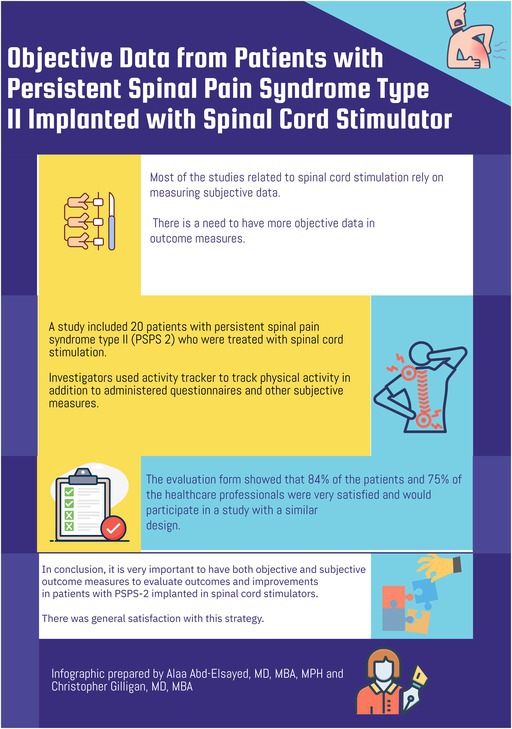 Figure 1
Peer Reviews
No public reviews on file for this paper yet. If you reviewed it on a platform where reviews are public (OpenReview, ICLR, NeurIPS, ICML), you can paste yours below so the community can read it here.
Videos
No videos yet. Explain this paper in a talk, walkthrough, or lecture? Add one.
Taxonomy
TopicsPain Management and Treatment · Transcranial Magnetic Stimulation Studies · Laser Applications in Dentistry and Medicine
Persistent spinal pain syndrome Type 2 (PSPS Type 2) causes severe pain associated with limitations of physical activities and affects the emotional and social aspects of patients' lives.
A study by Hamm‐Faber et al. [1] conducted a study to investigate the feasibility of collecting objective data from an activity tracker and a neurostimulator device to evaluate physical activity. The authors also evaluated the experiences of patients and healthcare professionals.
The authors concluded that the objective collection of data is feasible with a neuromodulation device and an activity tracker if the watch is correctly worn on the wrist or with clear instructions.
We encourage readers to read the full manuscript published in Pain Practice.
Conflicts of Interest
Dr. Christopher Gilligan is the editor in chief of Pain Practice and Dr. Alaa Abd‐Elsayed is a section editor of Pain Practice.
The reference list from the paper itself. Each links out to its DOI / PubMed record.
- 1T. Hamm‐Faber , I. Arnts , D. J. H. A. Henssen , et al., “Feasibility of Collecting Objective Data and Exploring Patient's Experiences on Physical Activity in Persistent Spinal Pain Syndrome Type 2 Patients Receiving Spinal Cord Stimulation: A Mixed Feasibility Study,” Pain Practice 25, no. 3 (2025): e 70013.39963711 10.1111/papr.70013 · doi ↗ · pubmed ↗