Outcomes of the SpineJack Implant System for Cancer Patients With Pathological Fractures
Alaa Abd‐Elsayed, Christopher Gilligan

Abstract
Genes, proteins, chemicals, diseases, species, mutations and cell lines named across the full text — each resolved to its canonical identifier and authoritative record.
Click any figure to enlarge with its caption.
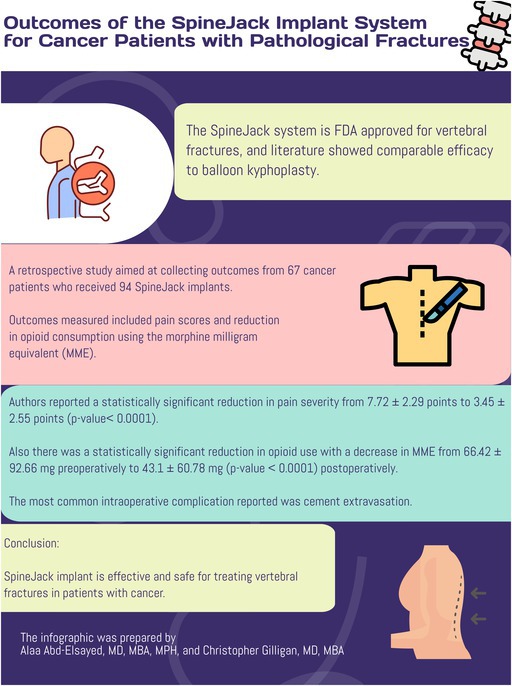 Figure 1
Peer Reviews
No public reviews on file for this paper yet. If you reviewed it on a platform where reviews are public (OpenReview, ICLR, NeurIPS, ICML), you can paste yours below so the community can read it here.
Videos
No videos yet. Explain this paper in a talk, walkthrough, or lecture? Add one.
Taxonomy
TopicsManagement of metastatic bone disease · Spine and Intervertebral Disc Pathology · Spinal Fractures and Fixation Techniques
The SpineJack system is an FDA‐approved therapy for vertebral compression fractures (VCFs) with efficacy comparable to balloon kyphoplasty.
Parmar et al. [1] conducted a retrospective study to examine the efficacy and safety of the SpineJack system. The authors collected data from 67 cancer patients who received 94 SpineJack procedures.
The authors found a significant reduction in pain scores and a reduction in opioid use in patients who received the SpineJack implant.
The authors concluded that the use of the SpineJack system for VCFs is effective and safe.
Conflicts of Interest
Dr. Christopher Gilligan is the editor in chief of pain practice, and Dr. Alaa Abd‐Elsayed is a section editor of pain practice.
The reference list from the paper itself. Each links out to its DOI / PubMed record.
- 1J. Parmar , A. Malik , G. Zemmedhun , and S. Javed , “Short‐Term Clinical Outcomes and Safety of the Spine Jack Implant System for the Treatment of Pathological Vertebral Compression Fractures in Cancer Patients: A Retrospective Analysis,” Pain Practice 25, no. 3 (2025): e 70020.40052575 10.1111/papr.70020 · doi ↗ · pubmed ↗