Phytochemical Composition and In Vitro Antibacterial Activity of the Essential Oil from Lippia grata Schauer (Verbenaceae) against Staphylococcus spp. from Caprine Mastitis
Alisson T. da Silva, Danillo S. Rosa, Gutiele do N. do É, Lucas S. Azevedo, Ana V. V. de Souza, Márcio R. S. Tavares, Renata de F. S. Souza, Jackson R. G. da S. Almeida, Mateus M. da Costa

TL;DR
This study shows that essential oil from Lippia grata can fight bacteria causing goat mastitis, including those that form protective biofilms.
Contribution
The study demonstrates the antibacterial and antibiofilm potential of Lippia grata essential oil against Staphylococcus spp. from caprine mastitis.
Findings
The essential oil of L. grata contains carvacrol as the main component and inhibits Staphylococcus spp. at concentrations of 256–512 μg/mL.
The oil reduced biofilm formation in some isolates and disrupted pre-established biofilms in all tested isolates.
L. grata essential oil shows promise as a treatment for caprine mastitis caused by biofilm-forming bacteria.
Abstract
Staphylococcus spp. are the primary pathogens responsible for caprine mastitis. These bacteria can form biofilms, hindering treatment and compromising milk production. In this context, plant-based natural products derived from Lippia grata Schauer have emerged as a potential alternative for treatment. This study aimed to evaluate the antibacterial and antibiofilm properties of the essential oil (EO) of L. grata against Staphylococcus spp. isolated from caprine mastitis. The EO was obtained by hydrodistillation, and its chemical constituents were identified by gas chromatography coupled with mass spectrometry. Fourteen clinical isolates of Staphylococcus spp. and two standard strains were tested. Antibacterial activity was assessed using broth microdilution. Biofilm production and the interference capacity of the EO were evaluated using a microplate adherence assay. The EO of L. grata…
Genes, proteins, chemicals, diseases, species, mutations and cell lines named across the full text — each resolved to its canonical identifier and authoritative record.
Click any figure to enlarge with its caption.
 1
1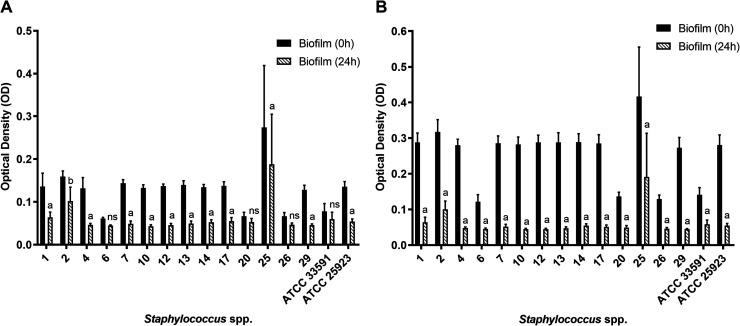 2
2| identification | property/state | species/MALDI-TOF |
|---|---|---|
| 1 | Juraci/Pernambuco | Staphylococcus chromogenes |
| 2 | Juraci/Pernambuco | S. chromogenes |
| 4 | Juraci/Pernambuco | S. chromogenes |
| 6 | Marciano/Pernambuco | S. aureus |
| 7 | Geraldo/Pernambuco | S. aureus |
| 10 | Clarice/Pernambuco | S. chromogenes |
| 12 | Clarice/Pernambuco | S. aureus |
| 13 | Ana Paula/Pernambuco | Staphylococcus xylosus |
| 14 | Ana Paula/Pernambuco | Staphylococcus caprae |
| 17 | Valberto/Pernambuco | S. aureus |
| 20 | Valberto/Pernambuco | Staphylococcus capitis |
| 25 | Domingos/Bahia | Staphylococcus lugdunensis |
| 26 | Domingos/Bahia | Staphylococcus simulans |
| 29 | Domingos/Bahia | Staphylococcus epidermidis |
| ATCC 33591 | - | S. aureus |
| ATCC 25923 | - | S. aureus |
| compound | IR | % |
|---|---|---|
| α-thujene | 945 | 0.05 |
| α-pinene | 951 | - |
| 1-octen-3-ol | 984 | 0.09 |
| myrcene | 994 | 0.49 |
| α-terpinene | 1020 | 0.25 |
|
|
|
|
| 1,8-cineole | 1034 | 0.24 |
|
| 1048 | - |
| γ-terpinene | 1061 | 1.35 |
|
| 1069 | 0.4 |
| linalool | 1102 | 0.53 |
| ipsdienol | 1148 | 0.61 |
| terpinen-4-ol | 1181 | 0.68 |
| methyl thymol ether | 1238 | 1.39 |
| methyl carvacrol ether | 1247 | 0.25 |
|
|
|
|
|
|
|
|
| thymol acetate | 1358 | - |
| carvacrol acetate | 1375 | 0.29 |
|
| 1425 | 1.56 |
| aromadendrene | 1443 | - |
| α-humulene | 1458 | 0.26 |
| ar-curcumene | 1484 | - |
| α-zingiberene | 1496 | - |
|
| 1509 | 0.16 |
|
| 1526 | |
| spathulenol | 1584 | 0.3 |
| caryophyllene oxide | 1591 | 0.76 |
| humulene epoxide | 1616 | - |
| total detected (%) | 97.9 | |
| yield % (v/p) | 5.47 |
| antimicrobial
activity | classification of
biofilm production | ||
|---|---|---|---|
| identification | MIC (μg mL–1) | MBC (μg mL–1) | classification |
| 1 | 512 | 512 | weak |
| 2 | 512 | 512 | weak |
| 4 | 512 | 512 | weak |
| 6 | 256 | 256 | weak |
| 7 | 512 | 512 | moderate |
| 10 | 512 | 512 | weak |
| 12 | 512 | 512 | weak |
| 13 | 512 | 512 | weak |
| 14 | 512 | 512 | weak |
| 17 | 512 | 512 | weak |
| 20 | 256 | 256 | weak |
| 25 | 512 | 512 | strong |
| 26 | 256 | 256 | weak |
| 29 | 512 | 512 | weak |
| ATCC 33591 | 256 | 256 | weak |
| ATCC 25923 | 512 | 512 | moderate |
- —Coordena??o de Aperfei?oamento de Pessoal de N?vel Superior10.13039/501100002322
- —Conselho Nacional de Desenvolvimento Cient?fico e Tecnol?gico10.13039/501100003593
- —Funda??o de Amparo ? Ci?ncia e Tecnologia do Estado de Pernambuco10.13039/501100006162
- —Funda??o de Amparo ? Ci?ncia e Tecnologia do Estado de Pernambuco10.13039/501100006162
- —Funda??o de Amparo ? Ci?ncia e Tecnologia do Estado de Pernambuco10.13039/501100006162
- —Funda??o de Amparo ? Ci?ncia e Tecnologia do Estado de Pernambuco10.13039/501100006162
- —Funda??o de Amparo ? Ci?ncia e Tecnologia do Estado de Pernambuco10.13039/501100006162
Peer Reviews
No public reviews on file for this paper yet. If you reviewed it on a platform where reviews are public (OpenReview, ICLR, NeurIPS, ICML), you can paste yours below so the community can read it here.
Videos
No videos yet. Explain this paper in a talk, walkthrough, or lecture? Add one.
Taxonomy
TopicsEssential Oils and Antimicrobial Activity · Probiotics and Fermented Foods · Phytochemistry and Biological Activities
Introduction
1
Dairy goat farming in Brazil has experienced substantial growth over the past decade,? with milk production estimated at approximately 300,000 tons in 2020.? Within this context, the Northeast regionparticularly the states of Bahia and Pernambucoplays a prominent role. Together, these two states are home to 46% of the national herd and are responsible for 48.9% of milk production in the region and 34% of the overall output in the country.?
Milk productivity and quality are significantly impacted by the occurrence of caprine mastitis,? defined as an inflammatory condition of the mammary gland that causes biochemical alterations in the milk and presents both local and systemic clinical symptoms.? It is one of the most prevalent diseases in dairy goats and poses a considerable economic burden on rural properties.? The combined effects of milk disposal and treatment expenses associated with the disease result in financial losses equivalent to approximately 36% of the total income of producers.?
Staphylococcus spp. are among the main causative agents of caprine mastitis.? Foodborne illnesses caused by bacteria from this group pose a threat to public health? due to the pathogenic components such as biofilm production and are frequently associated with resistance to multiple antibiotics.? Biofilms are exopolymeric structures composed of carbohydrates, proteins, and DNA that surround the microorganisms.? This matrix provides protection against immune responses, antimicrobial agents, and environmental conditions, while also facilitating the transfer of virulence genes between microorganisms.? Consequently, infections involving biofilm formation often become chronic, leading to the excessive and recurrent use of antibiotics without clinical improvement, thereby contributing to increased pathogen resistance.?
Antibiotic therapy is the primary treatment for caprine mastitis.? However, due to rising resistance, its efficacy has diminished.? Therefore, the search for new alternative therapies has become critical. Historically, the plant kingdom has served as a rich source of chemical compounds for treating various diseases, including bacterial infections.? Among plant-derived products, essential oils (EOs)aromatic liquids containing complex mixtures of volatile and semivolatile phytochemicals produced via secondary metabolismstand out.? The literature has seen a growing number of studies evaluating the biological activity of EOs, especially regarding their antibacterial and antibiofilm potential, highlighting their relevance as promising sources for novel drugs.?
Lippia grata Schauer (Verbenaceae), a shrub species native to the Caatinga ecosystem in northeastern Brazil, its popular names are alecrim-do-mato, alecrim-do-sertão, or alecrim-da-chapada ? and is mainly recognized for the medicinal properties of its EO. ?,? Studies have also reported the antibacterial potential of L. grata essential oil (EOLg). ?,? However, most of these studies have been conducted against standard bacterial strains or human clinical isolates, and little attention has been given to pathogens of veterinary relevance. To the best of our knowledge, no previous studies have evaluated the antibacterial and antibiofilm potential of L. grata EO against Staphylococcus spp. isolates obtained directly from cases of caprine mastitis. This gap is particularly relevant because it highlights the potential of this EO as a natural alternative strategy with great promise for sustainable animal production. Therefore, the aim of this research was to characterize the chemical profile and evaluate the in vitro antibacterial and antibiofilm activities of EOLg against Staphylococcus spp. strains isolated from caprine mastitis.
Materials and Methods
2
Collection of Plant Material
2.1
Leaves of L. grata were collected in March 2023, in the morning, at the Organic Medicinal Garden of the Federal institute of Sertão Pernambucano, Caatinga Biome in the region of Petrolina, Eastern Pernambuco State, Brazil (9°20′17.2″S and 40°41′56.4″W). Specimens were previously identified and deposited (no. 24998) in the Herbarium of Vale do São Francisco (HVASF).
Prior to collection, a voucher specimen was prepared, identified, deposited at the Herbarium of the Semi-Arid Tropics (HTSAspecimen no. 7232), and registered in SisGen under code AD0F005, in accordance with the Brazilian Biodiversity Law (13.123/2015). For the extraction of the essential oil, the leaves were air-dried at room temperature (≈28 °C ± 1 °C) for 7 days in the Biotechnology Laboratory of the same institution.
Extraction of EOLg
2.2
To obtain the EOLg, 100 g of dried L. grata leaves were subjected to hydrodistillation using a Clevenger-type apparatus for 4 h at 100 ± 5 °C. After the procedure, the essential oil yield was calculated, the aqueous phase was discarded, and the sample was stored in a freezer until further use.
Determination of the Chemical Composition
of EOLg
2.3
The evaluation of EOLg constituents was performed by gas chromatography coupled with mass spectrometry and flame ionization detection (GC–MS/GC–FID) (GC-2010 Plus; GCMS-QP2010 Ultra, Shimadzu Corporation, Kyoto, Japan), equipped with an AOC-20i automatic sampler (Shimadzu). Separations were carried out using an Rtx-5MS Restek fused silica capillary column (5% diphenyl–95% dimethylpolysiloxane) measuring 30 m × 0.25 mm internal diameter (i.d.) and 0.25 μm film thickness, under constant helium flow (99.999%) at a rate of 1.2 mL min^–1^. The injection volume was 0.5 μL (5 mg mL^–1^), with a split ratio of 1:10. The oven temperature program started at 50 °C (isothermal for 1.5 min), followed by a 4 °C/min ramp up to 200 °C, then a 10 °C/min ramp up to 250 °C, with a final Isothermal hold for 5 min at 250 °C.
GC–MS and GC–FID data were simultaneously acquired using a detector splitting system with a flow split ratio of 4:1 (MS/FID). A 0.62 m × 0.15 mm i.d. capillary restrictor column connected the splitter to the MS detector, while a 0.74 m × 0.22 mm i.d. restrictor column connected the splitter to the FID detector. The injector temperature was set at 250 °C, and the ion source temperature at 200 °C. Ions were generated at 70 eV, with a scan rate of 0.3 scans s^–1^ across a mass range of 40–350 Da. The FID temperature was set at 250 °C, with synthetic air, hydrogen, and helium supplied at flow rates of 30, 300, and 30 mL min^–1^, respectively. The quantification of each constituent was estimated by normalization of the peak area obtained from the FID (%). Compound concentrations were calculated based on the GC peak areas and presented in order of GC elution.
Constituent identification was based on the comparison of retention indices with literature values. Retention indices were calculated using the van Den Dool and Kratz? equation relative to a homologous series of n-alkanes (nC9–nC18). Three mass spectral librariesWILEY8, NIST107, and NIST21were used for spectral comparison, with an 80% similarity index as the threshold for identification.
Bacterial Isolates
2.4
A total of 14 clinical isolates of Staphylococcus spp. were selected from the microbial culture collection of the Laboratory of Animal Microbiology and Immunology, UNIVASF (SisGen A6C4D9C). These isolates were previously obtained from animals on six farms in the state of Pernambuco and one farm in the state of Bahia. Identification was performed using matrix-assisted laser desorption/ionization time-of-flight mass spectrometry (MALDI-TOF-MS), and the results are presented in Table (unpublished data). As controls, two standard Staphylococcus aureus strains from the American Type Culture Collection (ATCC) were used: ATCC 33591, a methicillin-resistant S. aureus (MRSA), and ATCC 25923, a methicillin-sensitive S. aureus (MSSA) and biofilm formation control.
1: Identification and Classification of Staphylococcus spp. Isolates from Caprine Mastitis on Brazilian Farms
Essential Oil Solubilization
2.5
To prepare the stock solution, EOLg was dissolved in a dimethyl sulfoxide/sterile water mixture (15:85, v/v) to achieve a final concentration of 4096 μg mL^–1^, following the protocol described by Limaverde et al.? After preparation, the solution remained in the dark and was kept at 8 °C prior to microbiological evaluations.
Antibacterial Activity
2.6
The minimum inhibitory concentration (MIC) and minimum bactericidal concentration (MBC) of EOLg were determined by broth microdilution, according to the guidelines of document M07.? Assays were performed in 96-well microplates, with EOLg serially diluted in Mueller–Hinton (MH) broth in a 1:1 ratio, tested at concentrations of 2048, 1024, 512, 256, 128, 64, 32, and 16 μg mL^–1^.
To prepare the inoculum, freshly grown colonies on brain heart infusion (BHI) agar were suspended in 5 mL of 0.85% saline solution to a turbidity equivalent to 0.5 on the McFarland scale (1.5 × 10^8^ CFU mL^–1^). Then, 10 μL of this suspension was added to 990 μL of MH broth. From this dilution, 10 μL was inoculated into each well, and the plate was incubated at 37 °C for 24 h under aerobic conditions.
Subsequently, the content of each well was plated onto MH agar and reincubated at 37 °C for 24 h. The MBC was established as the lowest EOLg concentration able to eliminate the inoculum. Concurrently, the MIC was established as the lowest EOLg concentration able to inhibit bacterial growth, verified when the color did not change after adding 30 μL of 1% 2,3,5-triphenyltetrazolium chloride solution. All tests were conducted in technical and biological triplicate. Sterility and bacterial viability controls were also included.
Biofilm Quantification
2.7
The biofilm-forming phenotype of the isolates was evaluated using the microtiter plate adherence assay with modifications. ?,?
Initially, isolated colonies were inoculated into 3 mL of Trypticase soy broth with 0.5% glucose (TSBg) and incubated at 37 °C for 24 h. Then, 195 μL of TSBg and 5 μL of the bacterial suspension (previously incubated) were added to each well of a microplate, followed by incubation at 37 °C for 24 h.
After incubation, 200 μL of sterile distilled water were used to clean each well and then the plate was air-dried for 5 min. The biofilm was fixed with methanol (150 μL in each well) at room temperature for 20 min, after which the solvent was removed and the plate stayed overnight at room temperature.
On the following day, the biofilm was stained with 100 μL of 0.25% crystal violet for 5 min, washed with sterile distilled water, and the remaining stain was solubilized with 200 μL of alcohol–acetone (80:20, v/v). Absorbance was assessed using a spectrophotometer (EXPERT PLUS-UV) at the wavelength of 620 nm. All assays were performed in technical and biological triplicate.
The isolates were classified in according to Stepanovic et al.,? based on the optical density (OD) as follows: nonbiofilm producer (ODs < ODc), weak biofilm producer (ODc < ODs < 2 × ODc), moderate biofilm producer (2 × ODc < ODs < 4 × ODc), or strong biofilm producer (ODs > 4 × ODc), where ODs represents the optical density of the sample and ODc that of the negative control.
Antibiofilm Activity
2.8
The assay to evaluate the interference of essential oil with biofilm formation and on preformed biofilm in according to Merino et al.? and Nostro et al.? methods, with adaptations.
First, bacterial inocula were cultured in tubes containing 3 mL of TSBg at 37 °C for 24 h. Then, 100 μL of this culture was added to each well of a 96-well microplate along with 100 μL of the EOLg solution, resulting in a final concentration of 1/2 MIC. After incubation at 37 °C for 24 h, the microplate underwent similar to those of cleaning, fixation, dyeing, solubilization, and assessing procedures used in the biofilm quantification assay.
To assess the effect of EOLg on preformed biofilms, 5 μL of the bacterial inoculum in TSBg was added to wells containing 195 μL of TSBg and incubated at 37 °C for 24 h. The microplates were then washed three times with 200 μL of sterile distilled water and left to air-dry for 5 min. Finally, 200 μL of EOLg solution (at 1× and 1/2 MIC concentrations) was added. Optical density readings were taken immediately after the addition of EOLg (0 h) and after 24 h of incubation at 37 °C. The percentage of interference was determined using the formula: (mean OD_0_h/mean OD_24_h) × 100. All assays were performed in technical and biological triplicate on independent days.
Statistical Analysis
2.9
The biofilm interference results were analyzed using nonparametric multiple comparisons tests, equivalent two-way ANOVA with the posthoc test of Sidak. Statistical analyses were assessed by GraphPad Prism 8 software, and results were plotted as mean ± standard deviation. Only p-value <0.05 was considered significant.
Results and Discussion
3
Yield and Chemical Composition of EOLg
3.1
The yield and chemical composition of the essential oil from L. grata leaves, determined by GC–MS/GC–FID, are presented in Table. The yield of EOLg was 5.47% (v/w). A total of 21 components were identified, accounting for 97.9% of the total composition. The major constituents were carvacrol (78%), thymol (7.1%), and p-cymene (3.16%). Minor components included E-caryophyllene (1.56%), methyl thymol ether (1.39%), and γ-terpinene (1.35%).
2: Chemical Composition of the Essential Oil from Lippia grata Schauer (Verbenaceae) Leaves
The phytochemical profile of the Lippia genus has been confirmed in several studies, with variations in the proportions of components influenced by environmental factors such as soil composition, season, altitude, humidity, plant developmental stage, and collection time. ?−? ? One study observed greater chemical diversity in EOLg composition during the rainy season, highlighting the influence of seasonality on constituent concentrations and oil yield.?
Felix et al.? identified thymol as the major compound across different seasons, with the highest concentration during the dry season. In contrast, p-cymene and carvacrol were not identified in samples collected in Ceará. Conversely, p-cymene, carvacrol, and γ-terpinene were the main constituents in EOLg extracted from plants collected in the states of Paraíba and Piauí.? Essential oils typically exhibit a complex composition dominated by two or three major constituents, whose concentrations range from 20% to 70% compared to other components.? The chemical similarity across different chemotypes suggests that the chemical profile of Lippia spp. essential oil is largely under genetic control, as the composition remains stable.?
The chemical profile of the EOLg obtained in this study showed carvacrol (78%) as the major component, accompanied by thymol and p-cymene in lower proportions. A previous study evaluating different doses of organic fertilization, with or without mineral supplementation, reported that nonirrigated plants fertilized with NPK exhibited increased levels of carvacrol.? Almeida et al.? also demonstrated that maintaining adequate levels of calcium, magnesium, and sulfur is essential for high carvacrol content in L. grata, whereas their deficiency significantly reduces this compound and increases the accumulation of p-cymene. High proportions of this compound (>40%) have also been reported in other L. grata chemotypes, reinforcing the consistency of our findings with chemical variations previously described in the species. ?−? ? It is worth noting that carvacrol, together with thymol, is widely recognized for its strong antimicrobial properties, including activity against Staphylococcus spp.? Therefore, the predominance of carvacrol in our oil may be relevant for understanding its biological potential, while possible synergistic interactions with minor constituents cannot be excluded.
Antibacterial Activity
3.2
EOLg exhibited both inhibitory and bactericidal activity against all tested Staphylococcus spp. isolates, with MIC and MBC values ranging from 256 to 512 μg mL^–1^, including the ATCC 25923 and ATCC 33591 strains (Table).
3: Antimicrobial Activity of the Essential Oil from Lippia grata Schauer (Verbenaceae) Leaves against Staphylococcus spp. Isolated from Caprine Mastitis
Throughout the coevolutionary relationship between humans and plants, humankind has used the therapeutic properties of plants to treat infectious diseases. Among plant-derived products, essential oilsvolatile compounds synthesized by various plant partshave shown biotechnological potential for the development of new drugs targeting pathogenic microorganisms.? The antimicrobial effect of plant-based compounds may be due to the action of a single secondary metabolite or the synergistic effect of multiple molecules, which can enhance inhibitory activity.? Furthermore, these compounds may act on multiple bacterial targets, triggering different inhibitory mechanisms such as bacteriostatic or bactericidal effects.? Another advantage of using EOs to treat microbial infections is their low cytotoxicity in mammals.?
In this context, essential oil extracted from Lippia spp. has demonstrated strong antimicrobial activity against Gram-positive pathogens.? The antibacterial activity observed against Staphylococcus spp. isolates may be attributed to the major constituents present in EOLg.? Literature reports indicate that thymol and carvacrol show antibacterial activity against Staphylococcus spp. isolated from bovine mastitis.? Additionally, although p-cymene has limited antimicrobial activity on its own, it enhances the inhibitory effect when combined with carvacrol.?
Numerous studies have demonstrated the antimicrobial potential of thymol and carvacrol against Gram-positive bacteria, including S. aureus,? Streptococcus spp., ?,? and Bacillus cereus.? The cytotoxic effect of the phenolic monoterpenoids thymol and carvacrol, as well as the monoterpene p-cymene, on microbial cells is due to increased permeability of the cytoplasmic membrane, leading to its rupture and subsequent leakage of intracellular content. ?,? The hydroxyl group in distinct positions on the aromatic ring of thymol and carvacrol is essential for their antimicrobial activity, enhancing hydrophilicity and reducing membrane potential.? In contrast, p-cymene lacks a hydroxyl group; its antimicrobial effect results from accumulation in the membrane due to its affinity for liposomal membranes, causing membrane expansion and ion leakage.?
We did not perform direct comparisons with conventional antibiotics in the MIC/MBC assays, as the primary aim of this study was to assess the intrinsic antibacterial properties of EOLg. We acknowledge this limitation and emphasize that the susceptibility of the same isolates to antibiotics commonly used in veterinary clinical practice is being investigated in complementary studies by our group. Once available, these results will provide a better contextualization of the therapeutic potential of EOLg.
Biofilm
3.3
Quantification of Biofilm Production
3.3.1
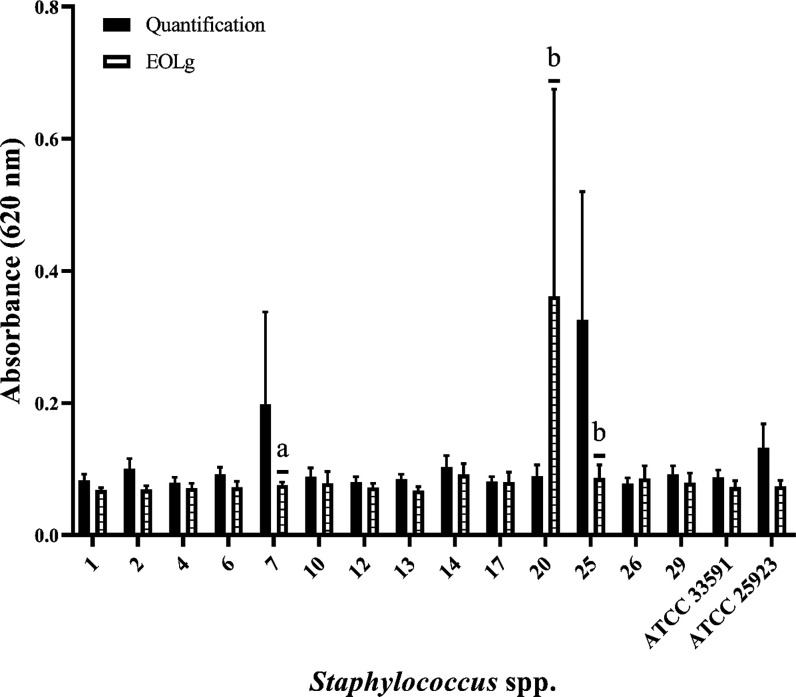
When evaluating the biofilm-forming ability of the clinical Staphylococcus spp. isolates on surfaces, all isolates (n = 14) demonstrated the ability to form biofilms (Table and Figure). Among them, 85.71% (12/14) were classified as weak biofilm producers, whereas isolate 7 (1/14, 7.14%, S. aureus) was classified as a moderate producer and isolate 25 (1/14, 7.14%, Staphylococcus lugdunensis) as a strong producer.
Effect of the essential oil from Lippia grata Schauer (Verbenaceae) leaves (EOLg) on the formation of biofilms produced by Staphylococcus spp. isolates from caprine mastitis. a: p < 0.01; b: p < 0.0001; ATCC: American Type Culture Collection; mean optical density of the negative control: 0.062.
Staphylococcus spp. strains isolated from mastitis cases are reported to be biofilm producers.? This is a key virulence mechanism that protects bacteria and ensures their survival.? Biofilm shields microorganisms from ultraviolet light and enhances resistance to extreme pH, high salinity environments, and the effects of antimicrobials.? Furthermore, eradicating bacteria embedded in biofilms requires antimicrobial concentrations up to a thousand times higher than those needed to eliminate planktonic forms of the same bacteria, due to the physical and mechanical protection conferred by the biofilm matrix.?
Antibiofilm Activity
3.3.2
As shown in Figure, the subinhibitory concentration of 1/2 MIC did not reduce biofilm formation in Staphylococcus spp. isolates classified as weak producers. However, for isolates 7 (S. aureus) and 25 (S. lugdunensis), EOLg was able to significantly reduce biofilm formation (p < 0.05). In contrast, isolate 20 (Staphylococcus capitis) exhibited increased biofilm formation when treated with EOLg (p < 0.0001). Additionally, concentrations of 1 and 1/2 MIC of EOLg were effective in disrupting preformed biofilms (FigureA,B).
Effect of the essential oil from Lippia grata Schauer (Verbenaceae) leaves on pre-established biofilms produced by Staphylococcus spp. isolates. The essential oil concentrations tested were MIC (A) and 1/2 MIC (B). OD readings were taken immediately after exposure to the essential oil (0 h) and 24 h postapplication. a: p < 0.0001; b: p < 0.01; ns: not significant; ATCC: American Type Culture Collection.
Among the evaluation of the antibiofilm effects of Lippia spp. EO, some studies against both Gram-negative and Gram-positive bacteria stand out. ?,? Porfírio et al.,? for example, evaluated the effect of essential oil extracted from the aerial parts of Lippia alba on biofilm formation by S. aureus (ATCC 6538). Among the three EO samples tested, the one with the highest activity inhibited biofilm formation by approximately 90% at a concentration of 500 μg mL^–1^ (1× MIC, 1× MBC). The major constituents identified in this oil were geranial (35.85%), neral (26.44%), and p-cymene (9.84%).?
Although most of the isolates evaluated in this study were classified as weak biofilm producers, the panel also included a moderate producer (S. aureus isolate 7), a strong producer (S. lugdunensis isolate 25), and the ATCC 25923 reference strain, which was also classified as a moderate producer. Similar findings were reported by Lopes et al.,? in which EOLg inhibited biofilm formation in different S. aureus strains (including ATCC 25923) at concentrations ranging from 0.156 to 10 mg mL^–1^. In all these cases, EOLg demonstrated effectiveness both in preventing biofilm formation and in destabilizing pre-established biofilms, indicating that its activity was not limited to weak producers.
Interestingly, isolate 20 (S. capitis) showed an increase in biofilm formation when exposed to EOLg. This behavior may be related to a stress-adaptive response, since subinhibitory concentrations of antimicrobials are known to modulate pathways associated with biofilm formation in Staphylococcus spp. and other bacteria. ?,? Similar phenomena have been described as hormetic responses, in which low doses of stressors stimulate defense mechanisms, including the enhancement of biofilm production.? Although the specific mechanism was not investigated in this study, it is important to elucidate the biochemical pathway of this phenomenon to better understand its implications for the therapeutic use of essential oils.
Conclusion
4
In conclusion, EOLgwhose main components were carvacrol, thymol, and p-cymene exhibited antimicrobial and antibiofilm activity against Staphylococcus spp. isolates from caprine mastitis, and standard S. aureus strains resistant and susceptible to methicillin. These findings encourage further research on EOLg, particularly regarding its in vivo effects on caprine mastitis. However, we acknowledge that cytotoxicity assays were not conducted in this study. Since safety is a fundamental requirement for therapeutic application, additional studies are necessary to evaluate the cytotoxic and in vivo effects of this essential oil before its clinical or veterinary use can be proposed. Nevertheless, this work contributes to the growing body of knowledge on phytotherapy and alternative antimicrobials in veterinary medicine, providing relevant insights for the development of potential strategies to treat mastitis in dairy goat farming.
The reference list from the paper itself. Each links out to its DOI / PubMed record.
- 1Miller B. A.Lu C. D.Current status of global dairy goat production: an overview Asian-Australas. J. Anim. Sci.20193281219123210.5713/ajas.19.025331357263 PMC 6668863 · doi ↗ · pubmed ↗
- 2Food and Agriculture Organization of the United Nations (FAO) . Statistical Databases 2022. https://www.fao.org/faostat/en/#search/goat%20milk%20brazil (accessed June 16, 2025).
- 3Instituto Brasileiro de Geografia e Estatística (IBGE) . Censo Agropecuário 2017: Resultados Definitivos; IBGE: Rio de Janeiro, 2019. https://censoagro 2017.ibge.gov.br/templates/censo_agro/resultadosagro/pecuaria.html?localidade=0&tema=75662 (accessed June 16, 2025).
- 4Novac C. S.Andrei S.The impact of mastitis on the biochemical parameters, oxidative and nitrosative stress markers in goat’s milk: a review Pathog 202091188210.3390/pathogens 9110882 PMC 769366733114454 · doi ↗ · pubmed ↗
- 5Cobirka M.Tancin V.Slama P.Epidemiology and classification of mastitis Anim 20201012221210.3390/ani 10122212 PMC 776096233255907 · doi ↗ · pubmed ↗
- 6Gabli Z.Djerrou Z.Gabli A. E.Bensalem M.Prevalence of mastitis in dairy goat farms in Eastern Algeria Vet. World 201912101563157210.14202/vetworld.2019.1563-157231849417 PMC 6868258 · doi ↗ · pubmed ↗
- 7da Silva Souza B. C.Araújo R. M. p.Nogueira D. M.Lima J. R. F.Costa M. M.Peixoto R. M.Economic impact and epidemiological aspects of subclinical mastitis and caprine arthritis-encephalitis in the semiarid northeastern region of Brazil Acta Vet. Brasilica 202115431031510.21708/avb.2021.15.4.10025 · doi ↗
- 8Omar S.Mat-Kamir N. F.Isolation and identification of common bacteria causing subclinical mastitis in dairy goats Int. Food Res. J.201825416681674