Aedes mosquito distribution across urban and peri-urban areas of Kinshasa city, Democratic Republic of Congo
Victoire Nsabatien, Josue Zanga, Nono Mvuama, Arsene Bokulu, Hyacinthe Lukoki, Glodie Diza, Dorcas Kantin, Leon Mbashi, Christelle Bosulu, Narcisse Basosila, Erick Bukaka, Fiacre Agossa, Jonas Nagahuedi, Jean-Claude Palata, Emery Metelo, Victoire NSABATIEN, Victoire NSABATIEN

TL;DR
This study provides a detailed map of Aedes mosquito distribution in Kinshasa, DRC, to support arbovirus control efforts.
Contribution
The paper presents the most comprehensive spatial dataset of Aedes mosquitoes in Kinshasa to date.
Findings
Aedes albopictus and Aedes aegypti were the most commonly recorded species.
The dataset includes detailed annotations such as species, sex, life stage, and spatial coordinates.
The dataset is publicly available via the Global Biodiversity Information Facility as a Darwin Core archive.
Abstract
In the Democratic Republic of Congo (DRC), Aedes mosquitoes are vectors of medically important arboviruses, mediating the transmission of yellow fever, dengue, and chikungunya. However, systematic surveillance of these species remains limited, preventing the rapid detection of changes in distribution, abundance, and behaviour. Here, we present a geo-referenced dataset of 6,577 entomological occurrence records collected in 2024 throughout urban and peri-urban areas of Kinshasa city, DRC, using Larval dipping, Human landing catches, Prokopack aspirator, and BG-Sentinel traps. Our records include Aedes albopictus (n = 2,694), Aedes aegypti (n = 1,939), Aedes vittatus (n = 2), and Aedes spp. (n = 1,942), annotated with species, sex, life stage, reproductive status, and spatial coordinates. Our dataset is published as a Darwin Core archive in the Global Biodiversity Information Facility.…
Genes, proteins, chemicals, diseases, species, mutations and cell lines named across the full text — each resolved to its canonical identifier and authoritative record.
Click any figure to enlarge with its caption.
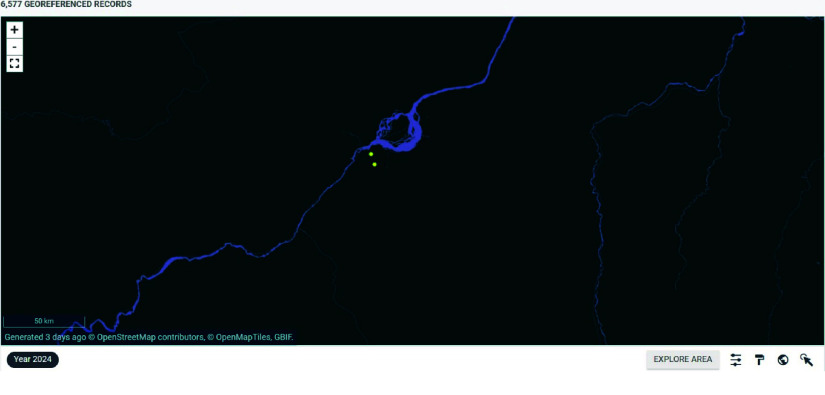 Figure 1
| Species | Sampling methods | ||||
|---|---|---|---|---|---|
| HLC | BG-Sentinel | Prokopack | Larva collected | Total | |
|
| 752 (41.8) | 262 (42.0) | 925 (41.8) | - | 1,939 (29.5) |
|
| 1,046 (58.1) | 362 (58.0) | 1,286 (58.1) | - | 2,694 (41.0) |
|
| 1 (0.1) | - | 1 (0.05) | - | 2 (0.03) |
|
| - | - | - | 1,942 (100) | 1,942 (29.5) |
|
|
|
|
|
|
|
| Location | Habitat | Season | Species | ||||
|---|---|---|---|---|---|---|---|
|
|
|
|
| Total | |||
| Kitambo | Urban | Rainy | 1,048 (40.5) | 774 (29.9) | - | 763 (29.5) | 2,585 (100) |
| Kitambo | Urban | Dry | 372 (52.7) | 125 (17.7) | - | 209 (29.6) | 706 (100) |
| Mont-Ngafula | Peri-urban | Rainy | 448 (16.9) | 1,416 (53.5) | 2 (0.08) | 781 (29.5) | 2,647 (100) |
| Mont-Ngafula | Peri-urban | Dry | 71 (11.1) | 379 (59.3) | - | 189 (29.6) | 639 (100) |
|
| 1,420 (44.4) | 899 (28.1) | - | 972 (27.5) | 3,291 (100) | ||
|
| 519 (15.7) | 1,795 (54.1) | 2 (0.06%) | 970 (29.2) | 3,286 (100) | ||
|
| 1,939 (29.5) | 2,694 (41.0) | 2 (0.03%) | 1,942 (29.5) | 6,577 (100) | ||
- —Bioecology and Vector Control Laboratory
Peer Reviews
No public reviews on file for this paper yet. If you reviewed it on a platform where reviews are public (OpenReview, ICLR, NeurIPS, ICML), you can paste yours below so the community can read it here.
Videos
No videos yet. Explain this paper in a talk, walkthrough, or lecture? Add one.
Taxonomy
TopicsMosquito-borne diseases and control · Dengue and Mosquito Control Research · Malaria Research and Control
Data description
Background and context
The spread of arbovirus vectors, such as Aedes aegypti (Linnaeus, 1762) (Diptera: Culicidea) and Aedes albopictus (Skuse, 1895) (Diptera: Culicidea), is accelerating across Africa, driven by human mobility, expanding transport networks, urbanisation and climate change [1–4]. These species are now established across African countries and have played a major role in the transmission of yellow fever virus, chikungunya virus and dengue virus in Central African countries, such as Cameroon, Gabon, the Central African Republic, the Republic of Congo and the Democratic Republic of Congo (DRC) [5–10].
In the DRC, Ae. aegypti is widespread, whereas Ae. albopictus remains largely restricted to the western regions, where it increasingly displaces Ae. aegypti. These observations are derived from limited entomological studies and global distribution models based on environmental variables, which lack entomological data [11–13]. Furthermore, no nationwide survey has been conducted to determine their distribution in the DRC. In Kinshasa City, the introduction in 2018 has led to the co-occurrence of both species in urban and peri-urban areas, increasing the risk of arbovirus transmission. Ae. aegypti is more common in densely populated urban areas with high building density, where it prefers to reproduce in artificial containers, while Ae. albopictus is more frequent in peri-urban and rural areas, where it prefers to reproduce in containers surrounded by vegetation [11–15].
Here we present recent data on the geographical distribution and abundance of Aedes species across Kinshasa, DRC, collected between January and December 2024.
Methods
General spatial coverage
This study was conducted in two areas with contrasting levels of urbanisation in Kinshasa city (Figure 1): Mont-Ngafula, a peri-urban area in the south-west of the city located between latitude 4°15′S and longitude 15°14′E, and Kitambo, an urban area in the north-west of the city located between latitude 04°20′S and longitude 15°16′E.
Interactive map of the geo-referenced occurrences hosted by GBIF [16]. https://www.gbif.org/dataset/564cd4e6-3682-4513-8b0b-5aa330840427
Mosquito collection
The general taxonomic coverage description for this work is the Culicidae Family, the Aedes genus, specifically Ae. aegypti (commonly known as the yellow fever mosquito; NCBI:txid7159), Ae. albopictus (commonly known as the Asian tiger mosquito or moustique tigre in French; NCBI:txid7160), Ae. vittatus (Bigot, 1861; formerly known as Culex vittatus; NCBI:txid317808), and other Aedes spp. where larval specimens are identified only to the genus level.
Four sampling techniques were used to collect immature and adult stages of Aedes between January 11, 2024, and December 20, 2024, covering both the dry and rainy seasons.
Immature mosquito stages were collected from potential breeding sites and identified to the genus level. For adult mosquitoes, collections were carried out monthly (12 rounds in total) in the two study areas. In each study area, 10 households were sampled using Human landing catches (HLC), 10 with the Prokopack aspirator, and 10 with the BG-Sentinel trap, totalling 30 households per study area (60 households in total) during the study period. All adult specimens were morphologically identified to the species level using taxonomic keys [17].
Larval collection
From January to December 2024, immature stages of Aedes spp. were sampled from domestic, peridomestic, and natural habitats using the dipping technique once a month. Larvae were collected with a standard dipper (350 mL), transferred and stored into jars containing water from their respective breeding sites, and transported to the insectary of the Laboratory of Bioecology and Vector Control (BIOLAV), where they were reared to adulthood under insectary conditions (temperature: 28 ±1 °C; relative humidity: 70–80%; the light:dark photoperiod was 14 h:10 h).
Human landing catches
HLC are a widely used method for directly quantifying human–mosquito contact in entomological surveillance [18]. In this study, Adult Aedes mosquitoes were collected by HLC, with sessions of mosquito capture conducted both indoors and outdoors with two groups of collectors, in two periods of time (6:00 a.m. to 12:00 p.m., and 12:00 p.m. to 6:00 p.m.). At each collection point, a bare-legged, barefoot volunteer served as bait, collecting mosquitoes using hemolysis tubes. Mosquito samples were then transported to the morphological identification unit of the BIOLAV.
Prokopack aspirator
Outdoor-resting Aedes mosquitoes were collected using Prokopack aspirators (Model 140, John W. Hock Co., Gainesville, FL, USA) [19]. Every hour, from 6 a.m. to 6 p.m., targeted sampling of potential exophilic resting sites was conducted both indoors and outdoors, particularly in crowded areas, under shady vegetation, flowers, and aquatic surfaces in aquatic habitats. The collected mosquitoes were placed in small containers labelled by time block and transported to BIOLAV.
BG-Sentinel trap
Although the BG-Sentinel 2 mosquito trap (Biogents Mosquito Monitoring) can operate using mains electricity, the option to run on rechargeable batteries offers a crucial advantage in regions where access to reliable power is limited. Monthly Aedes mosquito collections with the BG-Sentinel 2 were conducted every hour, from 6 a.m. to 6 p.m., both indoors and outdoors.
Quality control description
Fieldwork was supervised by a trained entomology technician, with one focal point per site, to ensure protocol adherence. All equipment was cleaned, inspected, and tested prior to each activity, with batteries charged the day before deployment (Prokopack Aspirator and BG-Sentinel 2). After field and laboratory work, and once digitized, the data was validated using the Integrated Publishing Toolkit (IPT) validator tool available from GBIF [20].
Results
Overall, 6,577 Aedes mosquitoes were collected across all sampling methods (Table 1). Ae. Albopictus was the most abundant species (41.0%, n = 2,694), followed by Ae. aegypti (29.5%, n = 1,939), while Ae. vittatus was rare (0.03%, n = 2). In addition, 1,942 Aedes larvae (29.5%) were collected and not identified to species level. The majority of adult mosquitoes were captured using the prokopack aspirator (n = 2,212) and HLC (n = 1,799), with fewer collected by BG-Sentinel traps (624).
Species composition showed strong contrasts between urban and peri-urban habitats (Table 2). In Kitambo (urban habitat), Ae. aegypti predominated, comprising 40.5% (n = 1,040) of captures during the rainy season and 52.7% (n = 372) in the dry season, whereas Ae. albopictus comprised 29.9% (n = 774) and 17.7% (n = 125) of captures, respectively. Unidentified Ae. spp. contributed nearly one-third of the collections during the rainy season (29.5%, n = 763). By contrast, Mont-Ngafula (peri-urban habitat) was dominated by Ae. albopictus, which accounted for more than half of all specimens in both rainy (53.5%, n = 1,416) and dry (59.3%) seasons.
Re-use potential
The dataset from this study provides various entomological data on Aedes across multiple area types (urban and peri-urban areas) and sampling methods, in Kinshasa, during rainy and dry seasons. It can be directly applied to vector surveillance programmes to identify high-risk areas and track mosquito abundance depending on the season, in both adult and immature stages. The dataset will also support spatial modelling and risk mapping, offering valuable inputs for developing predictive models of Aedes mosquitoes species under varying environmental and climatic conditions in the DRC.
The reference list from the paper itself. Each links out to its DOI / PubMed record.
- 1Bhatt S, Gething P, Brady O The global distribution and burden of dengue. Nature, 2013; 496: 504–507. doi:10.1038/nature 12060.23563266 PMC 3651993 · doi ↗ · pubmed ↗
- 2Garske T, Van Kerkhove M, Yactayo S Yellow fever in Africa: estimating the burden of disease and impact of mass vaccination from outbreak and serological data. P Lo S Med., 2014; 11(5): e 1001638. doi:10.1371/journal.pmed.1001638.24800812 PMC 4011853 · doi ↗ · pubmed ↗
- 3Jaenisch T, Junghans T, Wills B Dengue expansion in Africa-not recognized or not happening? Emerg. Infect. Dis., 2014; 20(10): e 140487. doi:10.3201/eid 2010.140487.25271370 PMC 4193177 · doi ↗ · pubmed ↗
- 4Kraemer M, Reiner R, Brady O Past and future spread of the arbovirus vectors Aedes aegypti and Aedes albopictus . Nat. Microbiol., 2019; 4(5): 854–863. doi:10.1038/s 41564-019-0376-y.30833735 PMC 6522366 · doi ↗ · pubmed ↗
- 5Fontenille D, Toto J. Aedes (Stegomyia) albopictus (Skuse), a potential new dengue vector in southern Cameroon. Emerg. Infect. Dis., 2001; 7(6): 1066–1067. doi:10.3201/eid 0706.010631.11747746 PMC 2631913 · doi ↗ · pubmed ↗
- 6Pagès F, Peyrefitte C, Mve M Aedes albopictus mosquito: the main vector of the 2007 Chikungunya outbreak in Gabon. P Lo S One, 2009; 4(3): e 4691. doi:10.1371/journal.pone.0004691.19259263 PMC 2649504 · doi ↗ · pubmed ↗
- 7Diallo M, Laganier R, Nangouma A. First record of Aedes albopictus (Skuse 1894), in Central African Republic. Trop. Med. Int. Health, 2010; 15(10): 1185–1189. doi:10.1111/j.1365-3156.2010.02594.x.20831673 · doi ↗ · pubmed ↗
- 8Kelvin A. Outbreak of chikungunya in the Republic of Congo and the global picture. J. Infect. Dev. Ctries, 2011; 5: 441–444. doi:10.3855/jidc.2171.21727642 · doi ↗ · pubmed ↗