Accelerated Intermittent Theta Burst Stimulation Combined with Balance Training Improves Balance in an Individual with Corticobasal Syndrome
Karishma R. Ramdeo, Stevie D. Foglia, Malaikah Ahmad, Nafia Al‐Mutawaly, Justin Lee, Robert Chen, Aimee J. Nelson

Abstract
Genes, proteins, chemicals, diseases, species, mutations and cell lines named across the full text — each resolved to its canonical identifier and authoritative record.
Click any figure to enlarge with its caption.
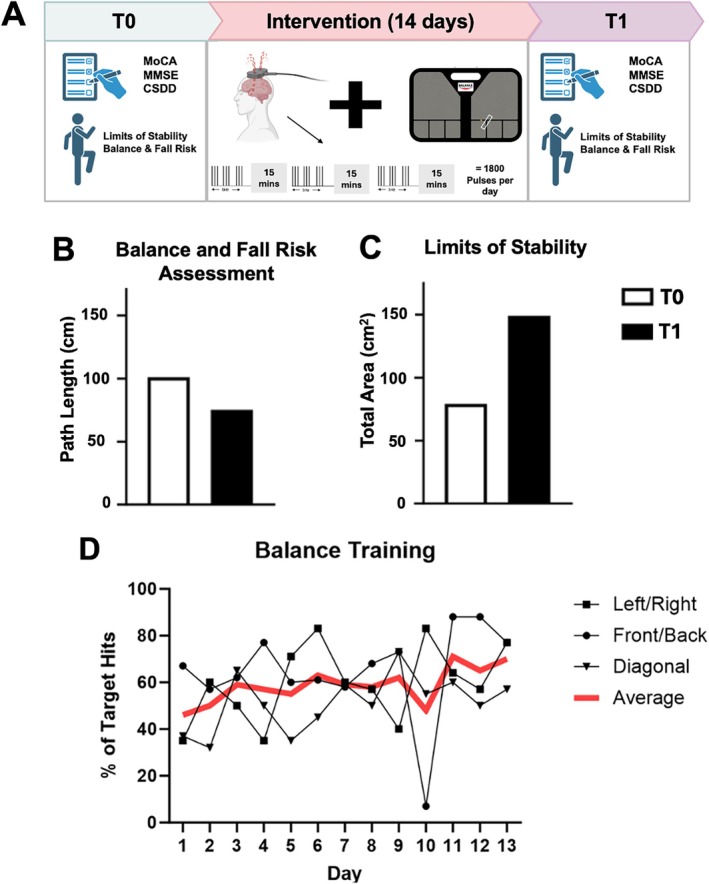 Figure 1
- —Canada Research Chair
Peer Reviews
No public reviews on file for this paper yet. If you reviewed it on a platform where reviews are public (OpenReview, ICLR, NeurIPS, ICML), you can paste yours below so the community can read it here.
Videos
No videos yet. Explain this paper in a talk, walkthrough, or lecture? Add one.
Taxonomy
TopicsTranscranial Magnetic Stimulation Studies · Pain Management and Treatment · Advanced Neuroimaging Techniques and Applications
Intermittent theta burst stimulation (iTBS) is an effective intervention for balance recovery when delivered over primary motor cortex (M1).1 Accelerated iTBS (aiTBS) delivers multiple sessions of iTBS spaced approximately one‐hour apart.2 aiTBS has antidepressant efficacy in major depressive disorder3 and improves memory in Alzheimer's disease.3 Here, we combine aiTBS with balance training. aiTBS was intended to prime M1 to enhance the opportunity for motor learning.4
Herein we report a 77‐year‐old female with corticobasal syndrome for 2 years, with left hand “alien limb” phenomenon, left‐hand dystonia, and sensory loss in left upper limb. At the time of diagnosis, the MoCA indicated 18/30. The individual was taking donepezil (10 mg), atorvastatin, telmisartan, furosemide, bisoprolol fumarate, empagliflozin, and acetylsalicylic acid.
Balance and cognition were measured 2 days before and following aiTBS and balance training (Fig. 1A). Using the BTracks System (Balance Tracking Systems Inc., USA), we assessed static balance impairments and fall risk. These data include the center of pressure (COP) path length from three 20‐second trials. The Limits of Stability protocol measures dynamic balance based on the size of the functional base of support. Cognitive performance was assessed using the Mini Mental State Examination (MMSE), Montreal Cognitive Assessment (MoCA) and Cornell Scale for Depression in Dementia (CSDD).3
aiTBS was delivered over the motor hotspot of abductor pollicis brevis muscle representation of the left primary motor cortex, ipsilateral to upper limb exhibiting alien limb phenomenon and dystonia, (Magstim Rapid 2, UK) with 90 mm diameter figure‐eight coil. aiTBS delivered three iTBS sessions separated by 15‐minutes3 (Fig. 1A). iTBS consisted of 600 stimuli delivered in 50 Hz bursts of 3 pulses at 80% of the resting motor threshold, (1800 stimuli per day)3 repeated for 14 consecutive days. Immediately following aiTBS, ~10 minutes of balance training was performed on the BTtracks system by having the individual move their COP to target zones displayed on the computer. Performance is based on the percentage of targets obtained within a session.
The participant completed all brain stimulation sessions (three sessions per day x 14 days) and 93% of balance training sessions. aiTBS was well tolerated. Results show an increase in the Limits of Stability by 88% (Fig. 1C) and a decrease in the Balance and Fall risk by 26% (Fig. 1B). A 35% increase in MMSE was observed following the intervention which exceeds the clinically meaningful improvement5 of 3 points (MMSE pre = 20, post = 27). Changes in MoCA are not clinically significant^5^ (MoCA pre = 18, post = 16). These data suggest improvements in attention‐related functions as reflected in MMSE without meaningful gains in executive or complex cognitive tasks as captured by MoCA. CSSD scores decreased by ~75% following the intervention (pre = 4, post = 1).
This is the first reported use of aiTBS in an individual with a Parkinson‐plus disorder. Limitations of the current research include the participant's use of donepezil, a cholinesterase inhibitor, which may influence cognitive scores. Additionally, the absence of a control condition limits the ability to isolate the effects of the intervention. Further, it would be beneficial to determine the longevity of the intervention by including a longer term follow up. This report provides insight into the potential clinical utility of aiTBS plus balance training to improve Parkinson‐plus disorder symptoms.
Author Roles
Research project: A. Conception, B. Organization, C. Execution; Statistical Analysis: A. Design, B. Execution, C. Review and Critique; Manuscript Preparation: A. Writing of the first draft, B. Review and Critique;
K.R.: 1A, 1B, 1C, 2A, 2B, 2C, 3A, 3B.
S.F.: 3B.
M.A.: 1C, 3B.
N.A.‐M.: 3B.
J.L.: 3B.
R.C.: 3B.
A.N.: 1A, 1B, 1C, 2A, 2B, 2C, 3A, 3B.
Disclosures
Ethical Compliance Statement: This research study was revied by the Hamilton Integrated Research Ethics Board. Written and oral consent was obtained for this work. We confirm that we have read the Journal's position on issues involved in ethical publication and affirm that this work is consistent with those guidelines.
Funding Sources and Conflict of Interest: This work was supported by Canada Research Chair funds to AJN. NA‐M is the president of Ressam Gardens Memory Care Community where the research was conducted.
Financial Disclosure for the previous 12 months: The authors declare that there are no additional disclosures to report.
Conflict of Interest
NA‐M is the president of Ressam Gardens Memory Care Community where the research was conducted.
Funding
This work was supported by Canada Research Chair funds to AJN.
The reference list from the paper itself. Each links out to its DOI / PubMed record.
- 1Liao LY , Zhu Y , Peng QY , et al. Intermittent theta‐burst stimulation for stroke: primary motor cortex versus cerebellar stimulation: a randomized sham‐controlled trial. Stroke 2024;55:165. 10.1161/STROKEAHA.123.044892.38037225 · doi ↗ · pubmed ↗
- 2Cole EJ , Stimpson KH , Bentzley BS , et al. Stanford accelerated intelligent neuromodulation therapy for treatment‐resistant depression. Am J Psychiatry 2020;177(8):716–726.32252538 10.1176/appi.ajp.2019.19070720 · doi ↗ · pubmed ↗
- 3Wu X , Ji GJ , Geng Z , et al. Accelerated intermittent theta‐burst stimulation broadly ameliorates symptoms and cognition in Alzheimer's disease: a randomized controlled trial. Brain Stimul 2022;15:35–45. 10.1016/j.brs.2021.11.007.34752934 · doi ↗ · pubmed ↗
- 4Fang JH , Chen JJ , Hwang IS , Huang YZ . Repetitive transcranial magnetic stimulation over the human primary motor cortex for modulating motor control and motor learning. J Med Biol Eng 2010;30:193–201.
- 5Feeney J , Savva GM , O'Regan C , King‐Kallimanis B , Cronin H , Kenny RA . Measurement error, reliability, and minimum detectable change in the mini‐mental state examination, Montreal cognitive assessment, and color trails test among community living middle‐aged and older adults. J Alzheimers Dis 2016;53(3):1107–1114.27258421 10.3233/JAD-160248 · doi ↗ · pubmed ↗