Enhancing emergency medical education and training: Performance under pressure
Nadja Spitznagel, Benjamin Gordon, Stephan Hearns, Dominik Hinzmann, Patrick Meybohm, Oliver Happel, Carlos Hölzing

TL;DR
This paper explores a workshop designed to help emergency physicians manage stress and improve performance in high-pressure situations.
Contribution
The study introduces a blended-learning workshop to enhance stress management skills among emergency physicians.
Findings
Participants reported high psychological stress in their work environments.
The workshop improved participants' ability to cope with stress in emergency situations.
Participants felt the workshop techniques were applicable in clinical practice.
Abstract
Continuous development of professional skills is particularly relevant for emergency physicians because of the daily stress and high-pressure working conditions they face. Nevertheless, workshops that provide practical exercises for better handling these working conditions, especially for emergency physicians, are rare. The present workshop was designed as a part of a pilot project with a blended-learning approach. It lasted for 10 hours and took place over 1.5 days. Twenty-five emergency physicians took part: 22 from anesthesia and one participant each from trauma surgery, general surgery, and radiology. Both before and after the workshop, the participants were asked to assess and describe their experiences with this and similar workshops. The pre-workshop survey revealed that all the emergency physicians had already been in situations with high psychological pressure. They rated the…
Genes, proteins, chemicals, diseases, species, mutations and cell lines named across the full text — each resolved to its canonical identifier and authoritative record.
Click any figure to enlarge with its caption.
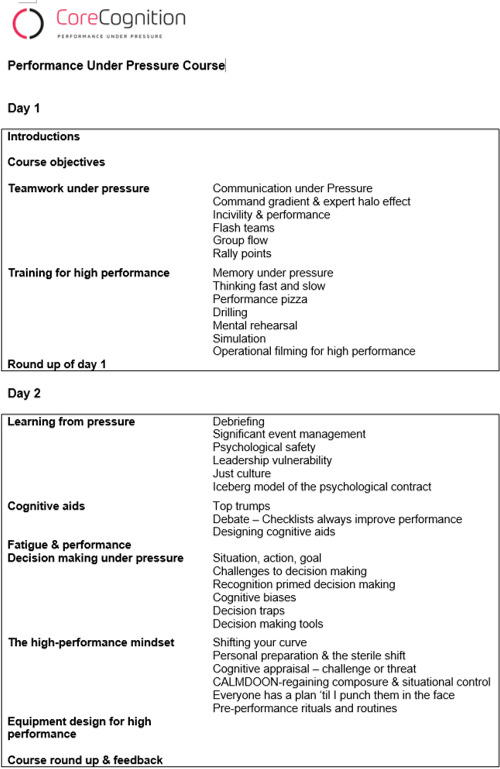 Figure 1
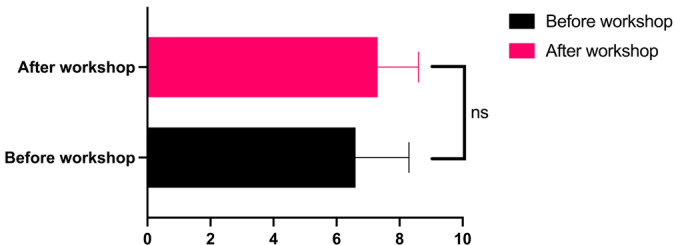 Figure 2
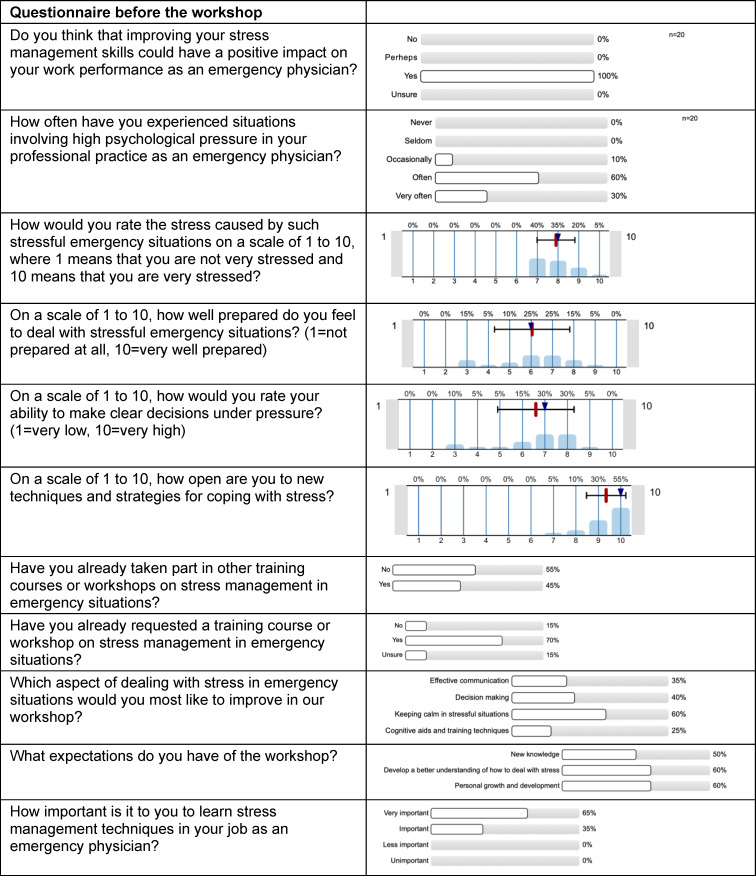 Figure 3
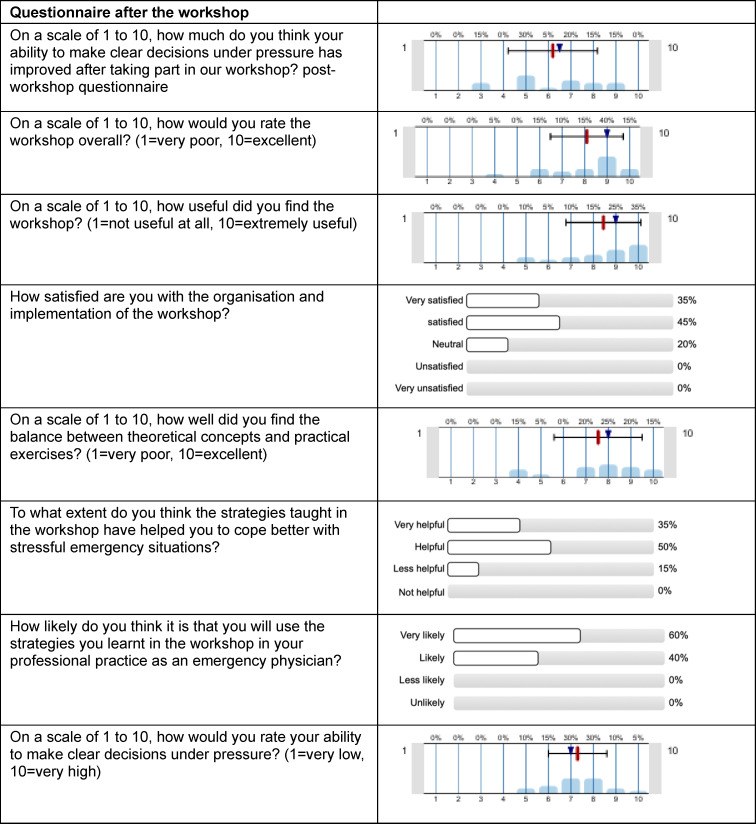 Figure 4
Peer Reviews
No public reviews on file for this paper yet. If you reviewed it on a platform where reviews are public (OpenReview, ICLR, NeurIPS, ICML), you can paste yours below so the community can read it here.
Videos
No videos yet. Explain this paper in a talk, walkthrough, or lecture? Add one.
Taxonomy
TopicsEmergency and Acute Care Studies · Nursing Roles and Practices
1. Context and objective
Continuing education and training is essential for medical professionals. In particular, emergency physicians are constantly exposed to stressful situations in their working environment, which requires them to act quickly and correctly. These situations represent a constant physical and psychological burden that must be dealt with in everyday working life. Current training courses often focus on technical skills and their further development. However, to meet the specific requirements of one’s profession, it is necessary to offer supplementary courses and supplement existing ones [1], [2], [3]. With this in mind, a workshop was designed to better prepare emergency physicians for their daily challenges and to deal with pressure situations. In terms of content, the course includes strategies for optimizing individual and organizational performance. Various aspects are covered, including the psychology of stress and decision-making, the influence of fatigue and environmental factors, and how cognitive biases can be managed. The workshop also shows how organizations can foster high-performance cultures through targeted leadership, corporate culture, and team selection. Practical techniques for coping with pressure include communication strategies, cognitive tools such as checklists, and measures for effective teamwork. Another focus is on targeted preparation through mental training (see figure 1 (Fig. 1)).
2. Implementation
The present workshop is based on the theoretical principles and concepts from the book “emergency mind” by Dan Dworkis and the “core cognition” approach by Dr. Stephen Hearns. The workshop was developed and offered as a 1.5-day (10 hour) event using a blended-learning concept. It included theoretical foundations as well as group work and practical exercises on the physiological effects of pressure on clinical performance, effective communication in stressful situations, critical decision-making, maintaining one’s calm and composure, and the use and development of cognitive tools. The structure and content of the curriculum are shown in figure 1 (Fig. 1). Specifically, the aim is to understand how stress and pressure affect performance and then to learn techniques for maintaining composure and control in critical situations. In addition, the development and reinforcement of core values and an understanding of cognitive bias are taught in order to improve performance and the approach to handling errors.
3. Evaluation
The evaluation was carried out using a two-part questionnaire. The first part of the questionnaire was completed after the course materials had been sent out and before the start of the first learning unit in the seminar room. The second part was completed in the seminar room after completing the last learning unit. The questionnaire consists of a general part (A) and a specific part (B). The questions were intended to record the expectations from the workshop, personal experiences with psychological pressure in emergency situations, and the resulting stress and experiences with previous training measures before the start of the workshop. After completion of the workshop, feedback on the experience with the course content, satisfaction and subjectively perceived improvement in skills was recorded.
4. Survey results
4.1. Survey results before the workshop
The results of the pre-workshop survey are summarized in table 1 (Tab. 1). All participants stated that improving their stress management skills would positively affect their work performance as emergency physicians. In response to the question “How often have you experienced situations involving high psychological pressure in your professional practice as an emergency physician?” 10% of respondents answered “occasionally”; 60% answered, “frequently”; and 30% answered, “very frequently” (5-point Likert scale: 1=never, 5=very frequently). In rating the stress caused by such stressful emergency situations, participants averaged a score of 7.9 ± 0.9 points (median=8; scale: 1=somewhat stressful, 10=severely stressful). In rating their own preparation for stressful emergency situations, they averaged a score of 6.1±1.8 points (median=6; scale: 1=not prepared at all, 10=very well prepared). In assessing their own ability to make clear decisions under pressure, participants averaged a score of 6.6±1.7 points (median=7; scale: 1=very low, 10=very high). They averaged 9.4±0.9 points (median=10; scale: 1=very low, 10=very open) in rating their openness to new techniques and strategies for coping with stress. Overall, 70% of respondents had already expressed a desire to take part in a workshop on coping with stress in emergency situations. When asked which aspect of dealing with stress in emergency situations should be improved the most in the workshop, 60% of participants responded that they considered the ability to maintain their calm and composure in stressful situations to be the most important aspect.
4.2. Survey results after the workshop
Table 2 (Tab. 2) shows the results of the post-workshop survey. In assessing the improvement in their ability to make clear decisions under pressure, participants scored an average of 6.2±2.0 (median=6.5). Their overall assessment of the workshop averaged 8.1±1.6 (scale: 10=excellent). In responding to the question “How useful did you find the workshop?” (1=not at all useful, 10=extremely useful), participants assigned an average rating of 8.5±1.7. A total of 85% of respondents stated that the strategies taught in the workshop helped or greatly helped them cope better with stressful emergency situations. All participants stated that they were likely to apply the strategies learned in the workshop in their professional practice as emergency physicians. In a post-workshop assessment of their own ability to make clear decisions under pressure, participants scored an average of 7.3±1.3 (median=7; scale: 10=very high), indicating an improvement compared with pre-workshop assessments, even if the difference was not statistically significant (see figure 2 (Fig. 2)).
5. Outlook
This pilot project underlines the interest of emergency physicians in learning techniques and strategies for coping with stress in emergency situations. The results of the post-workshop survey show that participants felt they had benefited from the workshop and the techniques they learned to manage psychological pressure in emergency situations and apply them in clinical practice. Existing CRM/TRM course formats already provide important foundations for working in high-pressure situations. The course described here specifically expands this approach to include individual, personality-oriented components that emergency physicians need in order to remain capable of acting even in extremely demanding situations. Future studies need to demonstrate the benefits of this workshop as a part of the training curriculum for emergency physicians at scale.
Authors’ ORCIDs
- Nadja Spitznagel: [0000-0002-3139-8977]
- Dominik Hinzmann: [0000-0001-5943-352X]
- Patrick Meybohm: [0000-0002-2666-8696]
- Oliver Happel: [0000-0001-7320-8521]
- Carlos Hölzing: [0000-0002-3732-6544]
Competing interests
The authors declare that they have no competing interests.
The reference list from the paper itself. Each links out to its DOI / PubMed record.
- 1Cydulka RK Emerman CL Shade B Kubincanek J Stress levels in EMS personnel: a national survey Prehosp Disaster Med 199712213614010.1017/S 1049023 X 0003742010186997 · doi ↗ · pubmed ↗
- 2Dworkis D The Emergency Mind: Wiring Your Brain for Performance Under Pressure 2021 Independently published
- 3Guise J Hansen MO'Brien K Dickinson C Meckler G Engle P Lambert W Jui J Emergency medical services responders’ perceptions of the effect of stress and anxiety on patient safety in the out-of-hospital emergency care of children: a qualitative study BMJ Open 201772 e 01405710.1136/bmjopen-2016-014057 PMC 533774528246139 · doi ↗ · pubmed ↗
- 4Harvey A Nathens AB Bandiera G Leblanc VR Threat and challenge: cognitive appraisal and stress responses in simulated trauma resuscitations Med Educ 201044658759410.1111/j.1365-2923.2010.03634.x 20604855 · doi ↗ · pubmed ↗
- 5Hearns S Peak Performance under Pressure: Lessons from a Helicopter Rescue Doctor 2019 Independent Publishing Network
- 6Ignacio J Dolmans D Scherpbier A Rethans JJ Lopez V Liaw SY Development, implementation, and evaluation of a mental rehearsal strategy to improve clinical performance and reduce stress: A mixed methods study Nurse Educ Today 201637273210.1016/j.nedt.2015.11.00226602239 · doi ↗ · pubmed ↗
- 7Le Blanc VR Regehr C Tavares W Scott AK Mac Donald R King K The Impact of Stress on Paramedic Performance During Simulated Critical Events Prehosp Disaster Med 201227436937410.1017/S 1049023 X 1200102122831965 · doi ↗ · pubmed ↗