Design of Residual Stress-Balanced Transferable Encapsulation Platform Using Urethane-Based Polymer Superstrate for Reliable Wearable Electronics
Sung-Hun Jo, Donghwan Kim, Chaewon Park, Eun Gyo Jeong

TL;DR
This paper introduces a new encapsulation design for wearable electronics that improves durability and reliability by balancing residual stress using a urethane-based polymer and inorganic layers.
Contribution
The novel contribution is a stress-balanced encapsulation platform using p(IEM-co-HEMA) and SiO2 to enhance barrier performance and mechanical reliability in ultrathin wearable devices.
Findings
The WVTR was reduced to 3.75 × 10⁻⁵ g/m2/day with a stress-balanced design, an order-of-magnitude improvement.
OLEDs on the platform maintained efficiency and stable emission for over 20 days in ambient storage.
The platform achieved LT80 lifetimes of 140–190 h at 400 cd/m2 after water-assisted transfer and on-skin deformation.
Abstract
Wearable and skin-mounted electronics demand encapsulation designs that simultaneously provide strong barrier performance, mechanical reliability, and transferability under ultrathin conditions. In this study, a residual stress-balanced transferable encapsulation platform was developed by integrating a urethane-based copolymer superstrate [p(IEM-co-HEMA)] with inorganic thin films. The polymer, deposited via initiated chemical vapor deposition (iCVD), offered over 90% optical transmittance, low RMS roughness (1–3 nm), and excellent solvent resistance, providing a stable base for inorganic barrier integration. An ALD Al2O3/ZnO nano-stratified barrier initially delivered effective moisture blocking, but tensile stress accumulation imposed a critical thickness of 30 nm, where the WVTR plateaued at ~2.5 × 10⁻⁴ g/m2/day. To overcome this limitation, a 40 nm e-beam SiO2 capping layer was…
Genes, proteins, chemicals, diseases, species, mutations and cell lines named across the full text — each resolved to its canonical identifier and authoritative record.
Click any figure to enlarge with its caption.
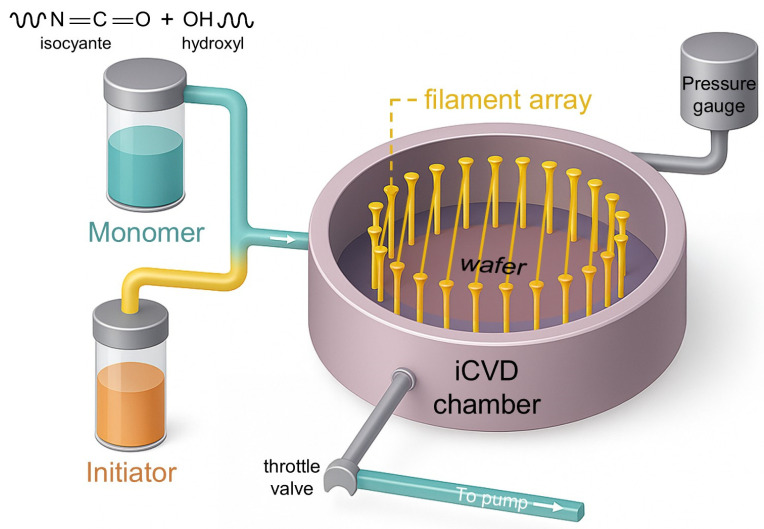 Figure 1
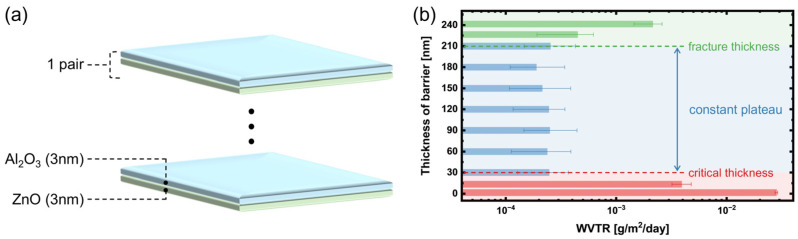 Figure 2
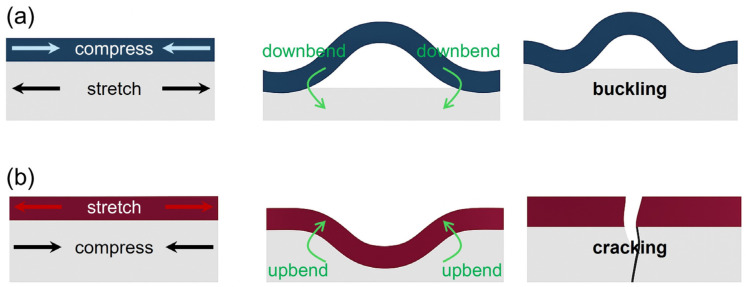 Figure 3
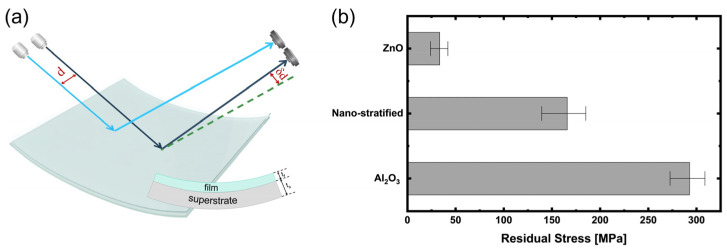 Figure 4
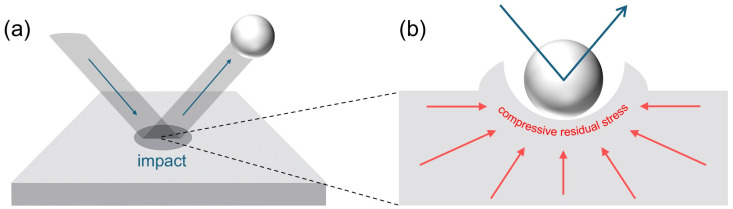 Figure 5
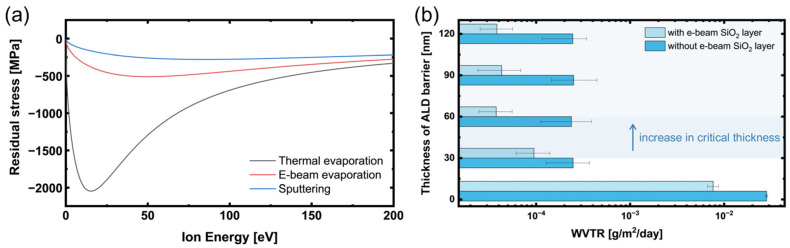 Figure 6
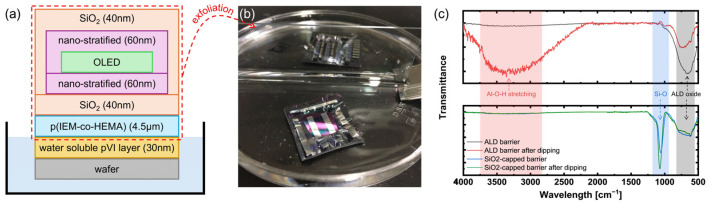 Figure 7
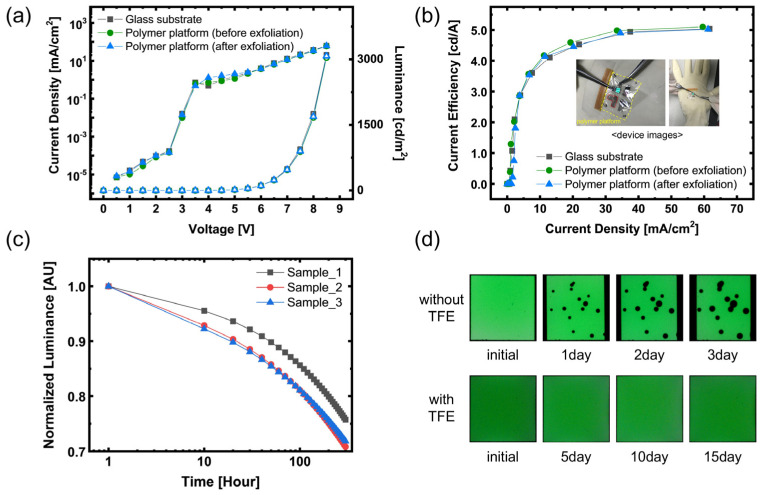 Figure 8
Peer Reviews
No public reviews on file for this paper yet. If you reviewed it on a platform where reviews are public (OpenReview, ICLR, NeurIPS, ICML), you can paste yours below so the community can read it here.
Videos
No videos yet. Explain this paper in a talk, walkthrough, or lecture? Add one.
Taxonomy
TopicsAdvanced Sensor and Energy Harvesting Materials · Organic Light-Emitting Diodes Research · Conducting polymers and applications