Molecular Mechanisms of Silicone Network Formation: Bridging Scales from Curing Reactions to Percolation and Entanglement Analyses
Pascal Puhlmann, Dirk Zahn

TL;DR
This paper explores how silicone networks form at the molecular level, linking chemical reactions to structural properties using simulations and graph theory.
Contribution
The study bridges atomic-scale simulations with percolation and entanglement analyses to understand silicone network formation.
Findings
Silicone networks with 98–99% curing degree were modeled at different crosslinker contents.
3D percolation and branching characteristics of the networks were analyzed using graph theory.
Structural details were connected to experimental properties like elasticity and heat of formation.
Abstract
The curing of silicone networks from dimethylsilanediol and methylsilanetriol chainbuilder–crosslinker precursor mixtures is investigated from combined quantum/molecular mechanics simulations. Upon screening different crosslinker content from 5 to 15%, we provide a series of atomic-resolution bulk models all featuring 98–99% curing degree, albeit at rather different arrangement of the chains and nodes, respectively. To elucidate the nm scale alignment of the polymer networks, we bridge scales from atomic simulation cells to graph theory and demonstrate the analyses of 3-dimensional percolation of -O-Si-O- bonds, polydimethylsiloxane branching characteristics and the interpenetration of loops. Our findings are discussed in the context of the available experimental data to relate heat of formation, curing degree and elastic properties to the molecular scale structural details—thus…
Genes, proteins, chemicals, diseases, species, mutations and cell lines named across the full text — each resolved to its canonical identifier and authoritative record.
Click any figure to enlarge with its caption.
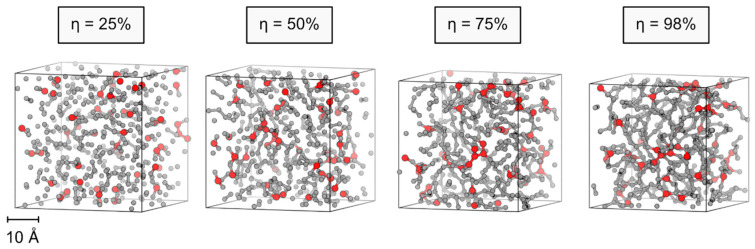 Figure 1
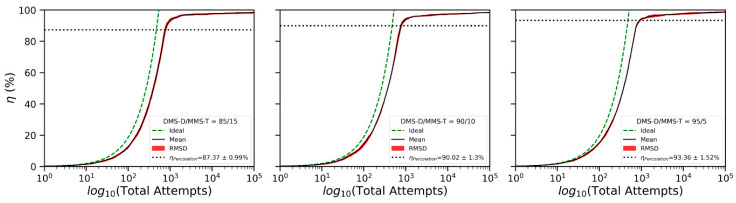 Figure 2
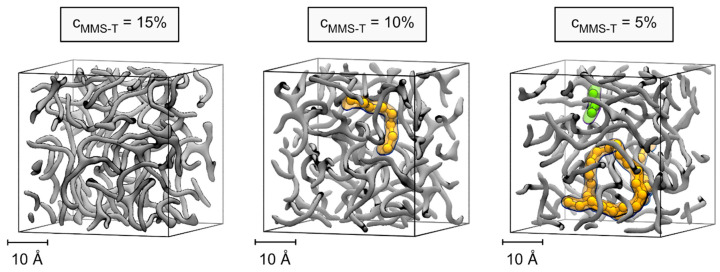 Figure 3
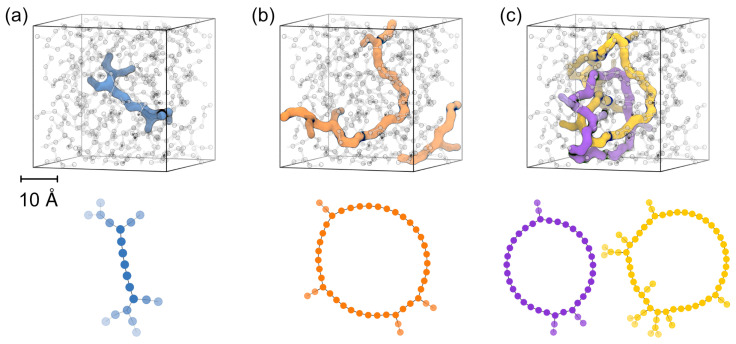 Figure 4
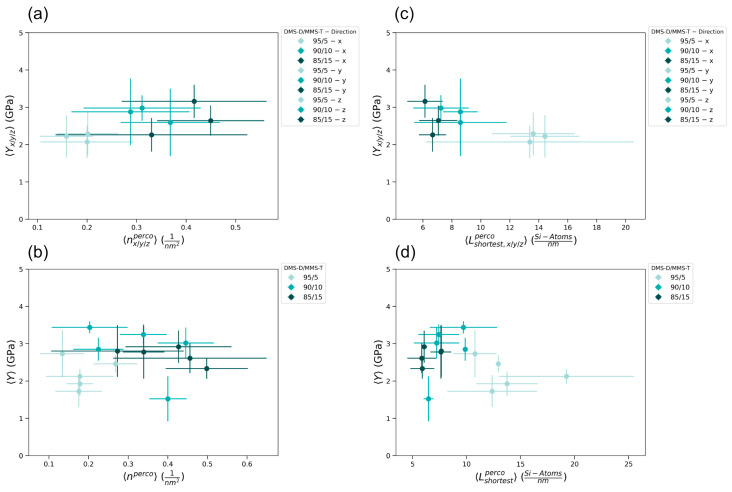 Figure 5
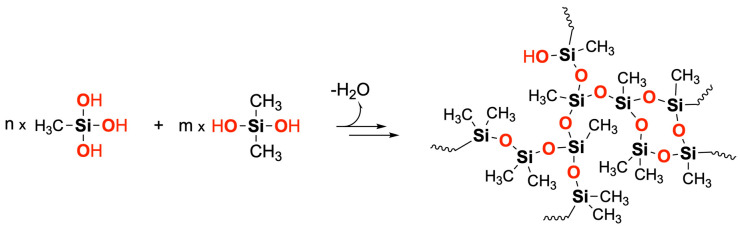 Figure 6
Peer Reviews
No public reviews on file for this paper yet. If you reviewed it on a platform where reviews are public (OpenReview, ICLR, NeurIPS, ICML), you can paste yours below so the community can read it here.
Videos
No videos yet. Explain this paper in a talk, walkthrough, or lecture? Add one.
Taxonomy
TopicsCarbon Nanotubes in Composites · Force Microscopy Techniques and Applications · Advanced Fluorescence Microscopy Techniques