Artificial Intelligence-Powered Interpretation of Corneal Epithelial Maps: A Comparative Pilot Study of ChatGPT, Google Gemini, and Microsoft Bing
Ruchi Shukla, Aparajita Shukla, Ashutosh K Mishra, Pragati Garg, Nilakshi Banerjee, Swarastra P Singh, Shrinkhal

TL;DR
This study compares how well ChatGPT, Google Gemini, and Microsoft Bing interpret corneal thickness maps for eye diseases like keratoconus and pterygium.
Contribution
The study introduces a novel evaluation of generative AI models for interpreting corneal epithelial thickness maps in diagnosing ocular surface disorders.
Findings
ChatGPT 4.0 achieved the highest diagnostic accuracy (80%) and clinical appropriateness (87%) among the tested AI models.
Google Gemini and Microsoft Bing showed lower performance with 60% and 53% diagnostic accuracy, respectively.
ChatGPT's clinical recommendations aligned with standard protocols in 87% of cases.
Abstract
Background This study aimed to compare the diagnostic interpretation accuracy and clinical suitability of three generative artificial intelligence (AI) models, i.e., ChatGPT 4.0, Google Gemini, and Microsoft Bing, in analyzing corneal epithelial thickness (CET) data across key ocular surface disorders, including keratoconus, vernal keratoconjunctivitis (VKC), and nasal pterygium. Methodology Standardized case scenarios with corresponding CET mapping data were constructed and input into all three AI platforms with the following query: “Evaluate the given CET map and provide the most likely diagnosis and appropriate clinical recommendation.” Responses were independently graded by a panel of three ophthalmologists for diagnostic accuracy and clinical appropriateness. Cases were selected based on known CET signature patterns derived from the literature, including doughnut patterns in…
Genes, proteins, chemicals, diseases, species, mutations and cell lines named across the full text — each resolved to its canonical identifier and authoritative record.
Click any figure to enlarge with its caption.
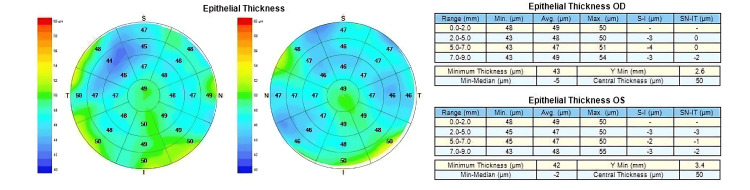 Figure 1
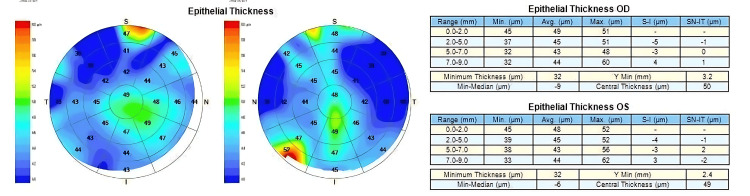 Figure 2
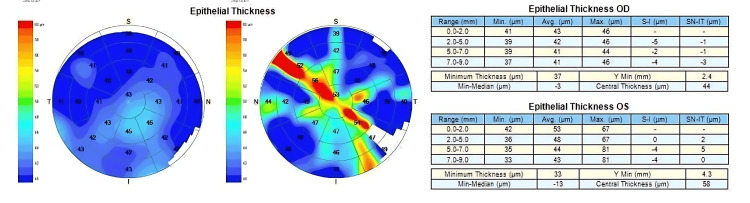 Figure 3
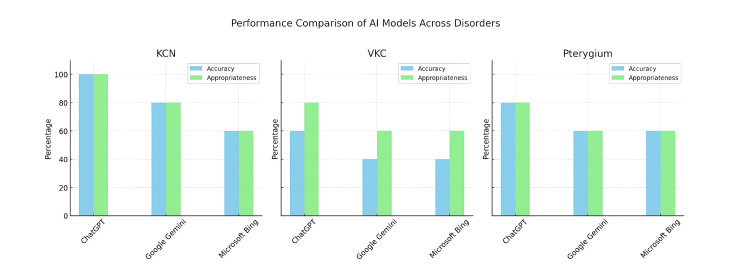 Figure 4
Peer Reviews
No public reviews on file for this paper yet. If you reviewed it on a platform where reviews are public (OpenReview, ICLR, NeurIPS, ICML), you can paste yours below so the community can read it here.
Videos
No videos yet. Explain this paper in a talk, walkthrough, or lecture? Add one.
Taxonomy
TopicsRetinal Imaging and Analysis · Corneal surgery and disorders · Retinopathy of Prematurity Studies