Thermal Stability of Color Centers in Lithium Fluoride Crystals Irradiated with Electrons and N, O, Kr, U Ions
Zhadra Malikova, Zhakyp T. Karipbayev, Abdirash Akilbekov, Alma Dauletbekova, Anatoli I. Popov, Vladimir N. Kuzovkov, Ainash Abdrakhmetova, Alyona Russakova, Muratbek Baizhumanov

TL;DR
This paper studies how radiation creates defects in lithium fluoride crystals and how these defects behave when heated.
Contribution
The study reveals a strong correlation between activation energy and pre-exponential factor in defect migration during thermal annealing.
Findings
Radiation-induced defects in LiF show different activation energies for interstitial migration depending on irradiation type.
Activation energy and pre-exponential factor decrease with increasing irradiation dose, enhancing defect diffusion.
Computer modeling of annealing processes aligns with observed thermal stability trends.
Abstract
Lithium fluoride (LiF) crystals are widely employed both as optical windows transparent in the ultraviolet spectral region and as efficient personal dosimeters, with their application scope recently expanding into lithium-ion technologies. Moreover, as an alkali halide crystal (AHC), LiF serves as a model system for studying and simulating radiation effects in solids. This work identifies radiation-induced defects formed in lithium fluoride upon irradiation with swift heavy ion beams (N, O, Kr, U) and intense pulsed electron beams, investigates their thermal stability, and performs computer modeling of annealing processes. The theoretical analysis of existing experimental kinetics for F-centers induced by electron and heavy ion irradiation reveals considerable differences in the activation energies for interstitial migration. A strong correlation between the activation energy Ea and the…
Genes, proteins, chemicals, diseases, species, mutations and cell lines named across the full text — each resolved to its canonical identifier and authoritative record.
Click any figure to enlarge with its caption.
 Figure 1
 Figure 2
 Figure 3
 Figure 4
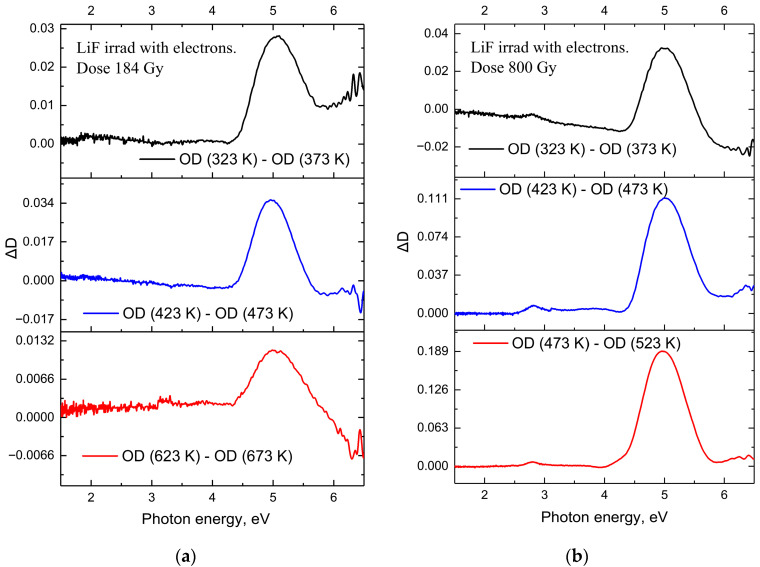 Figure 5
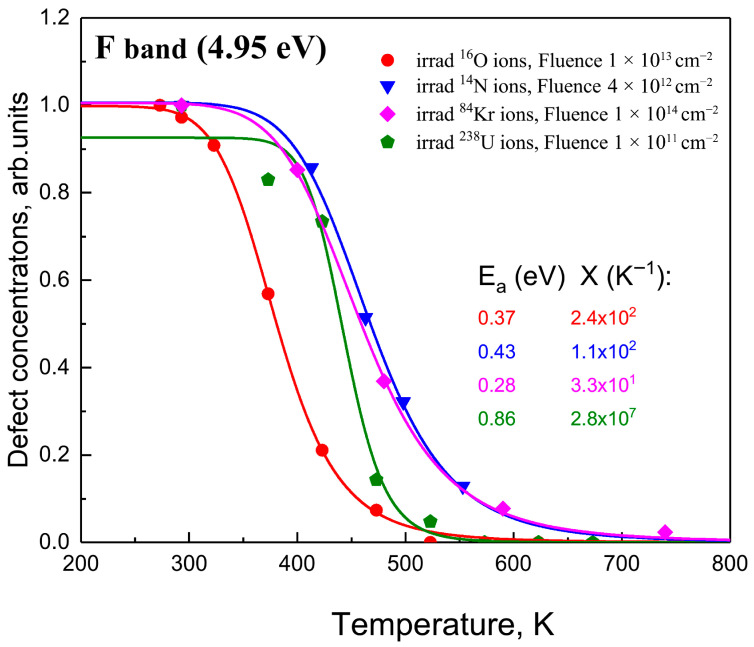 Figure 6
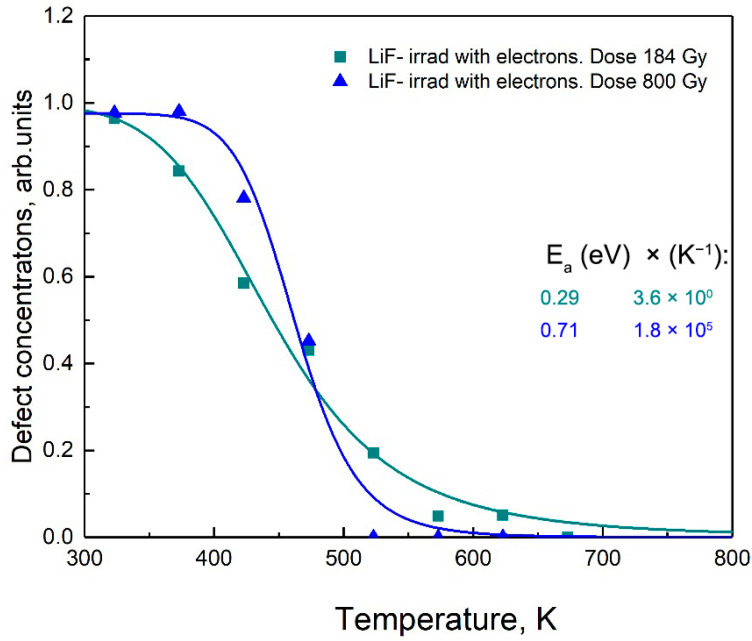 Figure 7
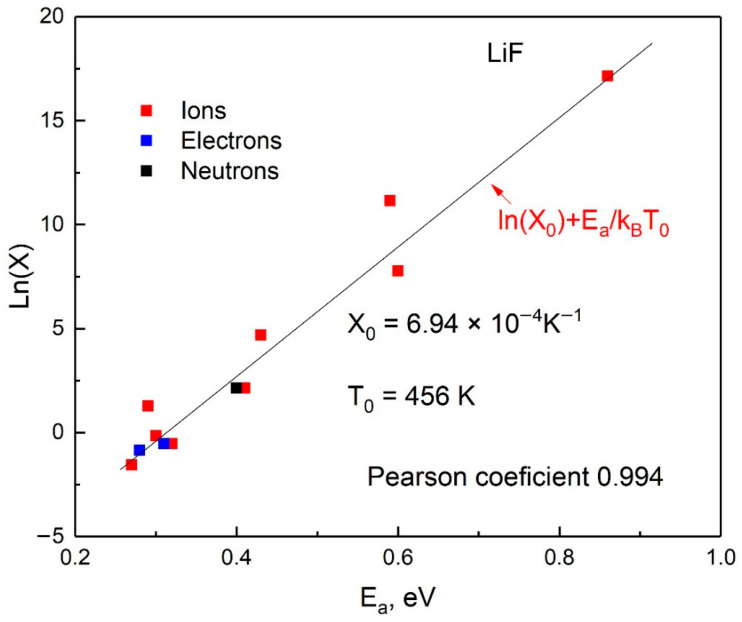 Figure 8
Peer Reviews
No public reviews on file for this paper yet. If you reviewed it on a platform where reviews are public (OpenReview, ICLR, NeurIPS, ICML), you can paste yours below so the community can read it here.
Videos
No videos yet. Explain this paper in a talk, walkthrough, or lecture? Add one.
Taxonomy
TopicsSemiconductor materials and devices · Ion-surface interactions and analysis · Ga2O3 and related materials