Color-Tunable and Efficient CsPbBr3 Photovoltaics Enabled by a Triple-Functional P3HT Modification
Yanan Zhang, Zhizhe Wang, Dazheng Chen, Tongwanming Zheng, Menglin Yan, Yibing He, Zihao Wang, Weihang Zhang, Chunfu Zhang

TL;DR
Scientists improved the performance of CsPbBr3 solar cells by using a special polymer that enhances light absorption, improves energy transfer, and stabilizes the material.
Contribution
A triple-functional P3HT modifier was introduced to enhance CsPbBr3 solar cells with tunable color and improved efficiency.
Findings
P3HT acted as an assistant photoactive layer, enhancing light absorption and broadening the spectrum response.
P3HT improved hole transport and formed stable Pb-S bonds, acting as a defect passivator.
Optimal P3HT concentration increased power conversion efficiency from 6.86% to 8.71% with better stability.
Abstract
All inorganic CsPbBr3 possesses ideal stability in halide perovskites, but its wide bandgap and relatively poor film quality seriously limit the performance enhancement and possible applications of perovskite solar cells (PSCs). In this work, a triple-functional poly(3-Hexylthiophene) (P3HT) modifier was introduced to realize color-tunable semi-transparent CsPbBr3 PSCs. From the optical perspective, the P3HT acted as the assistant photoactive layer, enhanced the light absorption capacity of the CsPbBr3 film, and broadened the spectrum response range of devices. In view of the hole transport layer, P3HT modified the energy level matching between the CsPbBr3/anode interface and facilitated the hole transport. Simultaneously, the S− in P3HT formed a more stable Pb-S bond with the uncoordinated Pb2+ on the surface of CsPbBr3 and played the role of a defect passivator. As the P3HT…
Genes, proteins, chemicals, diseases, species, mutations and cell lines named across the full text — each resolved to its canonical identifier and authoritative record.
Click any figure to enlarge with its caption.
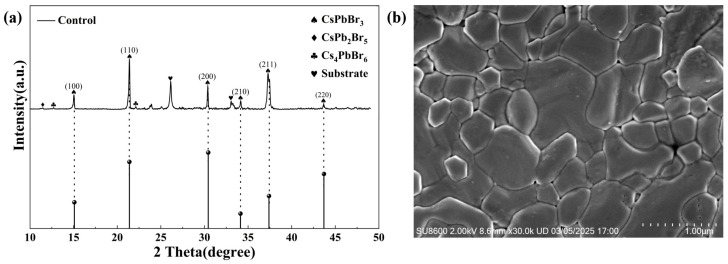 Figure 1
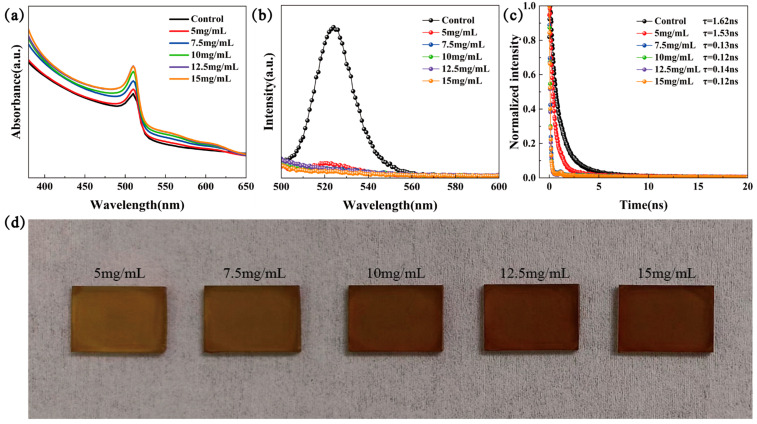 Figure 2
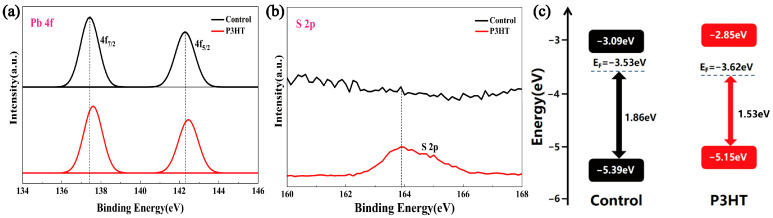 Figure 3
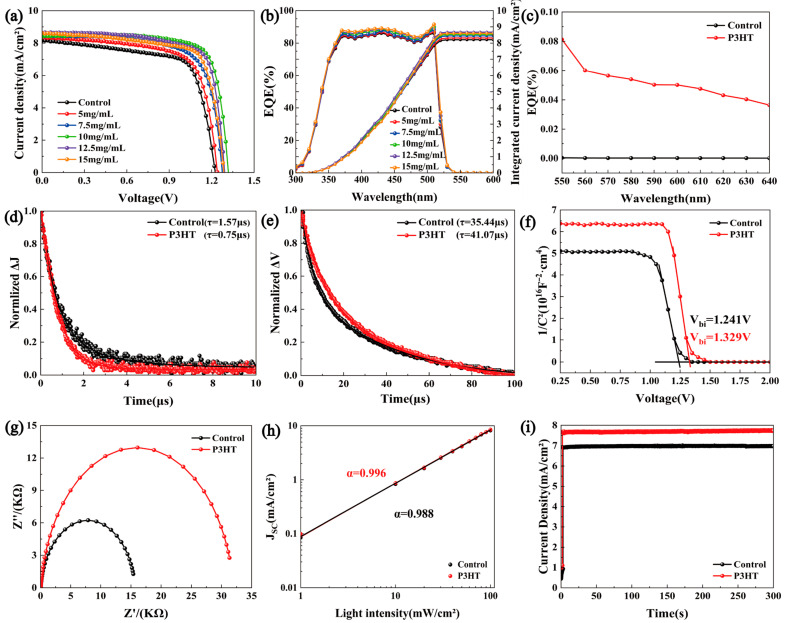 Figure 4
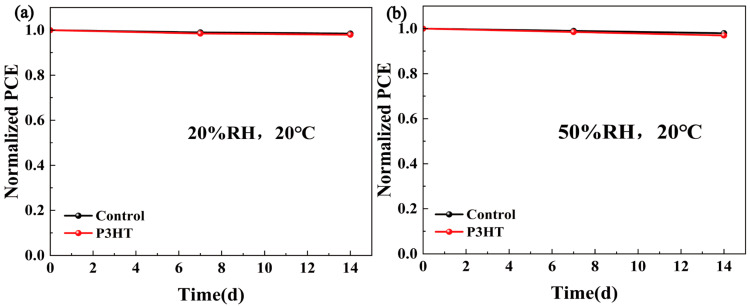 Figure 5
Peer Reviews
No public reviews on file for this paper yet. If you reviewed it on a platform where reviews are public (OpenReview, ICLR, NeurIPS, ICML), you can paste yours below so the community can read it here.
Videos
No videos yet. Explain this paper in a talk, walkthrough, or lecture? Add one.
Taxonomy
TopicsPerovskite Materials and Applications · Technostress in Professional Settings · Organic Light-Emitting Diodes Research