1H-Indoles from Deoxybenzoin Schiff Bases by Deprotonation—SNAr Cyclization
Nash E. Nevels, Richard A. Bunce

TL;DR
A new method for making 1H-indoles without using transition metals is described, using a sequence of deprotonation and SNAr cyclization from deoxybenzoin Schiff bases.
Contribution
The paper introduces a transition metal-free synthesis of 1,2,5-trisubstituted 1H-indoles via deprotonation–SNAr cyclization of deoxybenzoin Schiff bases.
Findings
The synthesis uses Friedel-Crafts acylation to prepare deoxybenzoins from activated aromatic compounds.
Schiff bases were formed by slow distillation of toluene from heated solutions of deoxybenzoin and amines.
Benzyl and phenethyl amines gave excellent yields, while volatile amines resulted in low yields.
Abstract
A transition metal-free synthesis of 1,2,5-trisubstituted 1H-indoles by a deprotonation–SNAr cyclization sequence from 1-aryl-2-(2-fluoro-5-nitrophenyl)ethan-1-one (deoxy-benzoin) Schiff bases is reported. The starting deoxybenzoins were prepared by Friedel-Crafts acylation of activated aromatic compounds by 2-(2-fluoro-5-nitrophenyl)acetyl chloride with AlCl3 or the corresponding acid with (CH3SO2)2O. The Schiff bases were generated by slow distillation of toluene (18–24 h) from a heated solution of each deoxybenzoin (1 equiv) with a benzyl- or phenethylamine, a high-boiling aliphatic amine, or an aniline derivative (5 equiv). Subsequent addition of N,N-dimethylformamide, 2 equiv of anhydrous K2CO3, and heating at 90–95 °C for 18–24 h completed the synthesis. Benzyl-, phenethyl-, and high-boiling amines gave excellent yields while the heating requirements for the initial condensation…
Genes, proteins, chemicals, diseases, species, mutations and cell lines named across the full text — each resolved to its canonical identifier and authoritative record.
Click any figure to enlarge with its caption.
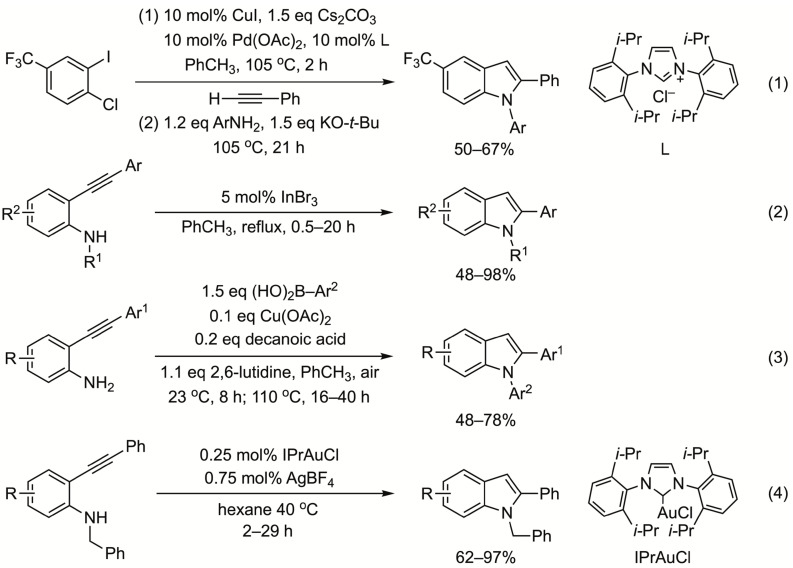 Figure 1
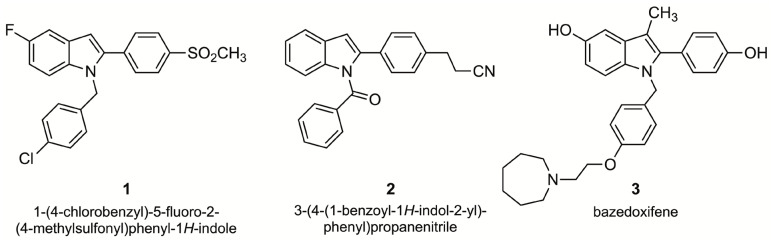 Figure 2
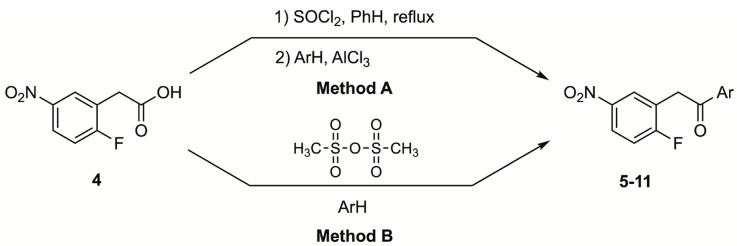 Figure 3
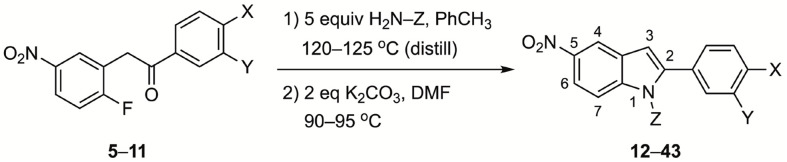 Figure 4
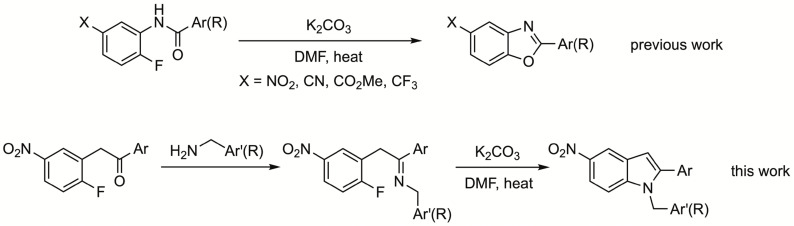 Figure 5
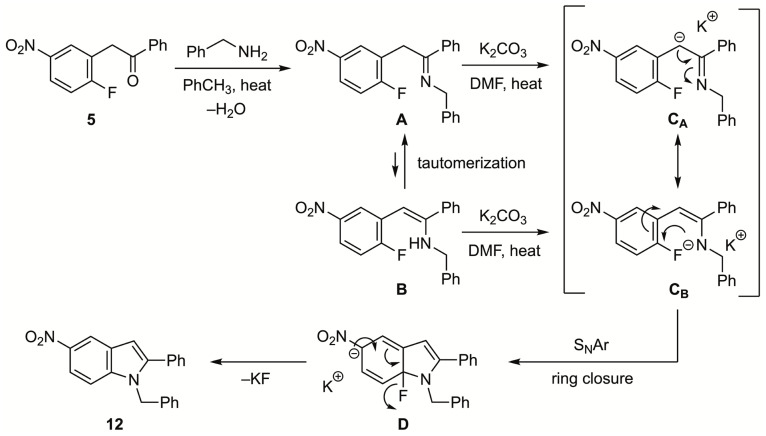 Figure 6
Peer Reviews
No public reviews on file for this paper yet. If you reviewed it on a platform where reviews are public (OpenReview, ICLR, NeurIPS, ICML), you can paste yours below so the community can read it here.
Videos
No videos yet. Explain this paper in a talk, walkthrough, or lecture? Add one.
Taxonomy
TopicsCatalytic C–H Functionalization Methods · Asymmetric Hydrogenation and Catalysis · Sulfur-Based Synthesis Techniques