Minimally Invasive Mitral Valve Repair for Commissural Prolapse: Safety, Success, and Long-Term Efficacy
Clemens Engler, Leo Pölzl, Felix Nägele, Michael Graber, Jakob Hirsch, Ronja Lohmann, Johannes Holfeld, Julia Dumfarth, Johannes Spilka, Ludwig Müller, Michael Grimm, Daniel Höfer, Can Gollmann-Tepeköylü, Nikolaos Bonaros

TL;DR
This study shows that minimally invasive surgery for a rare heart valve issue called commissural prolapse is safe and effective, with outcomes similar to a more common condition.
Contribution
Demonstrates the safety and long-term efficacy of minimally invasive mitral valve repair for commissural prolapse compared to posterior leaflet prolapse.
Findings
Minimally invasive mitral valve repair for commissural prolapse had comparable 30-day mortality and stroke rates to posterior leaflet prolapse.
Long-term outcomes like MR recurrence, reoperation, and survival were similar between commissural prolapse and posterior leaflet prolapse patients.
Despite longer operative times and hospital stays, commissural prolapse repair was found to be durable and successful.
Abstract
Commissural prolapse (CP) is a rare and complex mitral valve pathology which is complicated in preoperative diagnosis and repair. This study evaluated the safety, success, and long-term efficacy of minimally invasive mitral valve repair (MIMVR) for CP compared to posterior leaflet prolapse (PMLp). Between 2001 and 2022, 34 patients with CP and 590 with PMLp underwent MIMVR at our centre. Operative, perioperative, and long-term follow-up data were retrospectively collected. Surgical success was defined as freedom from conversion to valve replacement, sternotomy, and residual mitral regurgitation (MR) > grade I. Long-term efficacy included MR recurrence, reoperation, and survival. Median age was similar (CP: 64.0 years [53.2; 69.8] vs PMLp: 62.0 years [53.0; 69.0], P = .783). Barlow’s disease was more frequent in PMLp (80.3% vs 32.4%, P < .001). Cross-clamp (127.0 min vs 105.0 min, P =…
Genes, proteins, chemicals, diseases, species, mutations and cell lines named across the full text — each resolved to its canonical identifier and authoritative record.
Click any figure to enlarge with its caption.
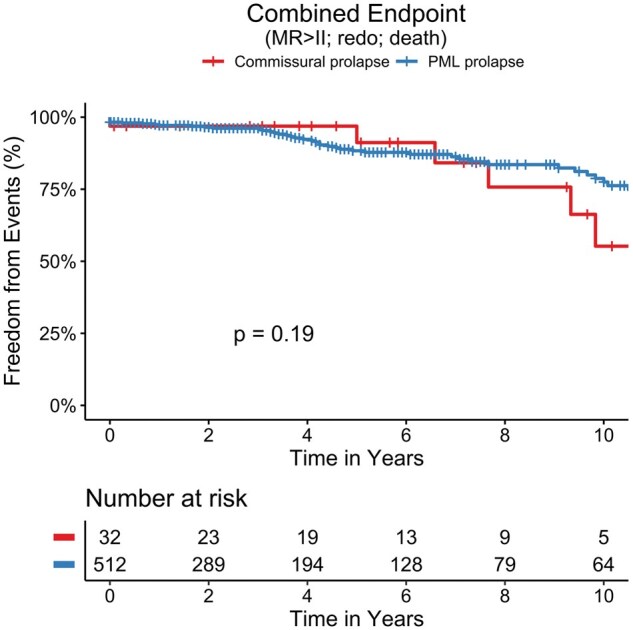 Figure 1
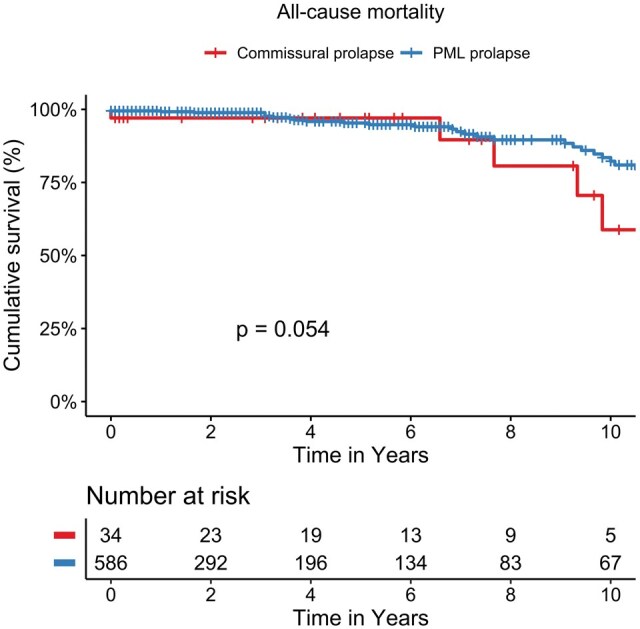 Figure 2
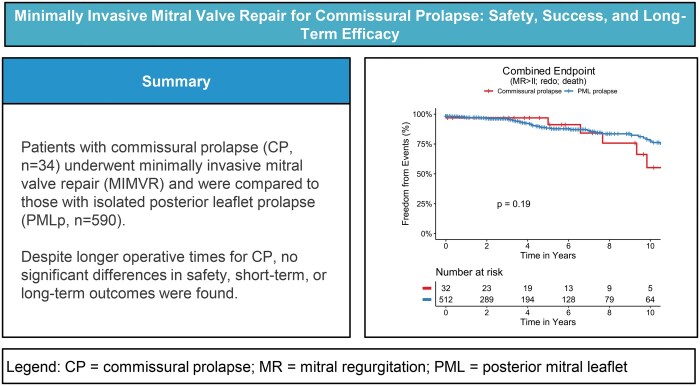 Figure 3
Peer Reviews
No public reviews on file for this paper yet. If you reviewed it on a platform where reviews are public (OpenReview, ICLR, NeurIPS, ICML), you can paste yours below so the community can read it here.
Videos
No videos yet. Explain this paper in a talk, walkthrough, or lecture? Add one.
Taxonomy
TopicsCardiac Valve Diseases and Treatments · Cardiac Structural Anomalies and Repair · Infective Endocarditis Diagnosis and Management