Advancing equity in cancer care: a pilot explanatory mixed methods study of a racially, ethnically, and linguistically concordant model of patient navigation
Ashlyn Tom, Citlali Gomez-Acosta, Vida Henderson, Jean McDougall, Jason A. Mendoza, Elizabeth Carosso, Eliza Brumer Cohn, Wendy E. Barrington, Liszet Bigelow-Chavez, Yaw A. Nyame, K. Casey Lion

TL;DR
A new patient navigation model that matches patients with navigators of similar race, ethnicity, or language improves cancer care satisfaction and reduces discrimination.
Contribution
This study introduces and evaluates a racially, ethnically, and linguistically concordant patient navigation model to address cancer care disparities.
Findings
Patients in the RELC PN model showed a 4.2-point increase in satisfaction with care.
Discrimination based on race decreased from 40% to 20% in the RELC model.
RELC PN patients were more likely to discuss clinical trials (80%) compared to traditional PN (17%) and no PN (20%).
Abstract
Disparities in cancer outcomes persist among systemically marginalized patients. A new racially, ethnically, or linguistically concordant (RELC) model of patient navigation (PN) was piloted at Fred Hutchinson Cancer Center in 2019. An explanatory mixed-methods observational study assessed patient-centered outcomes of RELC PN, traditional PN, and no PN. Patients from these models completed surveys at baseline and follow-up to measure changes in satisfaction, discrimination, resilience, stress, trust, and discussion of clinical trials. Interviews with patients receiving RELC PN were analyzed using thematic analysis. A total of 118 participants completed surveys. Satisfaction with care improved by 4.2 points (SD 7.0) on an 18-item 5-point Likert scale for those receiving RELC navigation, with no change in traditional or no PN groups. Discrimination based on race dropped from 40% (n = 2) to…
Genes, proteins, chemicals, diseases, species, mutations and cell lines named across the full text — each resolved to its canonical identifier and authoritative record.
Click any figure to enlarge with its caption.
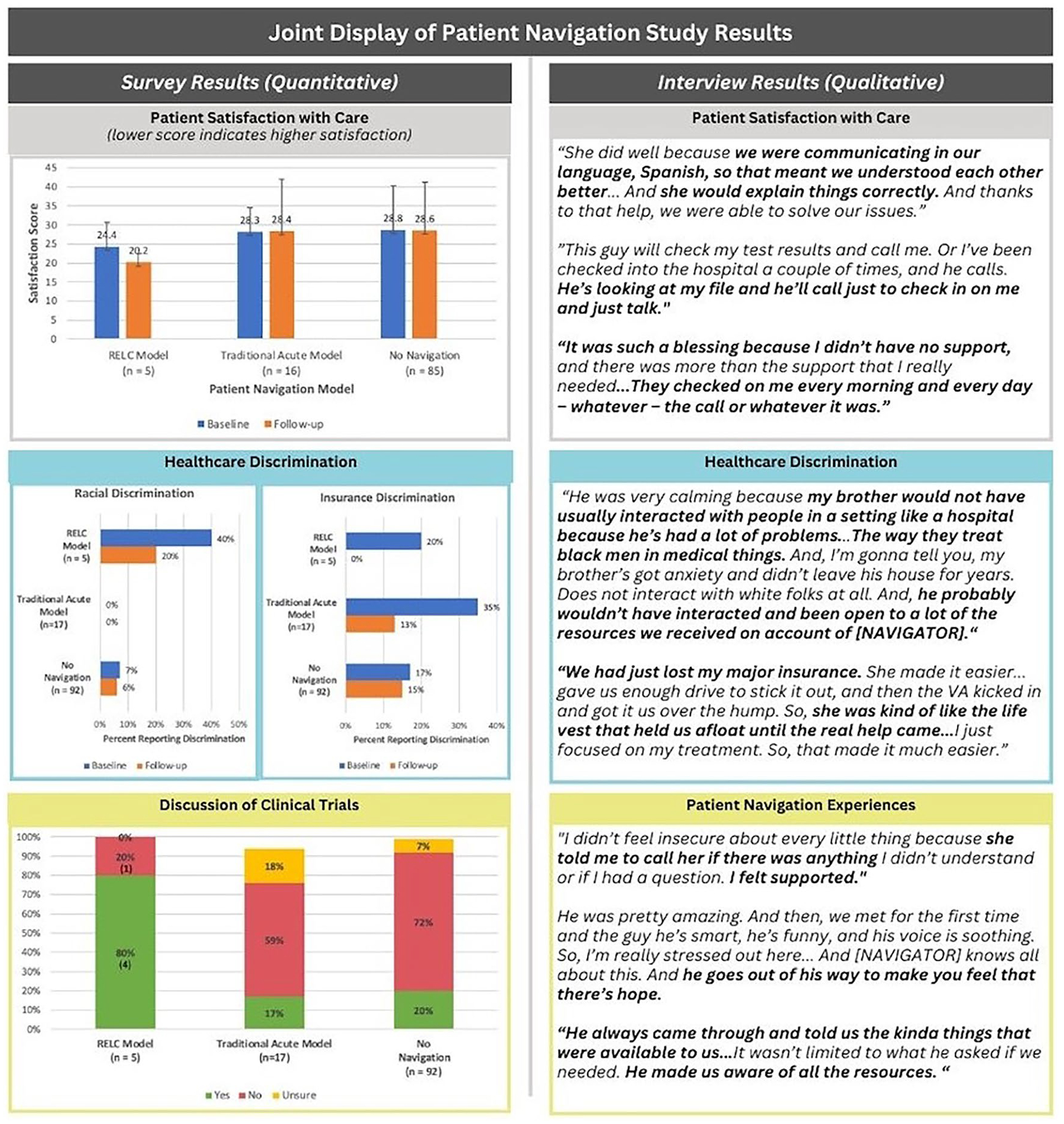 Figure 1
Peer Reviews
No public reviews on file for this paper yet. If you reviewed it on a platform where reviews are public (OpenReview, ICLR, NeurIPS, ICML), you can paste yours below so the community can read it here.
Videos
No videos yet. Explain this paper in a talk, walkthrough, or lecture? Add one.
Taxonomy
TopicsGlobal Cancer Incidence and Screening · Patient-Provider Communication in Healthcare · Colorectal Cancer Screening and Detection