The Role of Escherichia coli Autotransporters in Urinary Tract Infections and Urosepsis
Beata Krawczyk, Paweł Wityk

TL;DR
This paper reviews how specific proteins in Escherichia coli contribute to urinary tract infections and sepsis, suggesting new treatment and prevention strategies.
Contribution
The paper systematically reviews the roles of three autotransporter groups in UPEC pathogenesis, highlighting their potential as therapeutic targets.
Findings
Autotransporters aid in adhesion, serum resistance, and biofilm formation during UTIs.
SPATE, TAA, and AIDA-I proteins contribute to UPEC virulence and disease progression.
These proteins are promising targets for new therapies and preventive measures.
Abstract
Urinary tract infections (UTIs) caused by Uropathogenic Escherichia coli (UPEC) strains are among the most common bacterial infections in humans, causing cystitis, pyelonephritis and, in the absence of appropriate treatment, sepsis. Effective therapies and preventive strategies are still lacking, which highlights the need to better understand UPEC virulence mechanisms. Herein, we describe the role of three groups of bacterial autotransporters (ATs): serine protease autotransporter (SPATE), trimeric autotransporter adhesins (TAA), and autotransporter adhesin AIDA-I, and their possible contribution to the induction of UTI and urosepsis. AT, depending on the type, exhibits functions such as adhesion, serum resistance, hemagglutination, protease activity, biofilm formation and toxin activity. By summarizing the molecular functions of AT proteins, our review highlights their potential as…
Genes, proteins, chemicals, diseases, species, mutations and cell lines named across the full text — each resolved to its canonical identifier and authoritative record.
Click any figure to enlarge with its caption.
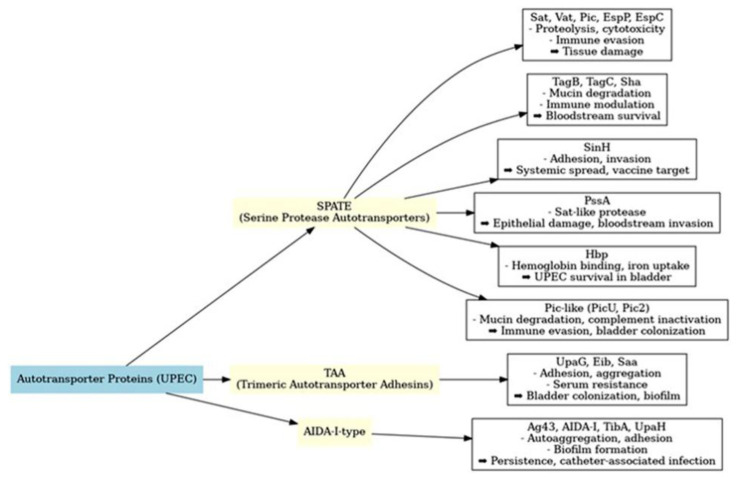 Figure 1
Peer Reviews
No public reviews on file for this paper yet. If you reviewed it on a platform where reviews are public (OpenReview, ICLR, NeurIPS, ICML), you can paste yours below so the community can read it here.
Videos
No videos yet. Explain this paper in a talk, walkthrough, or lecture? Add one.
Taxonomy
TopicsEscherichia coli research studies · Clostridium difficile and Clostridium perfringens research · Antibiotic Resistance in Bacteria