Dynamics of the Epigenome, Microbiome, and Metabolome in Relation to Early Adiposity in the Maternal–Infant Axis: Protocol for a Prospective, Observational Pilot Study in the Spanish NEMO Cohort
María Suárez-Cortés, Almudena Juan-Pérez, Alonso Molina-Rodríguez, Julia Araújo de Castro, María Ángeles Castaño-Molina, Virginia Esperanza Fernández-Ruiz, Almudena Jiménez-Méndez, Paula Martínez Pérez-Munar, Sara Rico-Chazarra, Bruno Ramos-Molina, Manuel Sánchez-Solís

TL;DR
This study explores how maternal and infant biological factors relate to early childhood obesity risk using multi-omics data from a Spanish cohort.
Contribution
The study introduces a novel multi-omics approach to identify non-invasive biomarkers of early adiposity in infants linked to maternal factors.
Findings
Maternal and infant epigenetic, microbiome, and metabolome data will be analyzed to identify early obesity risk markers.
The study will track changes in these biomarkers over time to understand their relation to infant adiposity development.
Findings may inform personalized prevention strategies for childhood obesity.
Abstract
Background: Childhood obesity has reached epidemic levels in developed countries and is an emerging concern in developing regions. Children with excess weight are more likely to maintain this condition over time into adulthood and face a higher risk of developing metabolic disorders such as type 2 diabetes, hypertension, metabolic dysfunction-associated liver disease, and dyslipidemia. Early identification of obesity risk is, therefore, a key public health challenge. Methods: This is an observational, prospective, single-center cohort pilot study in 66 mother–infant dyads recruited at the Gynecology and Obstetrics Service of the Virgen de la Arrixaca University Hospital (Murcia, Spain). The primary objective is to identify early-life, non-invasive biomarkers associated with increased adiposity by integrating multi-omics approaches and analyzing maternal–infant interactions. Pregnant…
Genes, proteins, chemicals, diseases, species, mutations and cell lines named across the full text — each resolved to its canonical identifier and authoritative record.
Click any figure to enlarge with its caption.
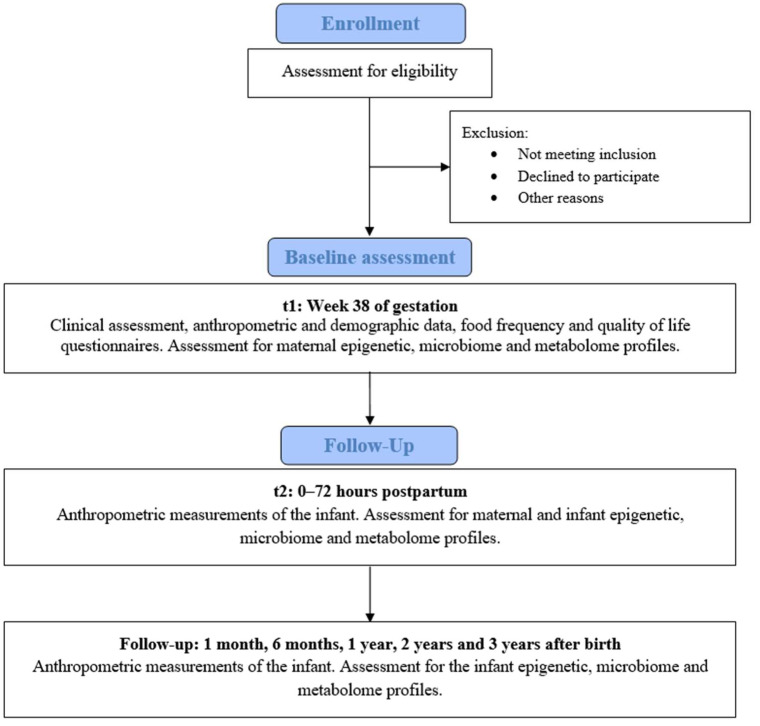 Figure 1
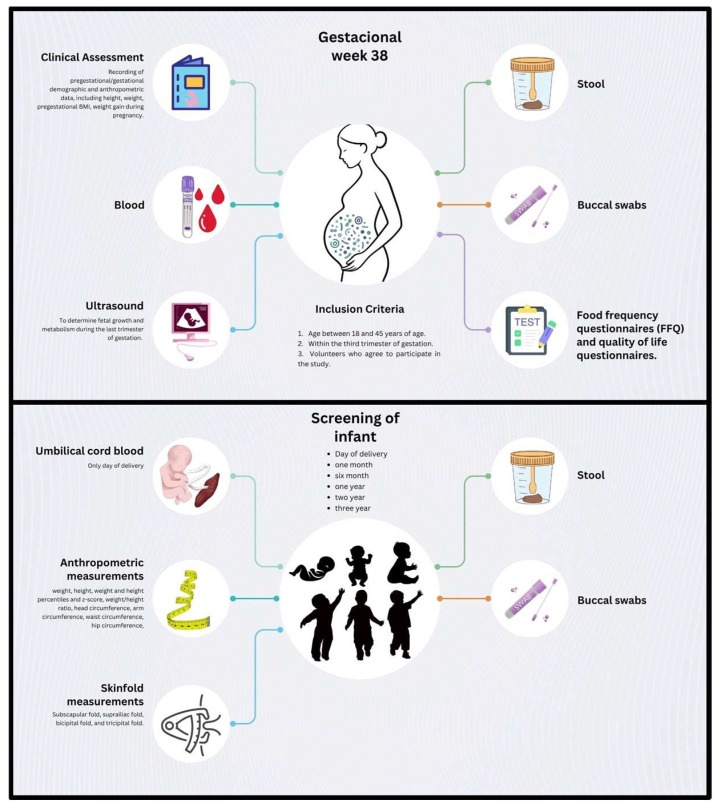 Figure 2
Peer Reviews
No public reviews on file for this paper yet. If you reviewed it on a platform where reviews are public (OpenReview, ICLR, NeurIPS, ICML), you can paste yours below so the community can read it here.
Videos
No videos yet. Explain this paper in a talk, walkthrough, or lecture? Add one.
Taxonomy
TopicsBirth, Development, and Health · Nutritional Studies and Diet · Gestational Diabetes Research and Management