Protective Effects of PACAP in Diabetic Complications: Retinopathy, Nephropathy and Neuropathy
Dora Reglodi, Andrea Tamas, Inez Bosnyak, Tamas Atlasz, Edina Szabo, Lina Li, Gabriella Horvath, Balazs Opper, Peter Kiss, Liliana Lucas, Grazia Maugeri, Agata Grazia D’Amico, Velia D’Agata, Eszter Fabian, Gyongyver Reman, Alexandra Vaczy

TL;DR
This review explores how PACAP, a neuropeptide, protects against various complications of diabetes, including retinopathy, nephropathy, and neuropathy.
Contribution
The paper provides a comprehensive summary of PACAP's protective effects in major diabetic complications and highlights its potential as a therapeutic agent.
Findings
PACAP counteracts retinal degeneration and inhibits apoptosis in diabetic retinopathy models.
PACAP improves kidney morphology and reduces fibrosis in diabetic nephropathy.
PACAP protects against axonal-myelin lesions in diabetic neuropathy.
Abstract
Pituitary adenylate cyclase-activating polypeptide (PACAP) is a neuropeptide exerting, among others, strong trophic and protective effects. It plays a role in several physiological functions, including glucose homeostasis. The protective effects of PACAP are mainly mediated via its specific PAC1 receptor by stimulating anti-inflammatory, anti-apoptotic and antioxidant pathways. The aim of the present review is to summarize data on the protective effects of PACAP in the three major complications of diabetes, retinopathy, nephropathy and neuropathy, as well as some other complications. In type 1 and type 2 diabetic retinopathy models and in glucose-exposed cells of the eye, PACAP counteracted the degeneration of retinal layers and inhibited apoptosis and factors leading to abnormal vessel growth. In models of nephropathy, kidney morphology was better retained after PACAP administration,…
Genes, proteins, chemicals, diseases, species, mutations and cell lines named across the full text — each resolved to its canonical identifier and authoritative record.
Click any figure to enlarge with its caption.
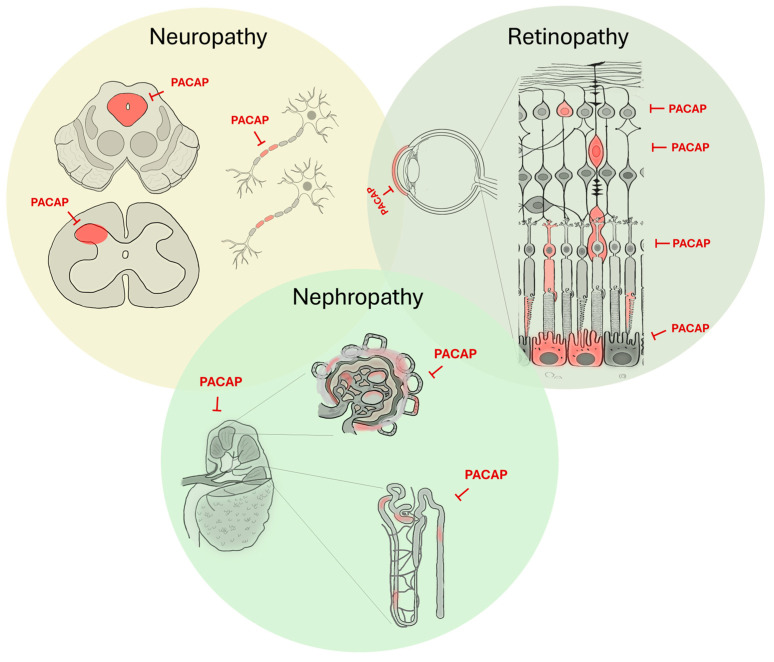 Figure 1
Peer Reviews
No public reviews on file for this paper yet. If you reviewed it on a platform where reviews are public (OpenReview, ICLR, NeurIPS, ICML), you can paste yours below so the community can read it here.
Videos
No videos yet. Explain this paper in a talk, walkthrough, or lecture? Add one.
Taxonomy
TopicsNeuropeptides and Animal Physiology · Cardiovascular, Neuropeptides, and Oxidative Stress Research · Receptor Mechanisms and Signaling