Outcomes at Patient and Limb Levels in Peripheral Artery Disease by the Location of Atherosclerotic Lower Limb Lesions: An Observational Study from a High-Volume German Center
Anne Zimmermann, David J. F. Holstein, Paulina Stürzebecher, Paul Medicke, Annika Niezold, Maximilian Brunotte, Samira Zeynalova, Armin Wiegering, Daniel Seehofer, Andrej Schmidt, Sabine Steiner, Dierk Scheinert, Daniela Branzan, Konstantin Uttinger

TL;DR
This study finds that patients with infrapopliteal PAD lesions or multi-level disease have the worst amputation-free survival outcomes.
Contribution
The study provides new insights into how lesion location affects patient and limb outcomes in peripheral artery disease.
Findings
Infrapopliteal lesions had the lowest amputation-free survival (59.3%) and highest risk of major amputation or death.
Infrainguinal-to-popliteal lesions showed reduced risk of major adverse limb events compared to multi-level disease.
Suprainguinal lesions were associated with the highest amputation-free survival (92.5%).
Abstract
Background: In Peripheral Artery Disease (PAD), there is an association between risk factors, the location of atherosclerotic lesions, and outcomes. Methods: This is a retrospective single-center analysis of adult PAD patients admitted between 2018 and 2021 with a follow-up until the end of 2023. Lesions were allocated to “suprainguinal”, “infrainguinal-to-popliteal”, “infrapopliteal”, “two of three levels” and “all three levels” categories based on angiogram findings. The primary endpoint at the patient level was amputation-free survival and was major adverse limb events (MALEs) at the limb level. Results: A total of 2067 patients with 2633 affected limbs were analyzed, and 28.8% were female. At first admission, the median age was 68, and the most frequent PAD Fontaine stage was IIb (44.9%). Lesions were suprainguinal in 11.6%, infrainguinal-to-popliteal in 18.3%, infrapopliteal in…
Genes, proteins, chemicals, diseases, species, mutations and cell lines named across the full text — each resolved to its canonical identifier and authoritative record.
Click any figure to enlarge with its caption.
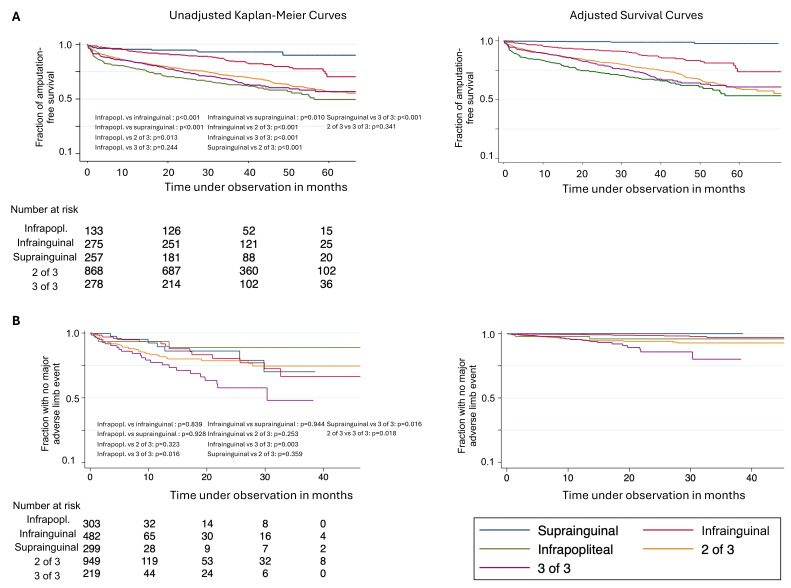 Figure 1
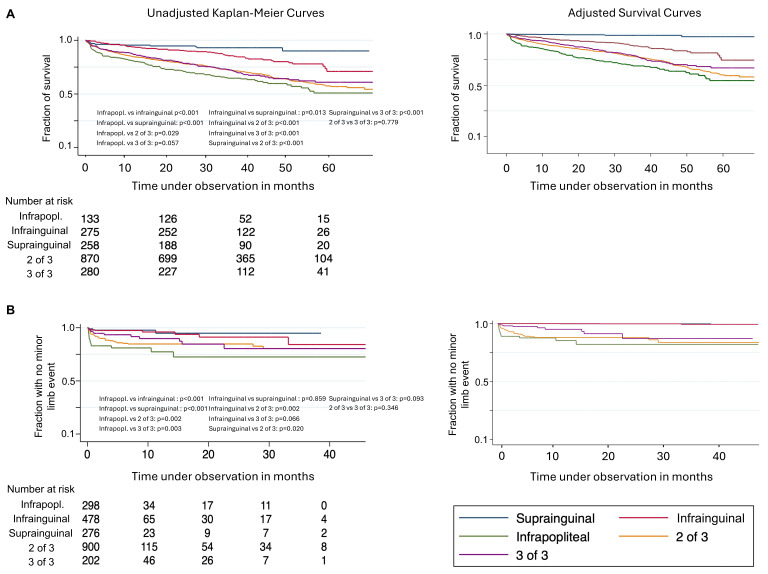 Figure 2
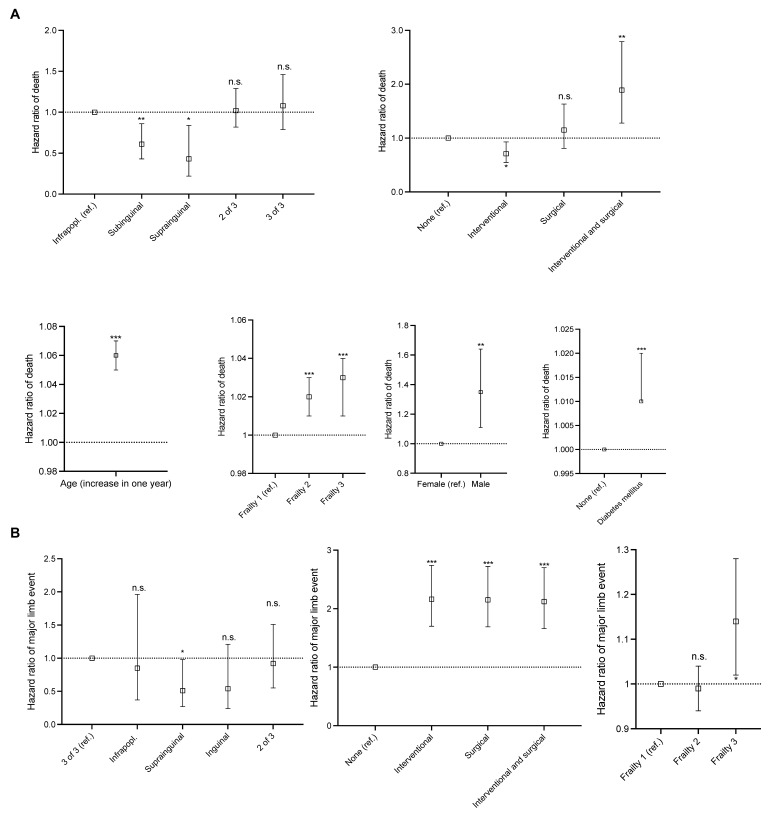 Figure 3
Peer Reviews
No public reviews on file for this paper yet. If you reviewed it on a platform where reviews are public (OpenReview, ICLR, NeurIPS, ICML), you can paste yours below so the community can read it here.
Videos
No videos yet. Explain this paper in a talk, walkthrough, or lecture? Add one.
Taxonomy
TopicsPeripheral Artery Disease Management · Diagnosis and Treatment of Venous Diseases · Lymphatic System and Diseases