Proteomic Profiling of Limited-Stage Follicular Lymphoma Reveals Differentially Expressed Proteins Linked to Disease Progression Post-Radiation Therapy
Jonas Klejs Hemmingsen, Marie Hairing Enemark, Emma Frasez Sørensen, Cecilie Dohrmann, Kristina Lystlund Lauridsen, Stephen Jacques Hamilton-Dutoit, Robert Kridel, Bent Honoré, Maja Ludvigsen

TL;DR
This study identifies proteins linked to disease progression in follicular lymphoma patients after radiation therapy, which could help predict outcomes and guide treatment.
Contribution
The study reveals differentially expressed proteins, particularly CASP4 and CASP8, associated with disease progression in follicular lymphoma.
Findings
78 proteins were significantly differentially expressed between progressing and non-progressing follicular lymphoma cases.
Low expression of CASP4 and CASP8 correlated with shorter progression-free survival in follicular lymphoma patients.
CASP4 and CASP8 expression patterns were associated with disease progression independent of disease stage.
Abstract
Follicular lymphoma (FL) is the most common indolent lymphoma. Despite a generally favorable prognosis and long-term survival for many patients, FL remains incurable, with disease progression occurring in approximately half of limited-stage FL cases. In this study, we employed high-throughput mass spectrometry-based proteomics to explore the differential protein expression in diagnostic lymphoma biopsies from 26 limited-stage FL patients. Of these, 9 patients experienced subsequent disease progression (sp-FL), while 17 did not (np-FL). A total of 1940 proteins were identified, with 78 showing significant differential expression between progressing and non-progressing cases. Unsupervised clustering analyses were able to separate the two patient groups based on these differential protein profiles. Notably, proteins involved in metabolism, immune regulation, and apoptosis were…
Genes, proteins, chemicals, diseases, species, mutations and cell lines named across the full text — each resolved to its canonical identifier and authoritative record.
Click any figure to enlarge with its caption.
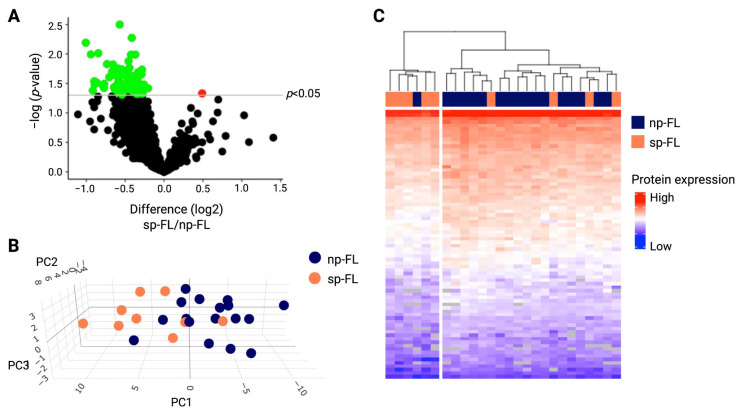 Figure 1
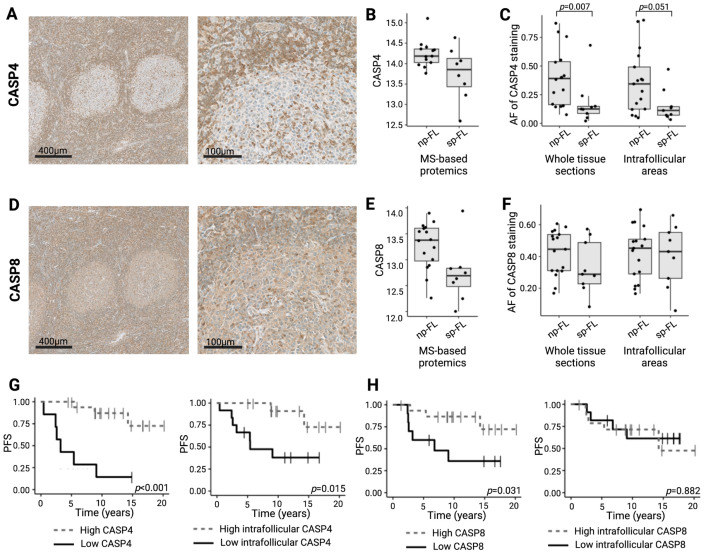 Figure 2
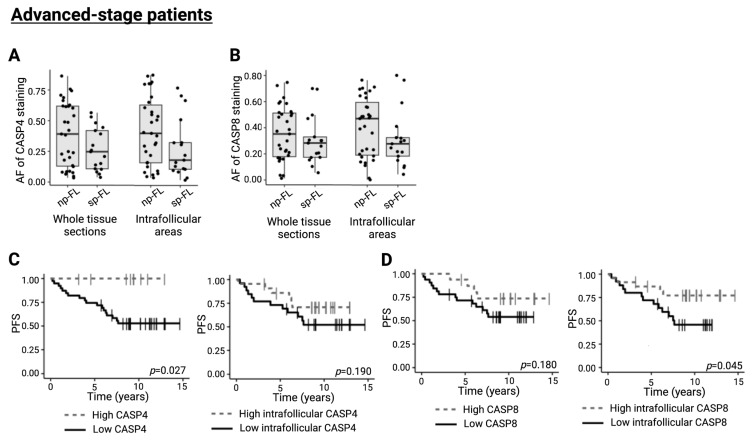 Figure 3
Peer Reviews
No public reviews on file for this paper yet. If you reviewed it on a platform where reviews are public (OpenReview, ICLR, NeurIPS, ICML), you can paste yours below so the community can read it here.
Videos
No videos yet. Explain this paper in a talk, walkthrough, or lecture? Add one.
Taxonomy
TopicsLymphoma Diagnosis and Treatment · Ubiquitin and proteasome pathways · RNA Research and Splicing