Ageing versus developmental silencing: Answers from the epigenome
Kirsten C. Sadler, Mekayla A. Storer, N. Sumru Bayin

TL;DR
Young animals regenerate better due to open chromatin, which becomes closed with age, limiting tissue repair.
Contribution
The paper proposes that epigenetic changes during aging and development limit regenerative capacity.
Findings
Regenerative capacity declines with age due to epigenetic silencing of necessary genes.
Chromatin becomes less accessible in older animals, hindering tissue regeneration.
The timing of regenerative decline varies by tissue type and life stage.
Abstract
A strong regenerative capacity is a hallmark of youth. From the tadpole's tail to the mammalian brain, young animals of many species can repair or regrow damaged tissues more effectively than older animals. Here, we take a broad perspective on ageing, inclusive of the transition from the developmental processes of embryogenesis through maturation to adulthood, as well as the processes that occur as an animal reaches the end of its lifespan. In some cases, the loss of regenerative capacity occurs once development is complete, and in others it occurs in the latter part of the animal's life. Regardless, the loss of regenerative capacity is caused by a failure to activate genes required for successful regeneration. This, in part, can be attributed to restructuring of the epigenome. It is easier for young animals to regenerate damaged or missing tissues. In this Viewpoint, we propose that…
Genes, proteins, chemicals, diseases, species, mutations and cell lines named across the full text — each resolved to its canonical identifier and authoritative record.
Click any figure to enlarge with its caption.
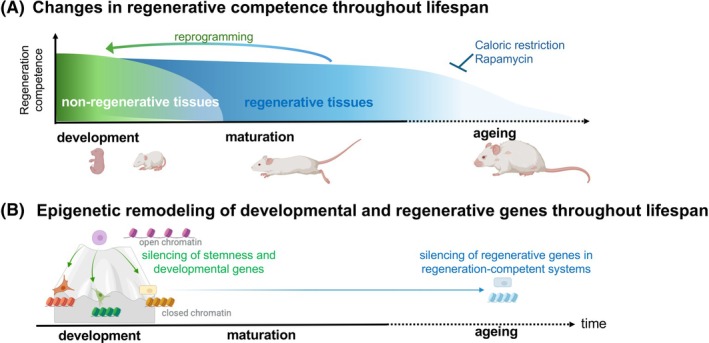 Figure 1
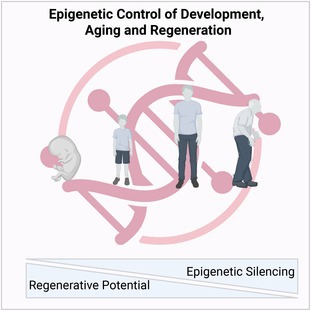 Figure 2
Peer Reviews
No public reviews on file for this paper yet. If you reviewed it on a platform where reviews are public (OpenReview, ICLR, NeurIPS, ICML), you can paste yours below so the community can read it here.
Videos
No videos yet. Explain this paper in a talk, walkthrough, or lecture? Add one.
Taxonomy
TopicsEpigenetics and DNA Methylation · Genetics and Neurodevelopmental Disorders · Pluripotent Stem Cells Research