Increased Rate of Anemia and Discontinuation in Older Patients with Myelofibrosis Treated with Ruxolitinib
Alessandro Laganà, Emilia Scalzulli, Ida Carmosino, Maria Laura Bisegna, Claudia Ielo, Costanza Andriola, Maurizio Martelli, Massimo Breccia

TL;DR
Older patients with myelofibrosis treated with ruxolitinib experience higher rates of anemia and drug discontinuation compared to younger patients, despite similar treatment responses.
Contribution
This study identifies age-related differences in ruxolitinib treatment outcomes and adverse events in myelofibrosis patients.
Findings
Patients aged ≥65 years had a 45% higher odds of not achieving spleen response compared to younger patients.
Older patients (≥65 years) had a two-fold increased risk of discontinuing ruxolitinib due to adverse events.
Very elderly patients (≥75 years) had a higher incidence of infectious events compared to the 65–74 years group.
Abstract
Background/Objectives: Myelofibrosis (MF) predominantly affects older individuals, and its incidence increases with age. Ruxolitinib (RUX), a JAK1/2 inhibitor, effectively reduces spleen volume and relieves disease-related symptoms in MF patients and can be prescribed regardless of age. Although advanced age is associated with poorer MF prognosis, the influence of patient age on RUX treatment efficacy and safety has not been fully elucidated. Methods: In this single-center, retrospective study, we included 216 adult MF patients who initiated RUX therapy between 2012 and 2024. Patients were stratified by age at the start of RUX as follows: <65 (n = 105), 65–74 (n = 64), and ≥75 years (n = 47). Clinical data were analyzed in order to assess the impact of age on RUX-associated responses, toxicities, and survival. Results: Compared to younger patients, those ≥65 years showed features of…
Genes, proteins, chemicals, diseases, species, mutations and cell lines named across the full text — each resolved to its canonical identifier and authoritative record.
Click any figure to enlarge with its caption.
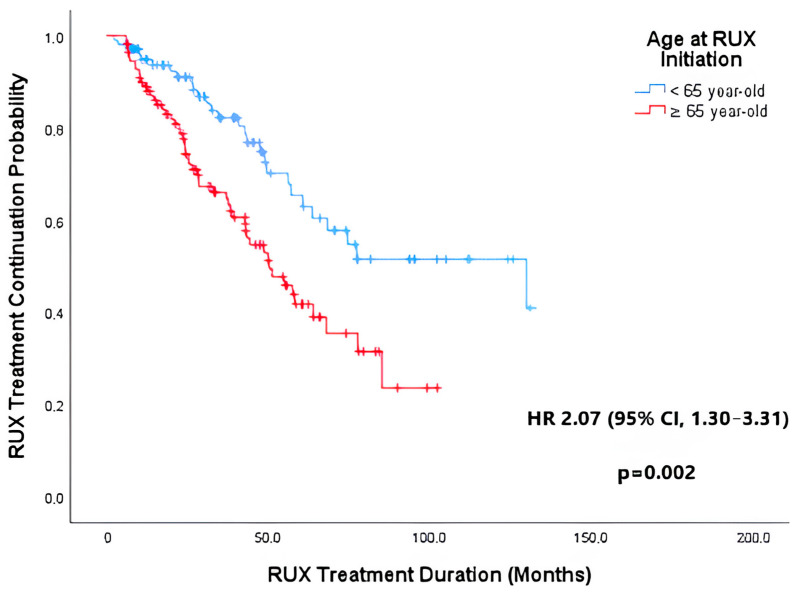 Figure 1
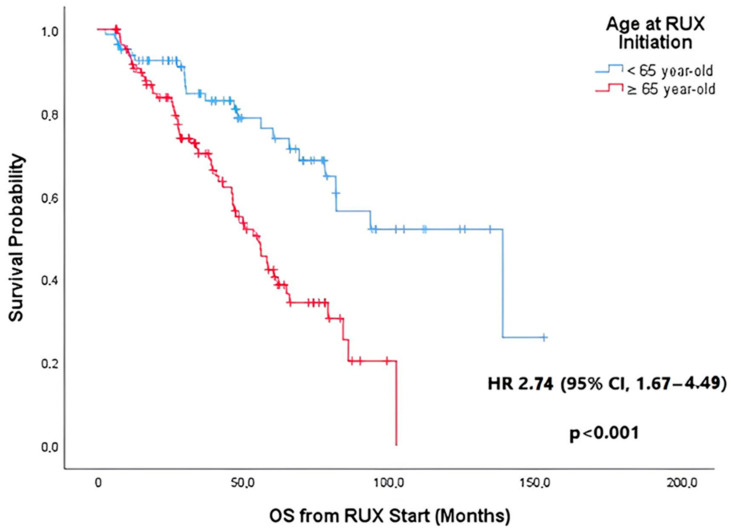 Figure 2
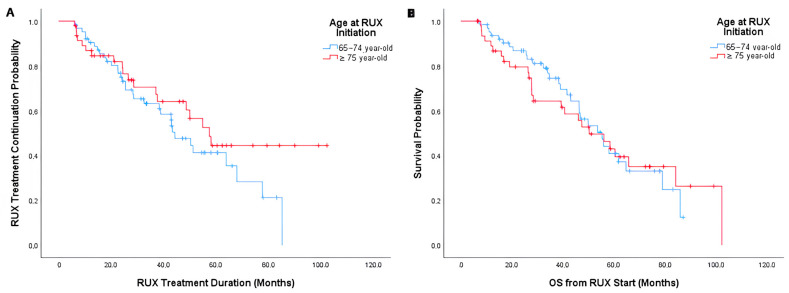 Figure 3
Peer Reviews
No public reviews on file for this paper yet. If you reviewed it on a platform where reviews are public (OpenReview, ICLR, NeurIPS, ICML), you can paste yours below so the community can read it here.
Videos
No videos yet. Explain this paper in a talk, walkthrough, or lecture? Add one.
Taxonomy
TopicsMyeloproliferative Neoplasms: Diagnosis and Treatment · Kruppel-like factors research · Acute Myeloid Leukemia Research