Distribution and Demographic Correlates of Ocular Wavefront Aberrations in a Korean Population
Ji Young Seo, Noh Eun Kwon, Jong Hwa Jun, Seung Pil Bang

TL;DR
This study establishes normative values for ocular wavefront aberrations in Koreans, finding that higher-order aberrations increase with age and are most influenced by vertical coma and spherical aberration.
Contribution
Provides the first normative reference ranges for ocular wavefront aberrations in a Korean population and identifies demographic correlations.
Findings
Vertical coma (Z7) and spherical aberration (Z12) were the largest contributors to higher-order aberration root mean square.
Higher-order aberration RMS increased with age (β = 0.003 μm/year) and decreased with spherical equivalent (β = −0.678 μm/D).
Interocular symmetry was significant, with ICCs of 0.75 for total RMS and 0.64 for HOA RMS.
Abstract
Background/Objectives: Ocular wavefront aberrations are clinically relevant for optimizing vision correction and predicting surgical outcomes. This study aimed to establish normative reference ranges for a Korean population by quantifying wavefront aberrations using a Hartmann–Shack wavefront sensor and Zernike coefficients, and to assess correlations with age, sex, and spherical equivalent (SE). Methods: Wavefront aberrations were measured in 98 Koreans (196 eyes) using a Hartmann–Shack aberrometer without cycloplegia. Five repeated measurements per eye at a 6 mm pupil size were averaged. Parameters included Zernike coefficients (Z3–Z20), higher-order aberration (HOA) root mean square (RMS, Z6–Z20), and total RMS (Z3–Z20). Associations with age, sex, and SE were assessed using univariable and multivariable linear mixed-effects models. Second-order polynomial regression assessed…
Genes, proteins, chemicals, diseases, species, mutations and cell lines named across the full text — each resolved to its canonical identifier and authoritative record.
Click any figure to enlarge with its caption.
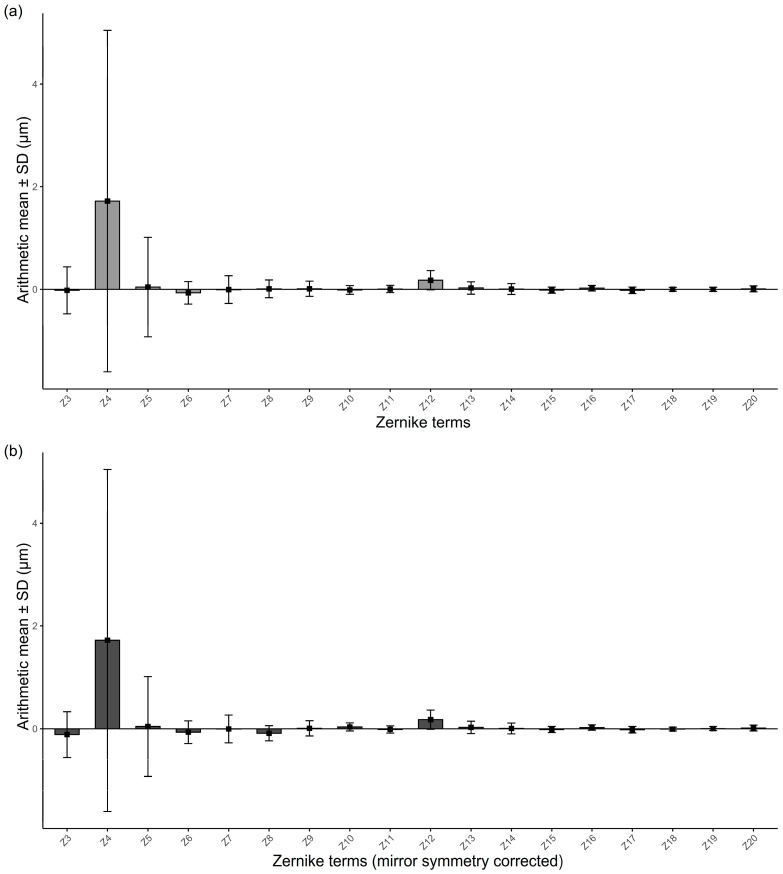 Figure 1
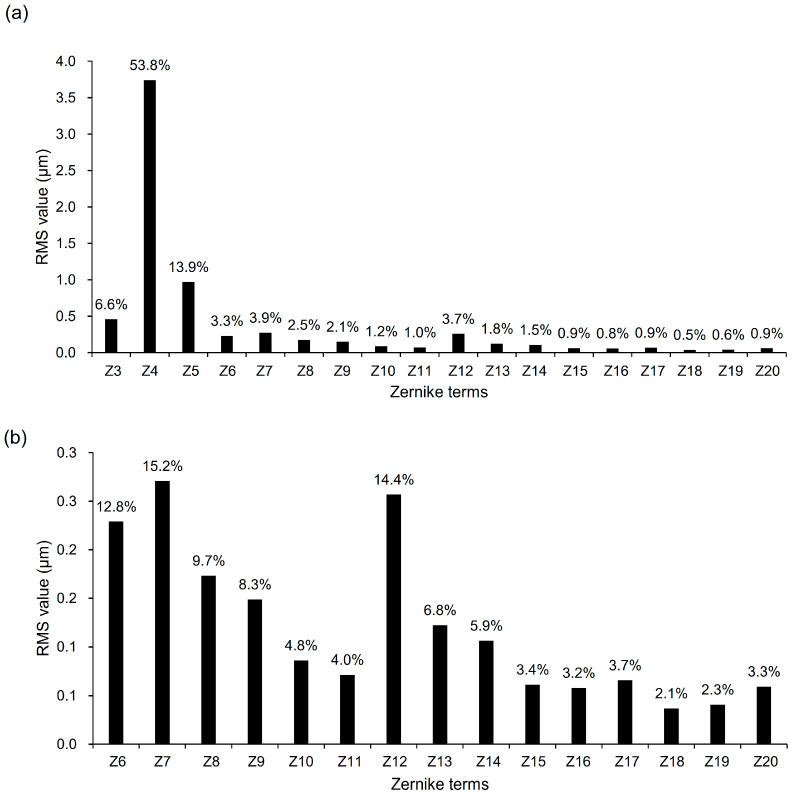 Figure 2
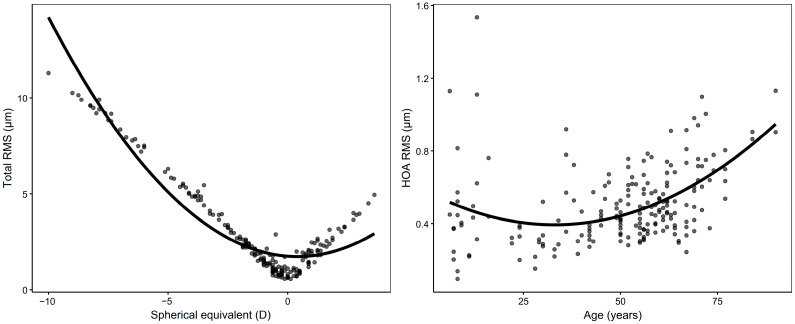 Figure 3
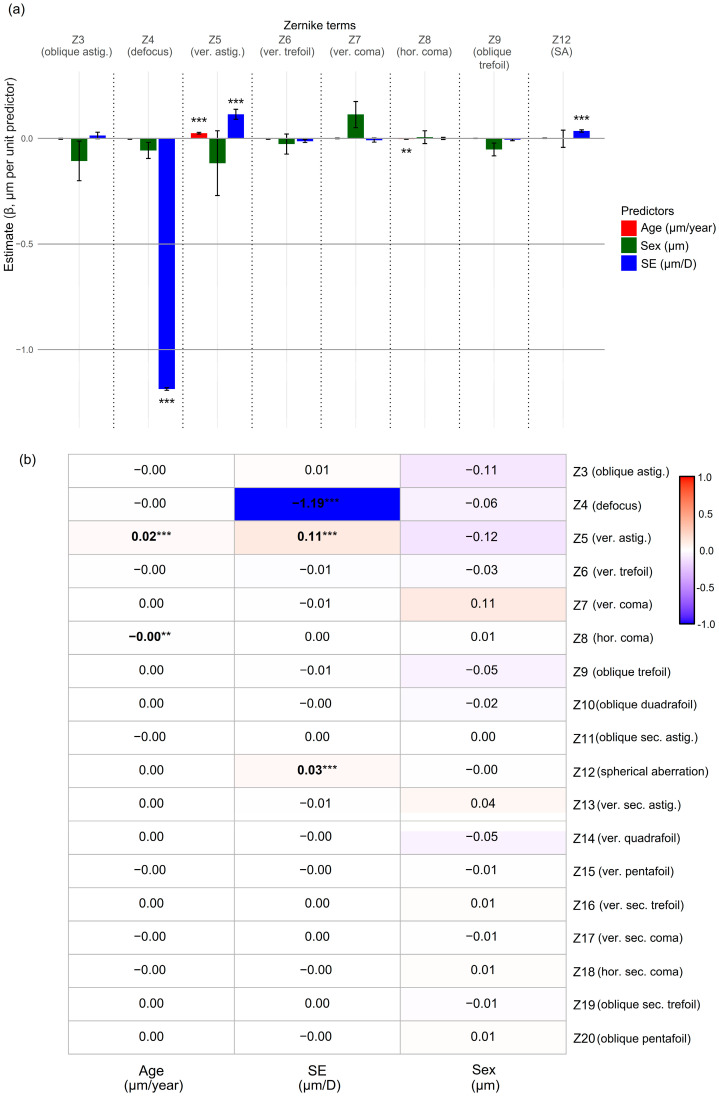 Figure 4
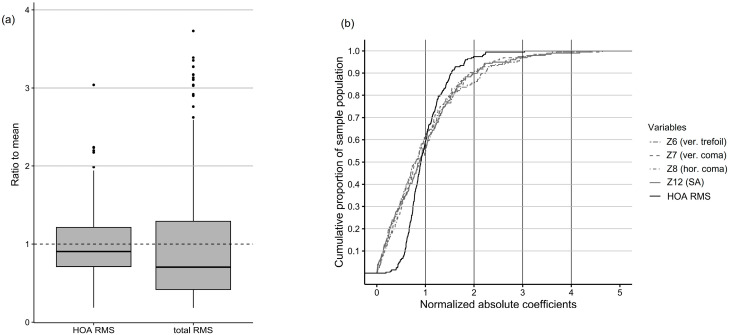 Figure 5
Peer Reviews
No public reviews on file for this paper yet. If you reviewed it on a platform where reviews are public (OpenReview, ICLR, NeurIPS, ICML), you can paste yours below so the community can read it here.
Videos
No videos yet. Explain this paper in a talk, walkthrough, or lecture? Add one.
Taxonomy
TopicsOphthalmology and Visual Impairment Studies · Intraocular Surgery and Lenses · Corneal surgery and disorders