Outcome of Metastatic Biliary Tract Cancer Harbouring IDH1 or FGFR2 Alterations: A Retrospective Observational Real-World Study from a French Cohort
Jean-Baptiste Barbe-Richaud, Fabien Moinard-Butot, Mathieu Cotton, Cécile Bigot, Pierre Rivière, Christine Belletier, Erwan Pencreach, Dan Karouby, Pascale Chiappa, Lauriane Eberst, Jean-Emmanuel Kurtz, Meher Ben Abdelghani

TL;DR
This study found that patients with metastatic biliary tract cancer and specific genetic changes (IDH1 or FGFR2) had better survival than those without these changes, but the benefit may come from targeted therapies.
Contribution
The study provides real-world evidence on the prognostic value of IDH1 and FGFR2 alterations in metastatic biliary tract cancer.
Findings
Patients with IDH1 or FGFR2 alterations had a median overall survival of 24.2 months compared to 10.8 months for wild-type tumors.
The hazard ratio for death was 0.46 for patients with IDH1 or FGFR2 alterations, indicating a survival benefit.
There was no difference in progression-free survival for first-line treatment between the groups.
Abstract
Background: Biliary tract cancer (BTC) management has undergone tremendous changes, benefiting from the identification of highly actionable molecular alterations. Among these, IDH1 mutations and FGFR2 fusions are the most common alterations detected and are classified as ESCAT tier 1 in BTC. However, their prognostic value in real-world settings remains uncertain. Objective: To explore overall survival (OS) in patients harbouring locally advanced or metastatic BTC (mBTC) with IDH1 or FGFR2 alterations, compared to those with wild-type tumours. Methods: This retrospective, multicentre study included patients with mBTC treated between 2020 and 2023 across five French centres. Patients were categorized into two cohorts based on molecular profiling: those with IDH1 or FGFR2 alterations, and those with wild-type tumours (WT-mBTC). Results: 119 consecutive patients were included. 18 were…
Genes, proteins, chemicals, diseases, species, mutations and cell lines named across the full text — each resolved to its canonical identifier and authoritative record.
Click any figure to enlarge with its caption.
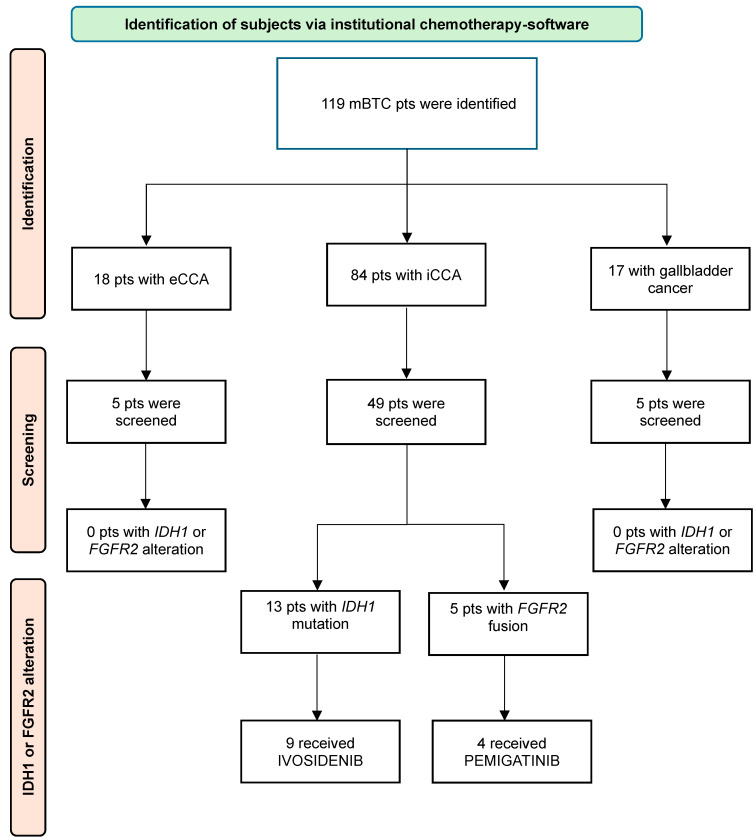 Figure 1
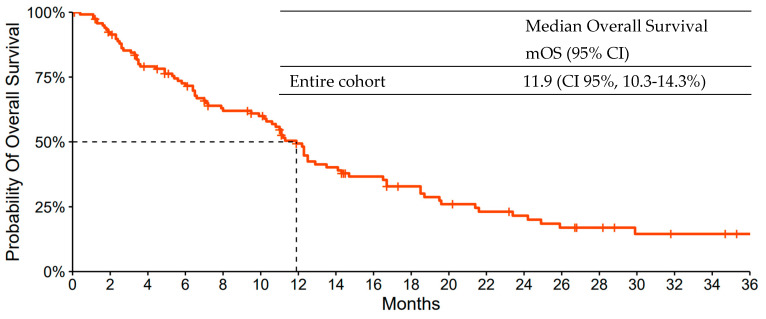 Figure 2
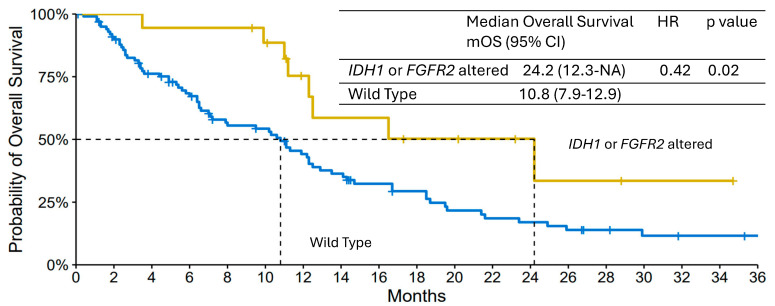 Figure 3
Peer Reviews
No public reviews on file for this paper yet. If you reviewed it on a platform where reviews are public (OpenReview, ICLR, NeurIPS, ICML), you can paste yours below so the community can read it here.
Videos
No videos yet. Explain this paper in a talk, walkthrough, or lecture? Add one.
Taxonomy
TopicsCholangiocarcinoma and Gallbladder Cancer Studies · Pancreatic and Hepatic Oncology Research · Fibroblast Growth Factor Research