Functional Independence Assessment in Children and Adolescents with Achondroplasia: A Multicenter Cross-Sectional Study Using the WeeFIM Scale
Chung-Lin Lee, Hung-Hsiang Fang, Chih-Kuang Chuang, Dau-Ming Niu, Ju-Li Lin, Mei-Chyn Chao, Yen-Yin Chou, Pao Chin Chiu, Chia-Chi Hsu, Tzu-Hung Chu, Yin-Hsiu Chien, Huei-Ching Chiu, Ya-Hui Chang, Yuan-Rong Tu, Yun-Ting Lo, Hsiang-Yu Lin, Shuan-Pei Lin

TL;DR
This study evaluates the daily living skills of children and adolescents with achondroplasia using the WeeFIM scale, finding high independence in most areas except mobility.
Contribution
The study provides the first comprehensive assessment of functional independence in achondroplasia using the WeeFIM scale across multiple centers.
Findings
Participants showed near-complete independence in cognitive functions and high self-care abilities.
Mobility tasks like stair climbing and bathtub transfers posed the greatest challenges.
Functional independence improved significantly during the transition from childhood to adolescence.
Abstract
Background/Objectives: Achondroplasia is the most common skeletal dysplasia, affecting 1 in 25,000 births. Limited research exists on the assessment of functional independence using standardized tools in children and adolescents with achondroplasia. The WeeFIM scale provides a comprehensive evaluation of daily living skills across multiple functional domains. This study aimed to assess the functional independence levels in children and adolescents with achondroplasia using WeeFIM and analyze functional capabilities. Methods: This multicenter cross-sectional study included 46 participants aged 6–18 years with confirmed achondroplasia. Data were collected through standardized WeeFIM assessments from medical centers and online surveys (2021–2024). WeeFIM evaluates 18 functional items across 3 domains: self-care (8 items), mobility (5 items), and cognition (5 items), scored 1–7 (complete…
Genes, proteins, chemicals, diseases, species, mutations and cell lines named across the full text — each resolved to its canonical identifier and authoritative record.
Click any figure to enlarge with its caption.
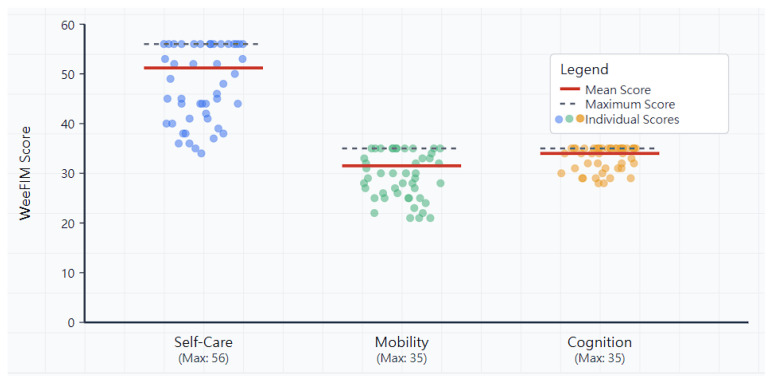 Figure 1
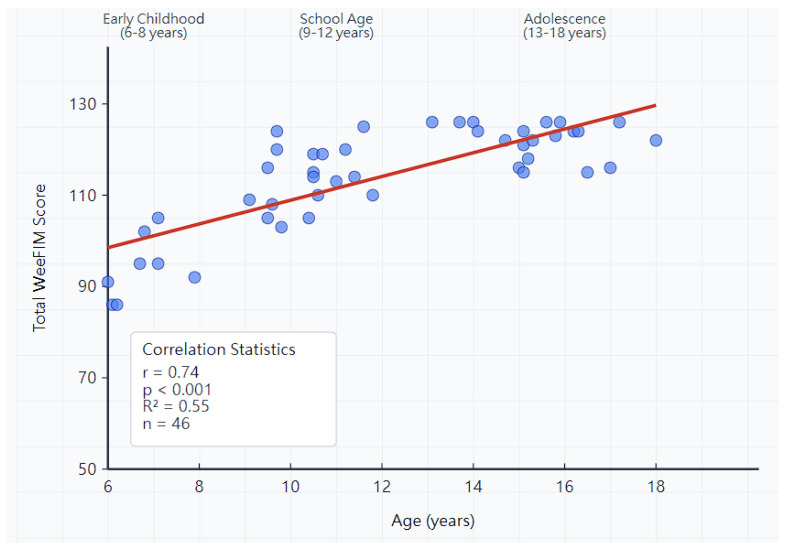 Figure 2
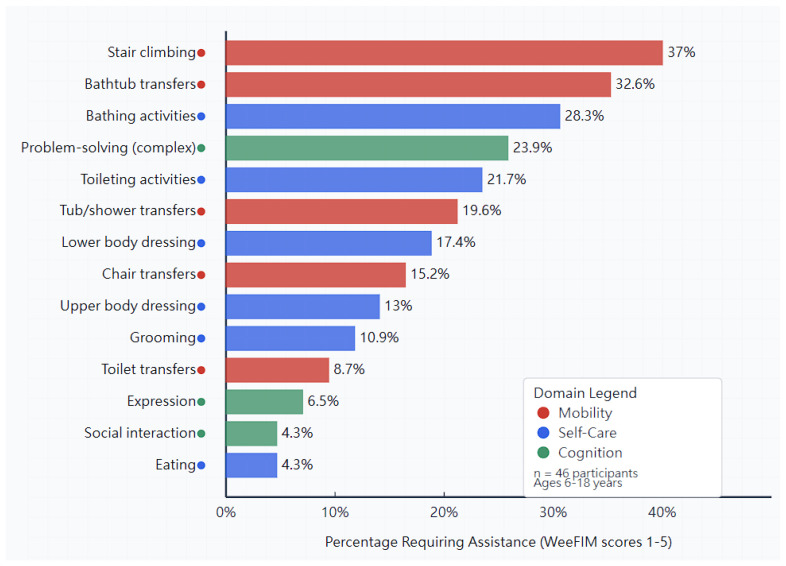 Figure 3
Peer Reviews
No public reviews on file for this paper yet. If you reviewed it on a platform where reviews are public (OpenReview, ICLR, NeurIPS, ICML), you can paste yours below so the community can read it here.
Videos
No videos yet. Explain this paper in a talk, walkthrough, or lecture? Add one.
Taxonomy
TopicsConnective tissue disorders research