Immunophenotypic Panel for Comprehensive Characterization of Aggressive Thyroid Carcinomas
Mihail Ceausu, Mihai Alin Publik, Dana Terzea, Carmen Adina Cristea, Dumitru Ioachim, Dana Manda, Sorina Schipor

TL;DR
This study identifies key immunohistochemical markers and molecular patterns that help distinguish aggressive thyroid cancers, offering insights for better diagnosis and classification.
Contribution
The study proposes a novel immunophenotypic panel for diagnosing aggressive thyroid carcinomas, highlighting specific biomarker associations and molecular patterns.
Findings
BRAFV600E is more prevalent in anaplastic thyroid carcinoma (ATC) and serves as a potential screening tool for the mutation.
Loss of TTF-1 and PAX-8 is associated with anaplastic transformation, while TERT is highly expressed in most cases.
Ki-67 proliferation index is significantly higher in ATC, indicating its role in assessing tumor aggressiveness.
Abstract
Aggressive thyroid carcinomas—anaplastic (ATC) and poorly differentiated (PDTC)—are rare but highly lethal malignant entities. Their immunophenotypical characterization is still incomplete, and no standardized diagnostic algorithms have been used. Our study retrospectively analyzes 40 thyroidectomy cases as follows: 12 ATC and 28 PDTC from 2014 to 2024 by evaluating clinical data, histopathological aspects, molecular analysis for presence of BRAFV600E and TERTC228/250T mutations, as well as immunohistochemical expression of BRAFV600E, total BRAF, K-RAS, TERT, PAX-8, TTF-1, P53, and Ki-67. BRAFV600E was present in 70% of cases, with higher prevalence in ATC. Total BRAF correlated positively with K-RAS and TERT and negatively with BRAFV600E. TERT abnormal expression was highly prevalent in over 90% of cases, while loss of TTF-1 and PAX-8 is associated with anaplastic transformation. Ki-67…
Genes, proteins, chemicals, diseases, species, mutations and cell lines named across the full text — each resolved to its canonical identifier and authoritative record.
Click any figure to enlarge with its caption.
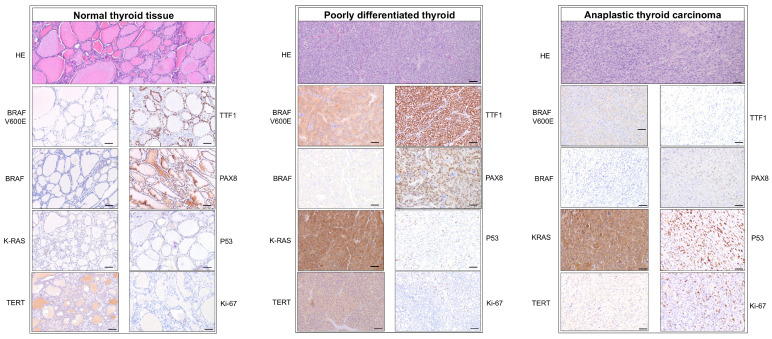 Figure 1
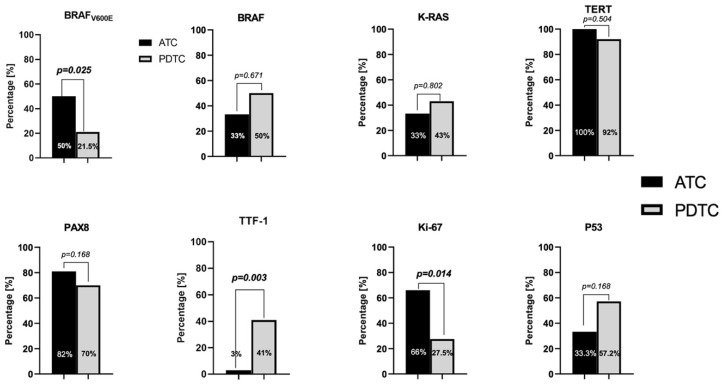 Figure 2
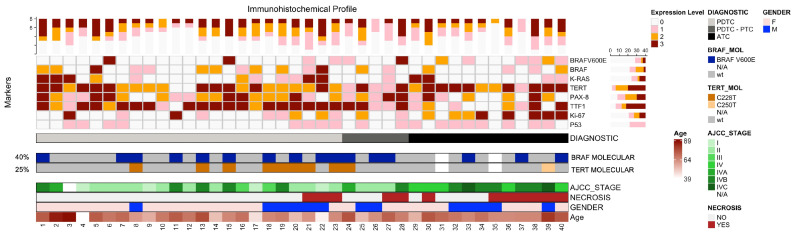 Figure 3
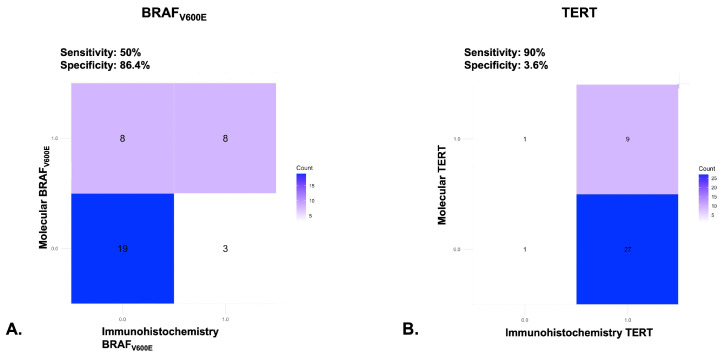 Figure 4
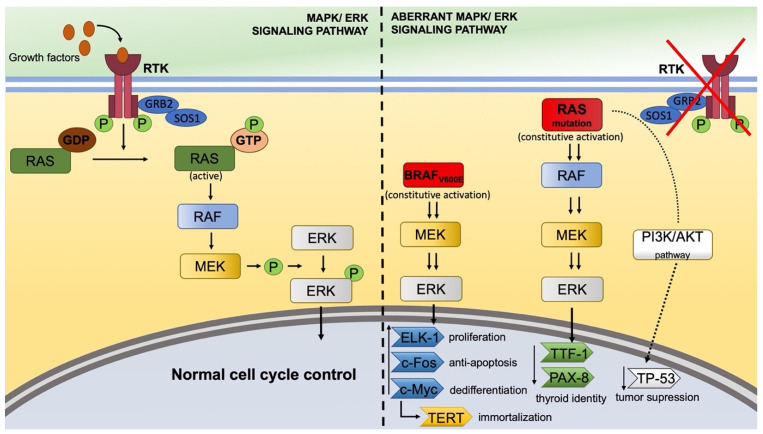 Figure 5
Peer Reviews
No public reviews on file for this paper yet. If you reviewed it on a platform where reviews are public (OpenReview, ICLR, NeurIPS, ICML), you can paste yours below so the community can read it here.
Videos
No videos yet. Explain this paper in a talk, walkthrough, or lecture? Add one.
Taxonomy
TopicsThyroid Cancer Diagnosis and Treatment · S100 Proteins and Annexins · Biomarkers in Disease Mechanisms