Combined Infrared Thermography and Agitated Behavior in Sows Improve Estrus Detection When Applied to Supervised Machine Learning Algorithms
Leila Cristina Salles Moura, Janaina Palermo Mendes, Yann Malini Ferreira, Rayna Sousa Vieira Amaral, Diana Assis Oliveira, Fabiana Ribeiro Caldara, Bianca Thais Baumann, Jansller Luiz Genova, Charles Kiefer, Luciano Hauschild, Luan Sousa Santos

TL;DR
Combining infrared thermography and behavioral signs in sows improves estrus detection accuracy using machine learning.
Contribution
Integrating infrared thermography with agitated behavior and machine learning improves estrus detection in sows.
Findings
The orbital region showed significant temperature differences between estrus and non-estrus states in sows.
Combining agitated behavior with orbital thermography achieved 87% accuracy in estrus detection using machine learning.
Supervised machine learning models like random forest and KNN were tested for estrus prediction.
Abstract
Estrus detection allows greater fertility success with artificial insemination. Thus, evaluating changes in body surface temperature can provide an accurate model to predict estrus occurrence. Nine LW × LD crossbred sows were studied in this pilot study, and thermographic images were collected post-weaning and in sows subjected to a hormonal induction protocol. The results show that significant temperature differences exist between pre-estrus and estrus, suggesting their potential as an indicator of changes in internal temperature during estrus, with 87% accuracy in estrus identification. They are good indicators for determining estrus in sows. The identification of estrus at the right moment allows for a higher success of fecundity with artificial insemination. Evaluating changes in body surface temperature of sows during the estrus period using an infrared thermography camera (ITC)…
Genes, proteins, chemicals, diseases, species, mutations and cell lines named across the full text — each resolved to its canonical identifier and authoritative record.
Click any figure to enlarge with its caption.
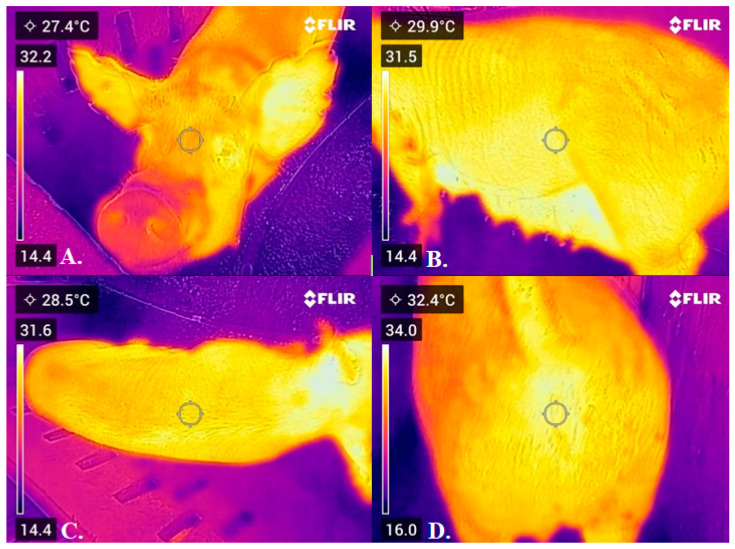 Figure 1
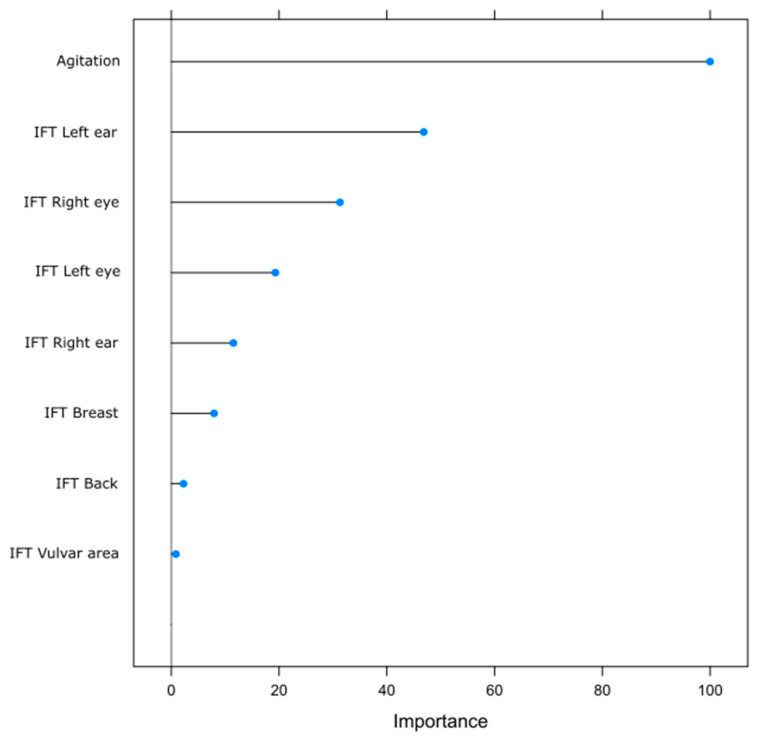 Figure 2
Peer Reviews
No public reviews on file for this paper yet. If you reviewed it on a platform where reviews are public (OpenReview, ICLR, NeurIPS, ICML), you can paste yours below so the community can read it here.
Videos
No videos yet. Explain this paper in a talk, walkthrough, or lecture? Add one.
Taxonomy
TopicsAnimal Behavior and Welfare Studies · Meat and Animal Product Quality · Effects of Environmental Stressors on Livestock