A health economics assessment of self-care with over-the-counter ibuprofen in dysmenorrhoea, migraine and acute rhinosinusitis in the United Kingdom
Daniela Afonso, Amy Dymond, Isabel Eastwood, William Green, William Laughey, Patricia Aluko, Graham Pennick, Imran Lodhi, Bruce Charlesworth

TL;DR
Using over-the-counter ibuprofen for minor conditions like dysmenorrhoea, migraine, and acute rhinosinusitis could save the NHS resources and reduce missed work and school days.
Contribution
This study quantifies the economic impact of increased self-care with ibuprofen on healthcare resource use and productivity in the UK.
Findings
A 5% increase in self-care with ibuprofen could prevent 409,243 NHS appointments in the UK over one year.
Approximately 882,875 work hours and 117,114 school hours could be saved with increased ibuprofen self-care.
Sensitivity analysis highlights the importance of self-care rates, working hours, and appointment waiting times in the model.
Abstract
Increased appropriate use of self-care for minor conditions can reduce the number of healthcare professional appointments and, hence, provide opportunity cost savings to the National Health Service (NHS). The receipt of over-the-counter medications can lead to faster access to treatment, improved health-related quality of life, and fewer education and work days lost. A model was developed to evaluate the economic impact of a change in the proportion of people using self-care with ibuprofen to manage three conditions (dysmenorrhoea, migraine and acute rhinosinusitis) on preventable healthcare resource use from the perspective of the NHS and Personal Social Services (PSS). The total number of appointments for each condition was estimated from NHS Digital and was based on the number of primary (n = 230,298,091) and secondary (n = 22,839,832) care visits, and the proportion of visits due…
Genes, proteins, chemicals, diseases, species, mutations and cell lines named across the full text — each resolved to its canonical identifier and authoritative record.
Click any figure to enlarge with its caption.
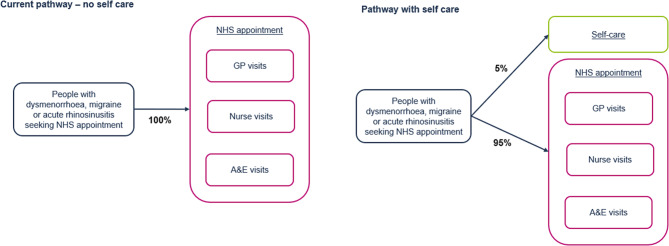 Figure 1
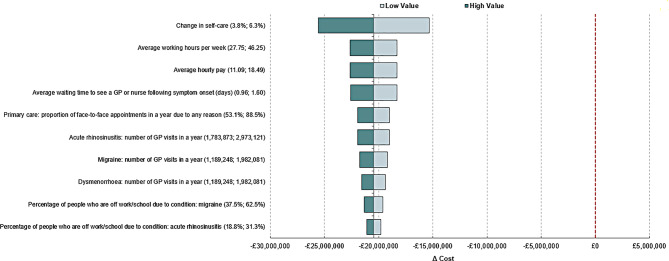 Figure 2
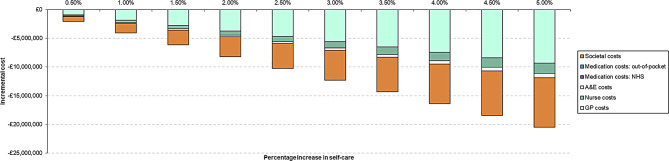 Figure 3
Peer Reviews
No public reviews on file for this paper yet. If you reviewed it on a platform where reviews are public (OpenReview, ICLR, NeurIPS, ICML), you can paste yours below so the community can read it here.
Videos
No videos yet. Explain this paper in a talk, walkthrough, or lecture? Add one.
Taxonomy
TopicsMaternal Mental Health During Pregnancy and Postpartum · Healthcare professionals’ stress and burnout · Menstrual Health and Disorders