Effect of perioperative repetitive transcranial magnetic stimulation on postoperative cognitive function and peripheral inflammation in elderly total knee arthroplasty patients: study protocol for a randomized controlled trial
Zhenhua Wu, Huan Tian, Sicheng Li, Hongfei Ren, Zizhe Yao, Cai Jiang, Xiaohua Ke, Dunbing Huang, Zhonghua Lin

TL;DR
This study tests if rTMS can reduce post-surgery cognitive issues and inflammation in elderly knee replacement patients.
Contribution
This is the first trial to investigate perioperative rTMS as a preventive intervention for postoperative cognitive dysfunction in TKA patients.
Findings
rTMS may reduce neuroinflammation and cognitive decline by targeting the DLPFC pre-surgery.
The trial will assess changes in cognitive scores and inflammatory markers like IL-1β, IL-6, and TNF-α.
Results could clarify if rTMS provides neuroprotection by blocking POCD pathways.
Abstract
Postoperative cognitive dysfunction (POCD) is a serious and common complication after total knee arthroplasty (TKA) in the elderly. Studies have suggested that repetitive transcranial magnetic stimulation (rTMS) can reduce the levels of tumor necrosis factor-alpha (TNF-α), interleukin-1 beta (IL-1β), and interleukin-6 (IL-6) inflammatory factors in the hippocampus, inhibit neuroinflammatory responses in the brain, and reduce the damage to synapses, thereby improving cognitive dysfunction. However, the effectiveness of rTMS for POCD remains to be explored. Therefore, the aim of this study is to treat POCD after TKA in the elderly with rTMS to evaluate the clinical efficacy of rTMS for POCD. This single-center, randomized, sham-controlled, assessor-blinded, parallel-group trial will enroll 207 elderly patients undergoing TKA and allocate them 1:1:1 to control group, active rTMS group, or…
Genes, proteins, chemicals, diseases, species, mutations and cell lines named across the full text — each resolved to its canonical identifier and authoritative record.
Click any figure to enlarge with its caption.
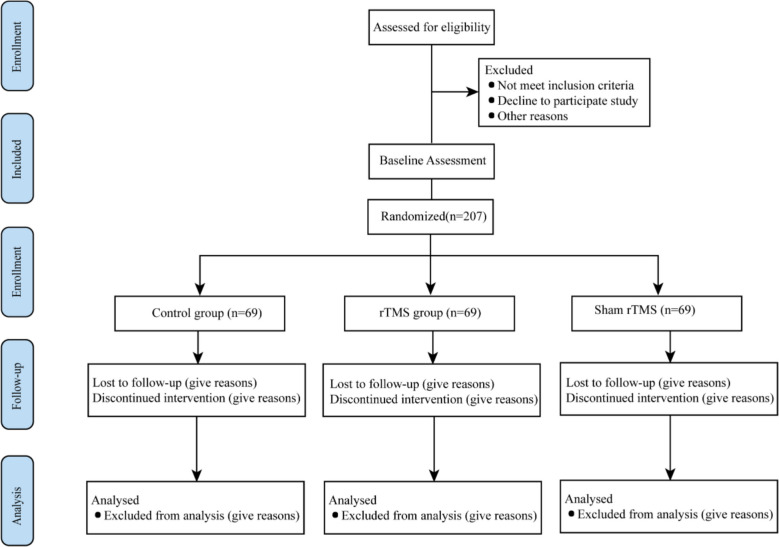 Figure 1
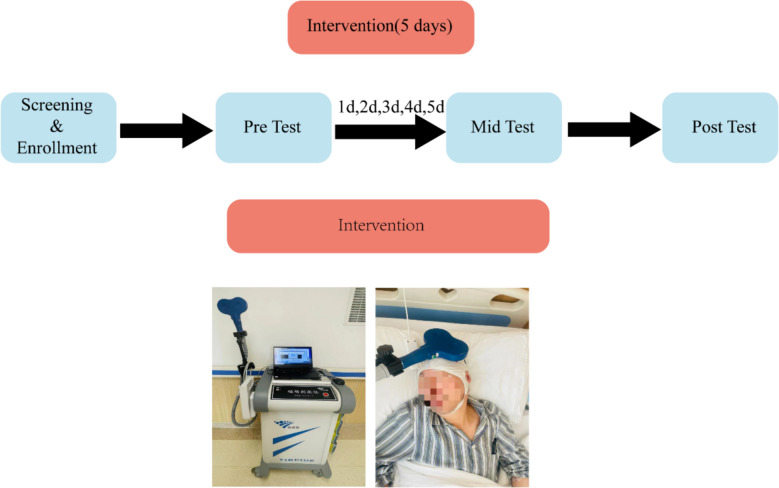 Figure 2
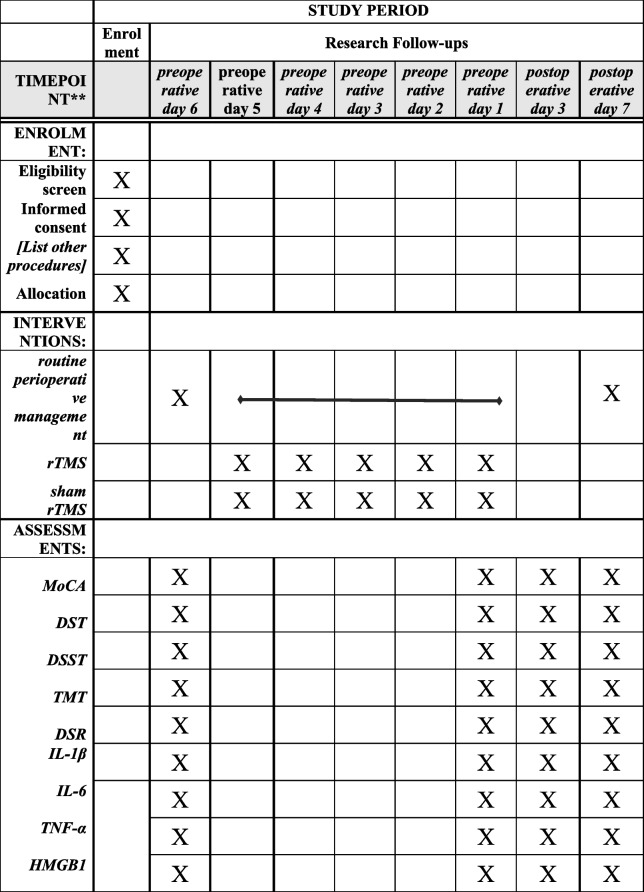 Figure 3
Peer Reviews
No public reviews on file for this paper yet. If you reviewed it on a platform where reviews are public (OpenReview, ICLR, NeurIPS, ICML), you can paste yours below so the community can read it here.
Videos
No videos yet. Explain this paper in a talk, walkthrough, or lecture? Add one.
Taxonomy
TopicsIntensive Care Unit Cognitive Disorders · Music Therapy and Health · Transcranial Magnetic Stimulation Studies