Genetic testing of common and rare variants in dementia patients from a memory clinic: Dementia-related genetic testing in memory clinic
Itziar de Rojas, Marc Hulsman, Niccoló Tesi, Rosalina M.L. van Spaendonk, Jetske van der Schaar, Janna I.R. Dijkstra, Wiesje M. van der Flier, Fred van Ruissen, Philip R. Jansen, Marcel T. Reinders, Mieke M. van Haelst, Yolande A.L. Pijnenburg, Maria Victoria Fernandez

TL;DR
This study explores how combining genetic risk factors can help diagnose Alzheimer's disease in memory clinic patients.
Contribution
The study evaluates a combined genetic score integrating common and rare variants for improved Alzheimer's diagnosis.
Findings
A combined genetic score increased the likelihood of an Alzheimer's diagnosis by 7 times in high-risk patients.
APOE genotypes and a polygenic risk score were independently associated with Alzheimer's disease.
Genetic testing altered the diagnosis in over half of patients with causal pathogenic variants.
Abstract
Many types of dementia have high heritability, which creates opportunities for DNA diagnostics. Clinicians sporadically test for causal genetic variants. However, in addition to causal genetic mutations, an increasing number of both common and rare risk factors are being identified, especially for Alzheimer’s disease (AD). Here, we describe and evaluate diagnostic performance of combining genetic risk factors for AD to assist memory clinic clinicians. A retrospective analysis of 998 consecutive patients (mean age 62.1, 40.3% females, 63.3% dementia) was conducted over 2.5 years in a Dutch memory clinic. The patients underwent a complete genetic risk assessment, including whole-exome sequencing and array genotyping. We examined known pathogenic genetic variants for all dementia types and their correlation with clinical diagnoses. We evaluated a combined genetic score (GS) based on all…
Genes, proteins, chemicals, diseases, species, mutations and cell lines named across the full text — each resolved to its canonical identifier and authoritative record.
Click any figure to enlarge with its caption.
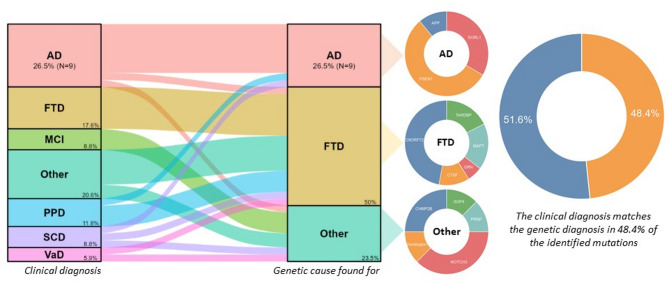 Figure 1
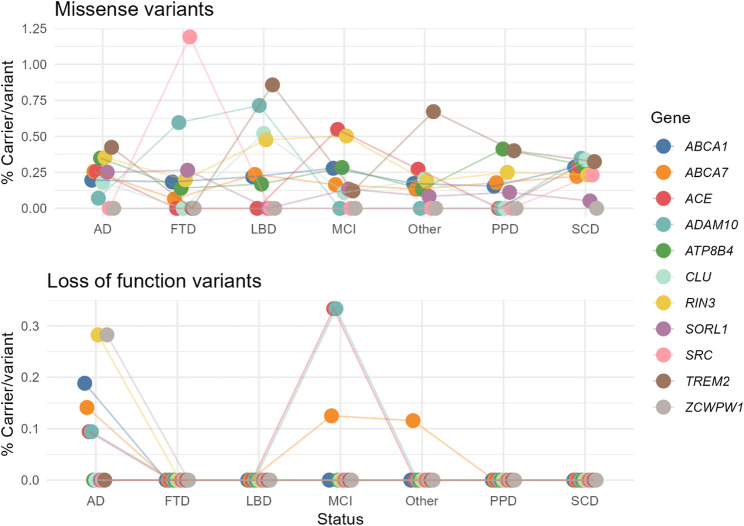 Figure 2
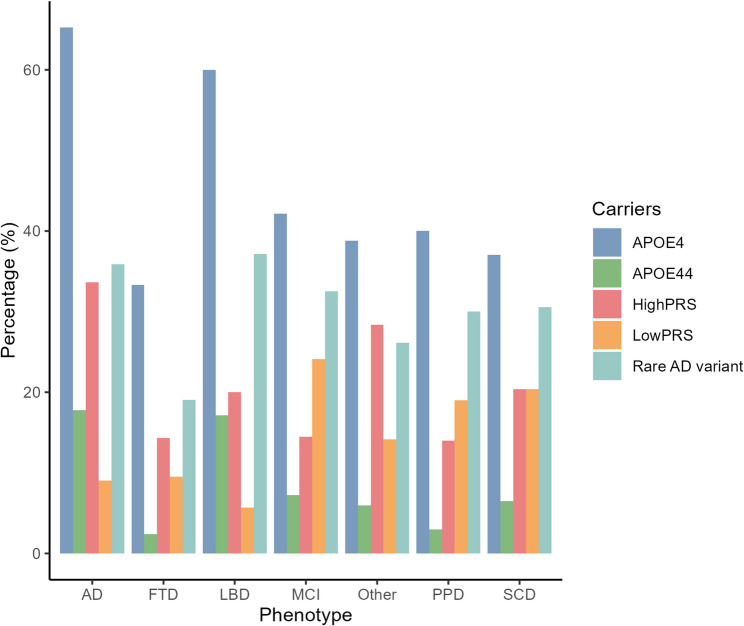 Figure 3
Peer Reviews
No public reviews on file for this paper yet. If you reviewed it on a platform where reviews are public (OpenReview, ICLR, NeurIPS, ICML), you can paste yours below so the community can read it here.
Videos
No videos yet. Explain this paper in a talk, walkthrough, or lecture? Add one.
Taxonomy
TopicsGenomics and Rare Diseases · Genetics and Neurodevelopmental Disorders · Epigenetics and DNA Methylation