Impact of timing of computed tomography staging and patient factors on the detection of ‘true’ cN+ bladder cancer
Markus von Deimling, Marc Furrer, Alberto Bianchi, Renate Pichler, Moritz Maas, Karl H. Tully, Mattia Longoni, Laura S. Mertens, Jacob Taylor, Francesco del Giudice, Roger Li, Andrea Gallioli, Simone Albisinni, Felice Crocetto, Maud Velev, Luca Afferi, Andrea Mari

TL;DR
This study finds that the timing of CT scans relative to bladder tumor surgery does not affect the accuracy of lymph node staging in bladder cancer patients.
Contribution
The study is the first to show that lymphovascular invasion at TURBT is a strong predictor of lymph node metastasis in clinically node-positive bladder cancer.
Findings
Timing of CT scans before or after TURBT does not impact staging accuracy for bladder cancer lymph nodes.
Lymphovascular invasion at TURBT is strongly associated with pathological lymph node metastasis at radical cystectomy.
About half of patients with clinically node-positive bladder cancer were found to have no lymph node metastasis at surgery.
Abstract
To evaluate whether computed tomography (CT) scans should be performed before or after transurethral resection of bladder tumour (TURBT) for accurate lymph node staging in clinically lymph node‐positive bladder cancer (BCa). Additionally, to identify patient factors that can aid in predicting lymph node metastasis. In this retrospective, multicentre study, we analysed patients with cN+ M0 BCa staged by CT and treated with upfront radical cystectomy (RC) and pelvic lymph node dissection. We stratified patients by the interval between TURBT and CT into three groups: (1) before TURBT; (2) within 30 days after TURBT; and (3) more than 30 days post‐TURBT. Staging accuracy, defined as concordance between clinical and pathological lymph node status, was evaluated. We utilised logistic regression analyses to identify patient factors, including the optimal timing of staging, in predicting…
Genes, proteins, chemicals, diseases, species, mutations and cell lines named across the full text — each resolved to its canonical identifier and authoritative record.
Click any figure to enlarge with its caption.
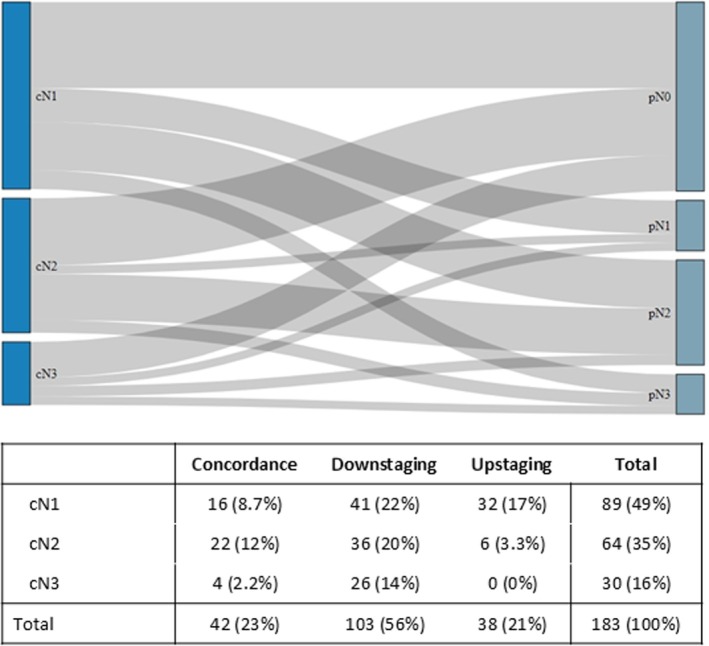 Figure 1
Peer Reviews
No public reviews on file for this paper yet. If you reviewed it on a platform where reviews are public (OpenReview, ICLR, NeurIPS, ICML), you can paste yours below so the community can read it here.
Videos
No videos yet. Explain this paper in a talk, walkthrough, or lecture? Add one.
Taxonomy
TopicsBladder and Urothelial Cancer Treatments · Urinary and Genital Oncology Studies · Urological Disorders and Treatments