Genotype characteristics of two non traveler sources burkholderia pseudomallei strains isolated from clinical patients for the first time in Chongqing, China
Gang Duan, Chunyan Liao, Gaomin Liu, Linghan Kong, Ling Wang

TL;DR
Two new Burkholderia pseudomallei strains were identified in Chongqing, China, showing genetic differences and antibiotic sensitivity, suggesting a potential rise in melioidosis due to climate change.
Contribution
First report of non-traveler B. pseudomallei infections in Chongqing, with genomic and antibiotic sensitivity analysis of two novel strains.
Findings
The two B. pseudomallei strains showed significant genetic differences with 17,197 SNPs and one novel sequence type (ST2149).
Both strains were sensitive to common antibiotics despite carrying beta-lactam resistance genes.
Strain CQ2024Bp-002 lacked certain virulence genes (boaB and wzt2) compared to CQ2024Bp-001.
Abstract
In 2024, two cases of melioidosis were discovered in Chongqing, China. This was the first instance of non-traveler infection cases being found in this region. The strain characteristics and phylogenetic relationships of the two B. pseudomallei (CQ2024Bp-001 and CQ2024Bp-002) remained poorly understood. An antibiotic sensitivity test, genomic sequencing, prediction of virulence genes and ARGs, wgSNP, and MLST were performed for the two strains. The results indicated that the two strains had significant genetic differences (17197 SNPs), and CQ2024Bp-002 was a novel sequence type (ST2149). CQ2024Bp-001 carried blaOXA-59 and blaOXA-57, while CQ2024Bp-002 only carried blaOXA-59. Despite carrying \documentclass[12pt]{minimal} \usepackage{amsmath} \usepackage{wasysym} \usepackage{amsfonts} \usepackage{amssymb} \usepackage{amsbsy} \usepackage{mathrsfs}…
Genes, proteins, chemicals, diseases, species, mutations and cell lines named across the full text — each resolved to its canonical identifier and authoritative record.
Click any figure to enlarge with its caption.
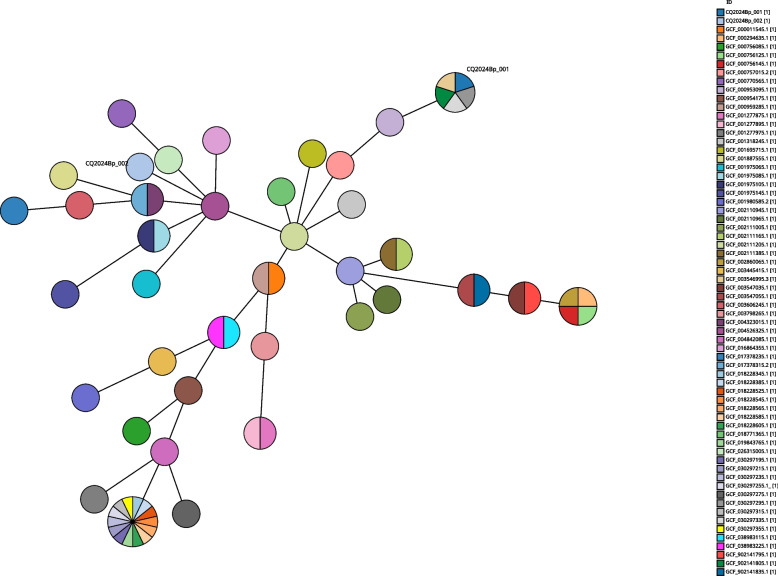 Figure 1
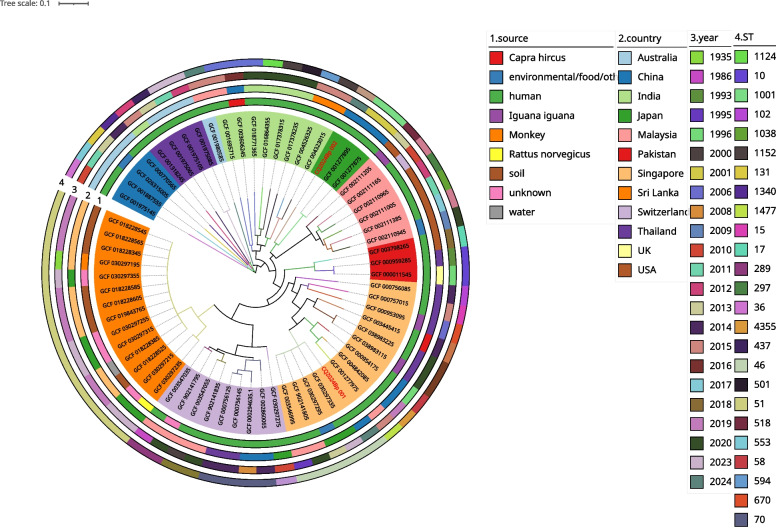 Figure 2
Peer Reviews
No public reviews on file for this paper yet. If you reviewed it on a platform where reviews are public (OpenReview, ICLR, NeurIPS, ICML), you can paste yours below so the community can read it here.
Videos
No videos yet. Explain this paper in a talk, walkthrough, or lecture? Add one.
Taxonomy
TopicsBurkholderia infections and melioidosis · Chemical Looping and Thermochemical Processes