Rhenium Chalcogenide Clusters Containing para-Substituted Phenylacetylide Ligands: Synthesis, Characterization, and Investigation of Substituent Effects on Spectroscopic and Electrochemical Properties
Katherine L. Helmink, Cory A. Hicks, B. Sage Lauper-Cook, Steven J. Peters, Christopher J. A. Daley, Yann Molard, Lisa F. Szczepura

TL;DR
This paper reports the synthesis and characterization of new rhenium cluster complexes with substituted phenylacetylide ligands and explores how these substitutions affect their electrochemical and optical properties.
Contribution
The study introduces new [Re6Se8]2+ cluster complexes with para-substituted phenylacetylide ligands and reveals unique substituent effects on their spectroscopic and electrochemical behavior.
Findings
The Hammett parameter σp correlates with the [Re6Se8]3+/2+ redox couple, showing substituent effects on electrochemistry.
The reversibility of the oxidative process is influenced by the nature of the para-substituent.
Substituents affect photophysical properties, but the emission trend is opposite to that seen in benzonitrile ligand studies.
Abstract
Four new organometallic [Re6Se8]2+-based cluster complexes containing para-substituted phenylacetylide ligands, [Re6Se8(PEt3)5(CC–C6H4–X)](SbF6) where X = NO2, CO2Me, CH3, and OMe, have been synthesized and fully characterized using 1H, 13C{1H} and 31P{1H} NMR, IR, and UV–vis spectroscopy, HRMS, and elemental analysis. Three of these cluster complexes, [Re6Se8(PEt3)5(CC–C6H4–NO2)]+, [Re6Se8(PEt3)5(CC–C6H4–CO2Me)]+, and [Re6Se8(PEt3)5(CC–C6H4–CH3)]+ were also characterized via single-crystal X-ray diffraction. Electrochemical studies of these newly reported complexes, as well as the unsubstituted phenylacetylide complex, [Re6Se8(PEt3)5(CC–C6H5)](SbF6), reveal a correlation between the Hammett parameter σp and the [Re6Se8]3+/2+ couple. The reversibility of this oxidative process is also significantly impacted by the nature of the para-substituent. The photophysical properties of…
Genes, proteins, chemicals, diseases, species, mutations and cell lines named across the full text — each resolved to its canonical identifier and authoritative record.
Click any figure to enlarge with its caption.
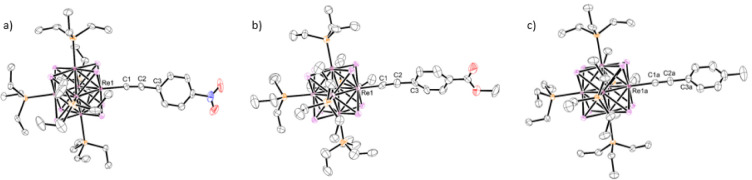 Figure 1
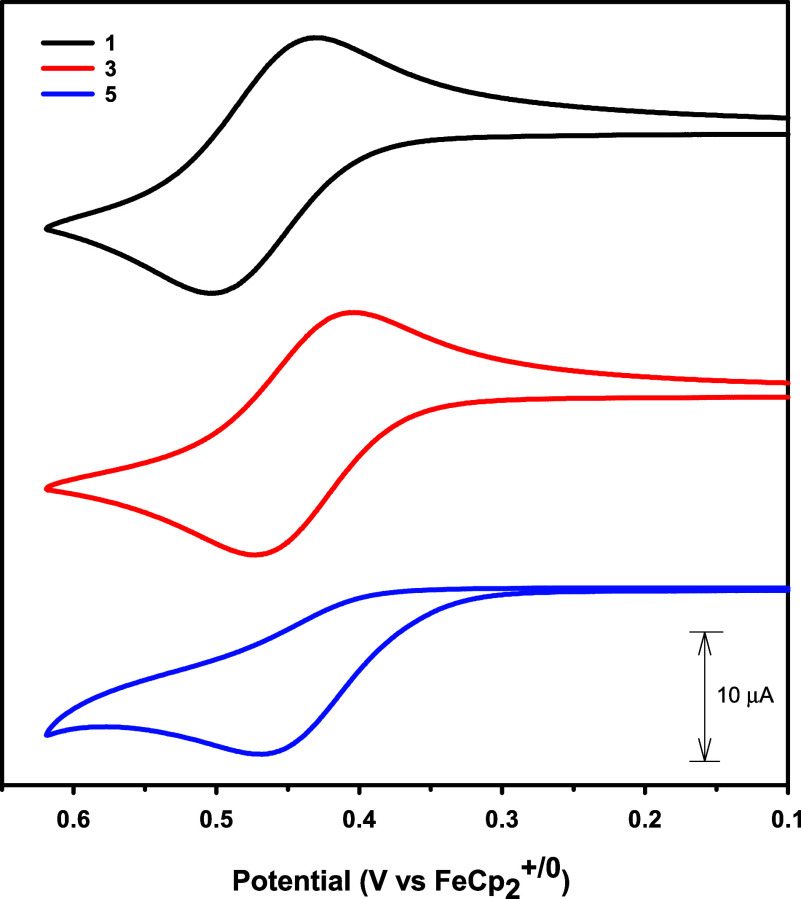 Figure 2
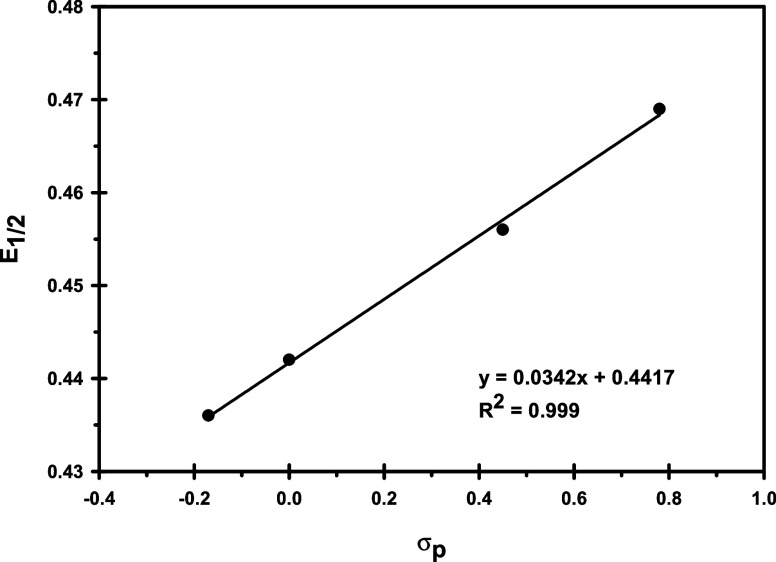 Figure 3
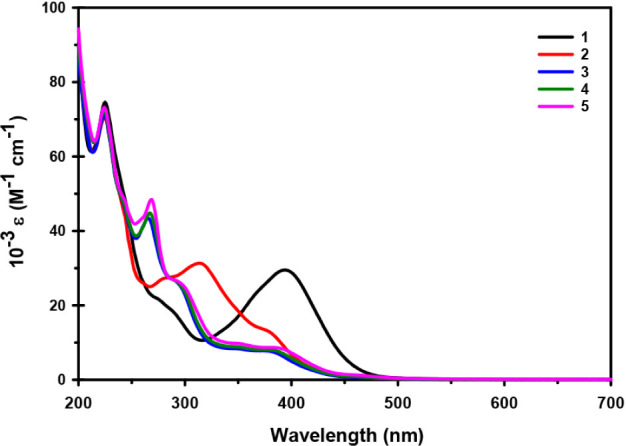 Figure 4
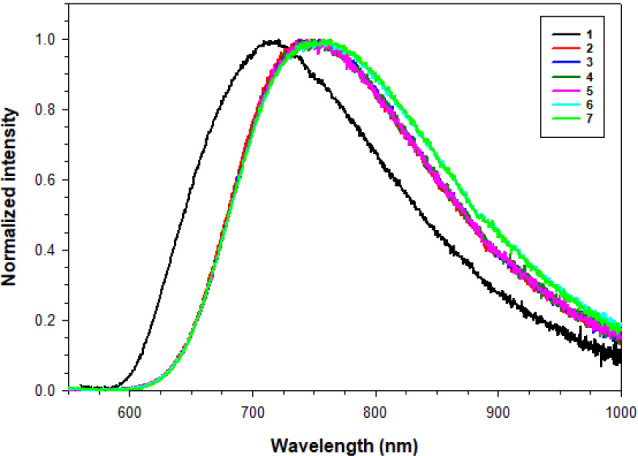 Figure 5
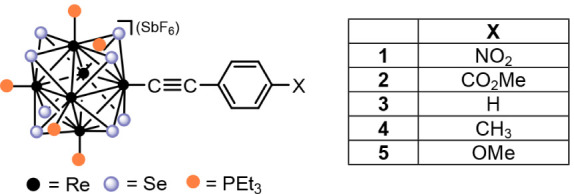 Figure 6
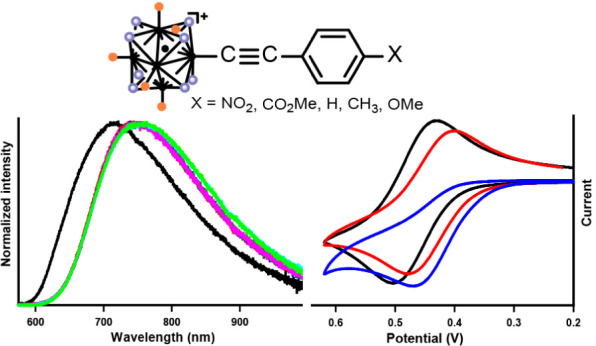 Figure 7
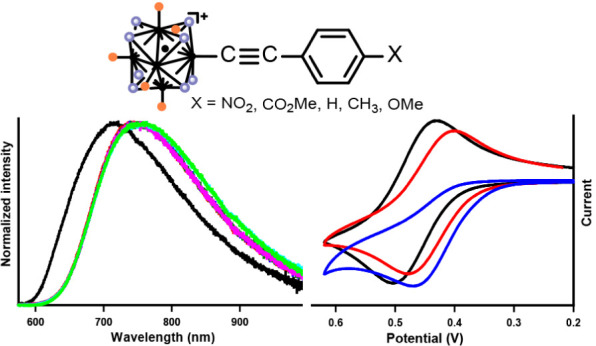 Figure 8
Peer Reviews
No public reviews on file for this paper yet. If you reviewed it on a platform where reviews are public (OpenReview, ICLR, NeurIPS, ICML), you can paste yours below so the community can read it here.
Videos
No videos yet. Explain this paper in a talk, walkthrough, or lecture? Add one.
Taxonomy
TopicsInorganic Chemistry and Materials · Organometallic Complex Synthesis and Catalysis · Nanocluster Synthesis and Applications