A Case of Worsened Refractory Ascites due to Prednisolone Administration for Stricture Prevention after Endoscopic Submucosal Dissection for Extensive Early Esophageal Cancer: Case Report and Literature Review
Yuki Tamura, Masanori Sekiguchi, Kaho Honda, Yu Maruyama, Kenta Ito, Makiko Inoue, Mitsuhiko Shibasaki, Daichi Takizawa, Hirotaka Arai, Toshio Uraoka

TL;DR
A patient with liver cirrhosis and severe ascites worsened after receiving corticosteroids to prevent esophageal stricture following cancer treatment, leading to fatal complications.
Contribution
This case report highlights the potential risks of corticosteroid use in cirrhotic patients with refractory ascites following endoscopic submucosal dissection.
Findings
Oral prednisolone administration in a cirrhotic patient with refractory ascites led to worsened ascites and thrombotic complications.
The patient developed non-occlusive mesenteric ischemia and bowel perforation, resulting in death.
The case suggests corticosteroids may increase thrombotic risk in decompensated liver cirrhosis patients.
Abstract
Endoscopic submucosal dissection (ESD) is widely used for early esophageal cancer, even in patients with liver cirrhosis (LC). Corticosteroids, administered orally or by local injection, are often used to prevent post‐ESD esophageal stricture. However, their safety in patients with decompensated LC and refractory ascites remains unclear. A man in his 70s with alcohol‐related decompensated LC and refractory ascites underwent ESD for subcircumferential superficial esophageal squamous cell carcinoma located on esophageal varices. To prevent post‐ESD stricture, both oral prednisolone and local triamcinolone were administered. Ascites worsened significantly, and large‐volume paracentesis was performed. Subsequently, the patient developed a mural thrombus in the superior mesenteric vein and non‐occlusive mesenteric ischemia, leading to bowel perforation and death on day 51 post‐ESD. In LC…
Genes, proteins, chemicals, diseases, species, mutations and cell lines named across the full text — each resolved to its canonical identifier and authoritative record.
Click any figure to enlarge with its caption.
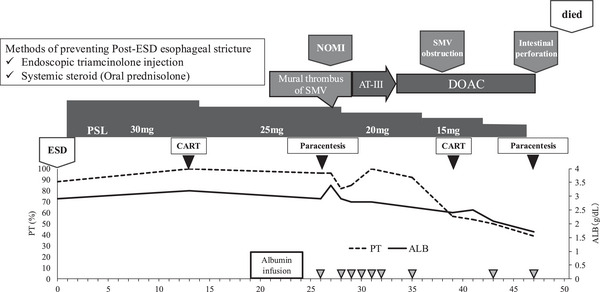 Figure 1
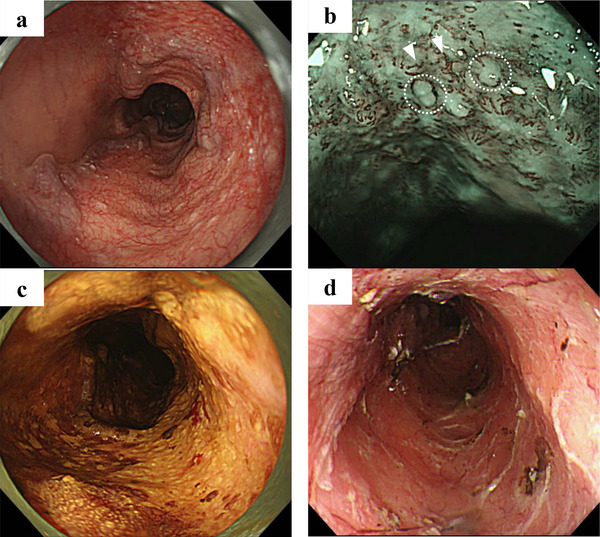 Figure 2
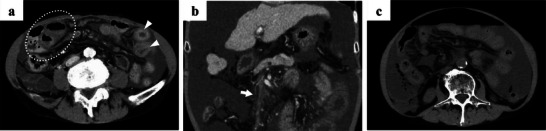 Figure 3
Peer Reviews
No public reviews on file for this paper yet. If you reviewed it on a platform where reviews are public (OpenReview, ICLR, NeurIPS, ICML), you can paste yours below so the community can read it here.
Videos
No videos yet. Explain this paper in a talk, walkthrough, or lecture? Add one.
Taxonomy
TopicsEsophageal and GI Pathology · Gastroesophageal reflux and treatments · Esophageal Cancer Research and Treatment