Determinants of oncologic outcomes in high‐grade organ‐confined prostate cancer after prostatectomy
Reem Youssef, Omer AM Saeed, Ezra Baraban, Mohammad Salimian, Kenneth A Iczkowski, Lorene J Chung, Nicholas Baniak, Eva M Compérat, Ying Wang, Geert JLH van Leenders, Ankur R Sangoi, Douglas Jian‐Xian Wu, Adeboye O Osunkoya, Shivani Kandukuri, Alicia Cuber, Kvetoslava Michalova

TL;DR
This study examines outcomes for patients with high-grade prostate cancer confined to the prostate after surgery, identifying factors like tumor size and PSA levels that predict cancer recurrence and spread.
Contribution
The study identifies preoperative PSA and tumor size as independent predictors of outcomes in high-grade prostate cancer confined to the prostate after surgery.
Findings
Preoperative PSA levels are an independent predictor of biochemical recurrence in high-grade prostate cancer patients.
Tumor size (cut-off 15 mm) is an independent predictor of metastasis risk in these patients.
Large cribriform components and lymphovascular invasion are associated with metastasis risk but not independently.
Abstract
In radical prostatectomy (RP), Grade Group (GG) 4/5 prostate cancer [high‐grade prostate cancer (HGPC) hereafter] is often associated with extension beyond the prostate and positive surgical margins. Hence, there is limited information on post‐RP outcomes of patients with completely resected HGPC confined to the prostate (pT2). Clinical outcomes were assessed in a cohort of patients with pT2 HGPC and negative surgical margins using Kaplan‐Meier statistics and Cox regression analysis. Four hundred and seven RPs were initially assessed: 236 (58%) with GG 4 and 171 (42%) with GG 5 prostate cancer (PCa). Survival analysis was performed on subsets of patients with available follow‐up (BCR: n = 343, metastases: n = 347) to identify clinicopathologic variables associated with the risk of biochemical recurrence and metastasis. The size of the dominant nodule (cut‐off 15 mm) (HR 1.654, 95% CI…
Genes, proteins, chemicals, diseases, species, mutations and cell lines named across the full text — each resolved to its canonical identifier and authoritative record.
Click any figure to enlarge with its caption.
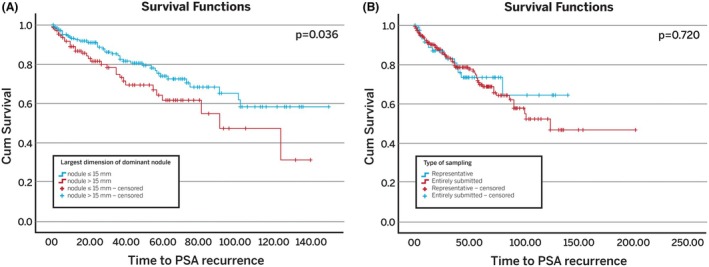 Figure 1
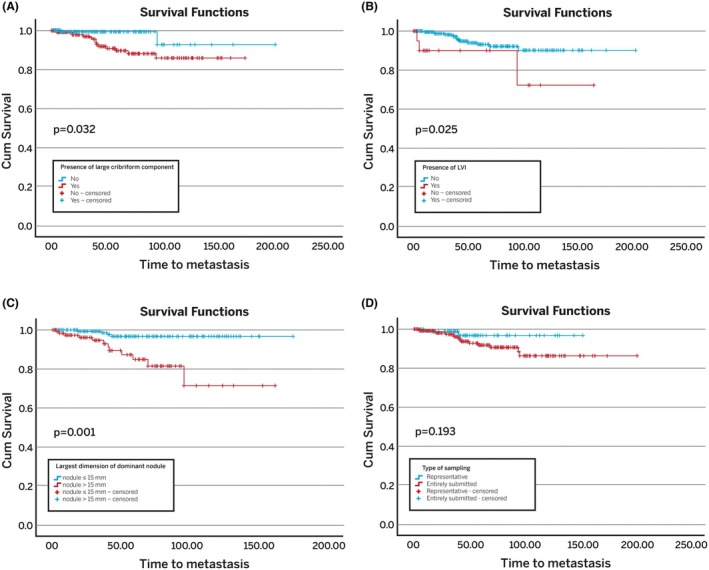 Figure 2
 Figure 3
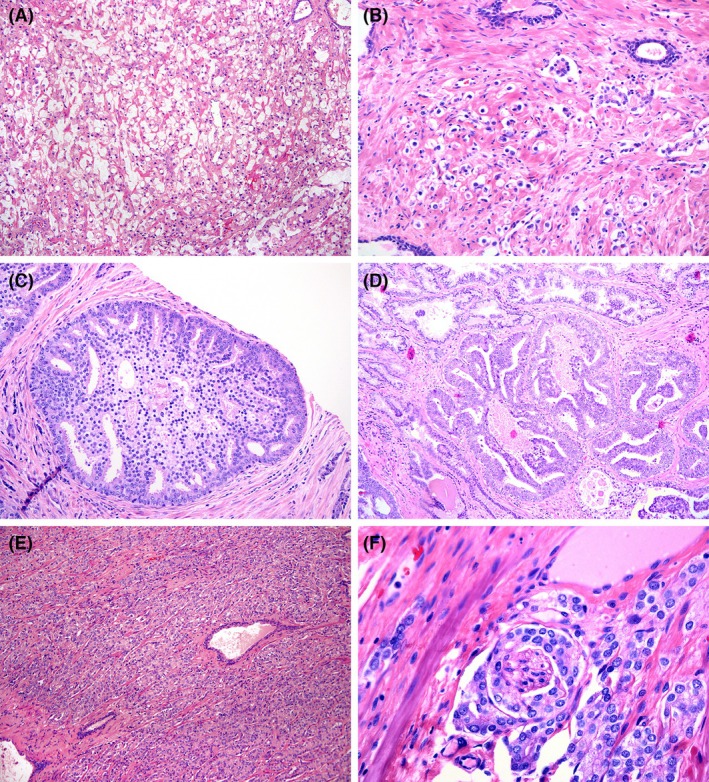 Figure 4
Peer Reviews
No public reviews on file for this paper yet. If you reviewed it on a platform where reviews are public (OpenReview, ICLR, NeurIPS, ICML), you can paste yours below so the community can read it here.
Videos
No videos yet. Explain this paper in a talk, walkthrough, or lecture? Add one.
Taxonomy
TopicsProstate Cancer Diagnosis and Treatment · Prostate Cancer Treatment and Research · Health Systems, Economic Evaluations, Quality of Life