Spontaneous and heritable change in iridescent properties of bacterium Tenacibaculum discolor str. IMLK18
Hooi Lynn Kee

TL;DR
A marine bacterium can spontaneously change its iridescent color during biofilm growth, a never-before-seen phenomenon in living organisms.
Contribution
The first observation of natural iridescence mutants in a living system, specifically a marine bacterium.
Findings
The bacterium Tenacibaculum discolor str. IMLK18 displays spontaneous and heritable changes in iridescence during biofilm growth.
Iridescence is only visible under epi-illumination and is absent in liquid culture.
This is the first report of natural iridescence mutants in any living organism.
Abstract
Iridescence is a structural color phenomenon where varying-colored hues arise from the interaction of light with physical surfaces, rather than from chemical pigments. Iridescence was thought to be unique to specific organisms such as butterflies, peacocks and birds, but it has been recently reported in bacterial species. Here we isolated a previously uncharacterized iridescent marine bacterial species from the ocean in Woods Hole, MA. Under epi-illumination the iridescence changes from vibrant red/orange/yellow to green. How living bacterial cells produces iridescence is an intriguing question, given that the architecture that gives rise to iridescence in terrestrial organisms are typically made up of non-living biological material in fish scales, bird feathers, or the arthropod exoskeleton. Notably, when the bacteria are grown in liquid culture, they do not display iridescence,…
Genes, proteins, chemicals, diseases, species, mutations and cell lines named across the full text — each resolved to its canonical identifier and authoritative record.
Click any figure to enlarge with its caption.
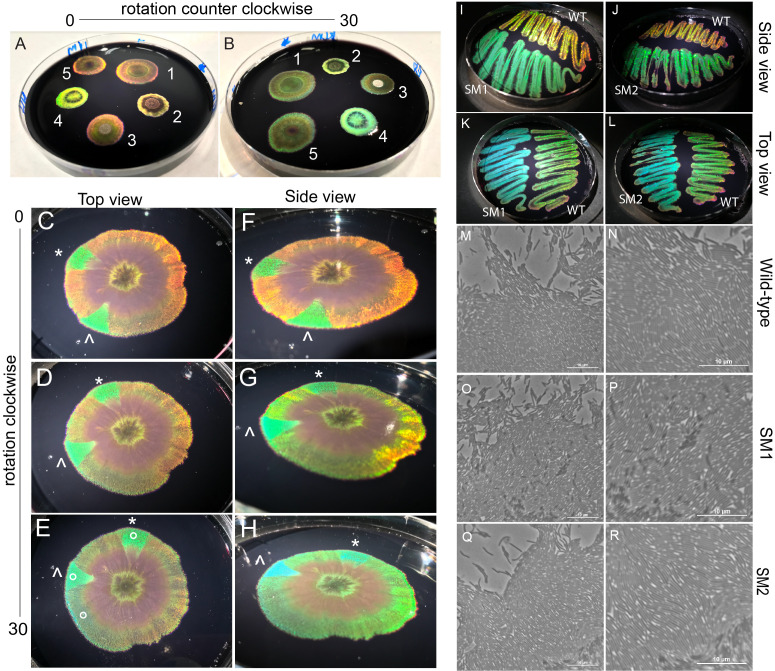 Figure 1
Peer Reviews
No public reviews on file for this paper yet. If you reviewed it on a platform where reviews are public (OpenReview, ICLR, NeurIPS, ICML), you can paste yours below so the community can read it here.
Videos
No videos yet. Explain this paper in a talk, walkthrough, or lecture? Add one.
Taxonomy
Topicsbioluminescence and chemiluminescence research