Culturally Tailored Diabetes Self-Management Education and Support Programs in Black African and Caribbean Adults With Type 2 Diabetes (HEAL-D): Protocol for a Multicenter, Pragmatic Randomized Controlled Trial
Louise M Goff, Drusus A Johnson, Vicky Bell, Susan Blyden, Peter Bower, Jeremy Dale, Tess Harris, Andrew Healey, Eleanor Hoverd, Huajie Jin, Tony Kelly, Carol Rivas, Clare Robinson, Jayne Thorpe, Sandra Tomlinson, Michael Ussher, Charlotte Wahlich, Barbara McGowan

TL;DR
This study tests a culturally tailored diabetes education program for Black African and Caribbean adults with type 2 diabetes to see if it improves health outcomes and is cost-effective.
Contribution
The study introduces a culturally tailored diabetes self-management program specifically designed for Black African and Caribbean populations.
Findings
The trial will assess clinical and cost-effectiveness of HEAL-D compared to standard programs.
A mixed methods process evaluation will explore delivery and implementation of the HEAL-D program.
Results will determine if culturally tailored programs improve diabetes management in ethnic minority groups.
Abstract
People of Black African and Black Caribbean ethnicity experience higher rates and poorer outcomes of type 2 diabetes (T2D) than people of White European ethnicity; these inequalities are compounded by poor healthcare access. Cultural tailoring of diabetes self-management education and support (DSMES) programs has the potential to improve healthcare engagement and clinical outcomes for ethnic minority groups. Healthy Eating & Active Lifestyles for Diabetes (HEAL-D) is a co-designed, culturally tailored group-based DSMES program for adults of Black African and Black Caribbean ethnicity. This trial aims to evaluate the clinical and cost effectiveness of the HEAL-D intervention, compared to standard DSMES programs, in Black African and Black Caribbean adults living with T2D. A 24-month, multicenter, pragmatic, open-label, 2-arm, parallel-group, individually randomized group treatment…
Genes, proteins, chemicals, diseases, species, mutations and cell lines named across the full text — each resolved to its canonical identifier and authoritative record.
Click any figure to enlarge with its caption.
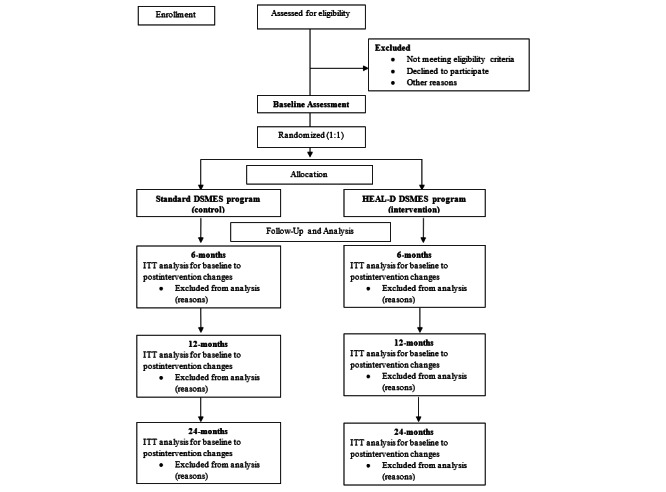 Figure 1
Peer Reviews
No public reviews on file for this paper yet. If you reviewed it on a platform where reviews are public (OpenReview, ICLR, NeurIPS, ICML), you can paste yours below so the community can read it here.
Videos
No videos yet. Explain this paper in a talk, walkthrough, or lecture? Add one.
Taxonomy
TopicsDiabetes Management and Education · Obesity and Health Practices · Chronic Disease Management Strategies