‘I don’t know if there’s a happy ending to this story’: An analysis of prostate cancer narratives in a follow-up setting
Laura Lahti, Piia Jallinoja

TL;DR
This study explores how men with prostate cancer in Finland tell their stories, revealing how cancer narratives evolve over time and include elements like tragedy, irony, and heroism.
Contribution
The study introduces two distinct prostate cancer storylines and highlights the role of cultural narrative types in long-term patient experiences.
Findings
Two recurring storylines emerged: one for radically treated men and another for those under active surveillance.
Irony and comedy appeared in narratives as side effects were reframed as part of aging, not the cancer itself.
Heroic narratives emerged when cancer was cured or non-aggressive, emphasizing the need for long-term support.
Abstract
Prostate cancer, the most common cancer among Finnish men, has a high survival rate. Treatment options vary from active surveillance to radical treatments, with potential long-term or permanent side effects. Traditional cancer narratives frame cancer as a tragedy or a hero story and thus fail to capture the chronic nature of prostate cancer and its impacts on patients’ lives. This study analyses the narratives of 22 prostate cancer patients, interviewed twice (1 and 3 years after diagnosis). We found two recurring storylines of prostate cancer narratives, one from radically treated men and the other from men under active surveillance. We analysed how cultural plot types – hero story, tragedy, comedy and irony – appear in the narratives. While tragedy dominated narratives, re-interviews also revealed irony as the tragic elements were caused by the treatment side effects, not the cancer…
Genes, proteins, chemicals, diseases, species, mutations and cell lines named across the full text — each resolved to its canonical identifier and authoritative record.
Click any figure to enlarge with its caption.
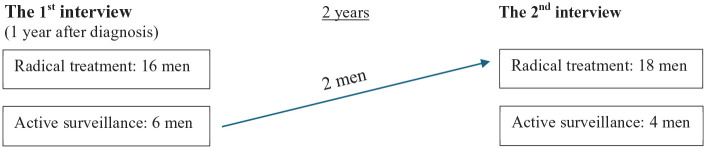 Figure 1
 Figure 2
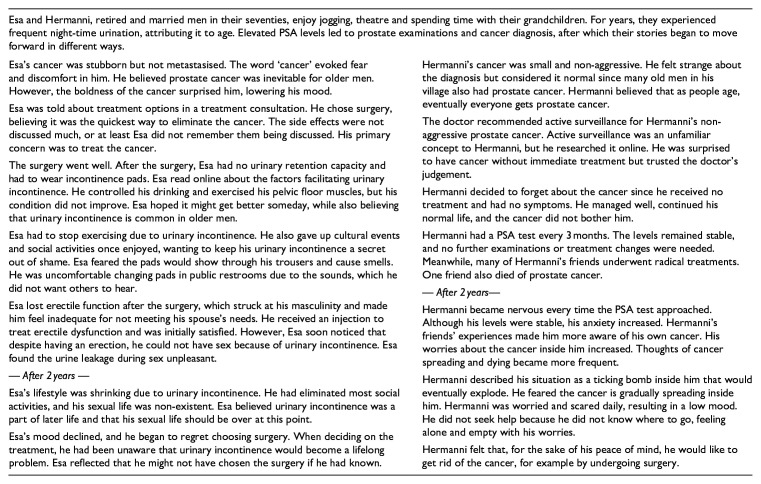 Figure 3
Peer Reviews
No public reviews on file for this paper yet. If you reviewed it on a platform where reviews are public (OpenReview, ICLR, NeurIPS, ICML), you can paste yours below so the community can read it here.
Videos
No videos yet. Explain this paper in a talk, walkthrough, or lecture? Add one.
Taxonomy
TopicsMedia Influence and Health · Empathy and Medical Education