Using a Learning Health System to Integrate Peer Support in Early Intervention Services for Psychosis in Quebec: Protocol for a Participatory, Mixed‐Methods Study (the PAIRPEP Project)
Beatrice Todesco, Srividya N. Iyer, Manuela Ferrari, Marc‐André Roy, Marie‐Hélène Morin, Julie Marguerite Deschênes, Camille Arbaud, Gabriel Julien, Annie Bossé, Mary Anne Levasseur, Amal Abdel‐Baki

TL;DR
This study outlines a protocol to integrate and evaluate peer support services in psychosis early intervention programs in Quebec using a learning health system.
Contribution
The novel contribution is a co-designed, mixed-methods protocol to implement and assess peer support within a rapid learning health system in Quebec.
Findings
The PAIRPEP project uses a participatory approach to implement peer support services across 12 early intervention clinics.
Quantitative and qualitative data will be collected over three years to evaluate implementation and stakeholder impact.
The study aims to foster real-time feedback and iterative improvements through integration with a rapid learning health system.
Abstract
Since 2019, SARPEP (Système Apprenant Rapide pour les programmes de Premiers Épisodes Psychotiques), a rapid learning health system (RLHS) for Quebec's Early Intervention for Psychosis Services, operates to bridge the evidence‐practice gap across the province. Despite strong stakeholder support and government recommendations, peer support services remained poorly available. To address this gap, since 2023, the PAIRPEP project was co‐developed to support and evaluate the implementation of peer support and family peer support. This paper describes the co‐designed study protocol, embedded within this RLHS. This participatory, mixed‐methods study aims to examine the implementation of the PAIRPEP intervention longitudinally over 3 years across 12 Early Intervention Services and its impact on multiple stakeholders. Informed by the Medical Research Council framework for complex interventions,…
Genes, proteins, chemicals, diseases, species, mutations and cell lines named across the full text — each resolved to its canonical identifier and authoritative record.
Click any figure to enlarge with its caption.
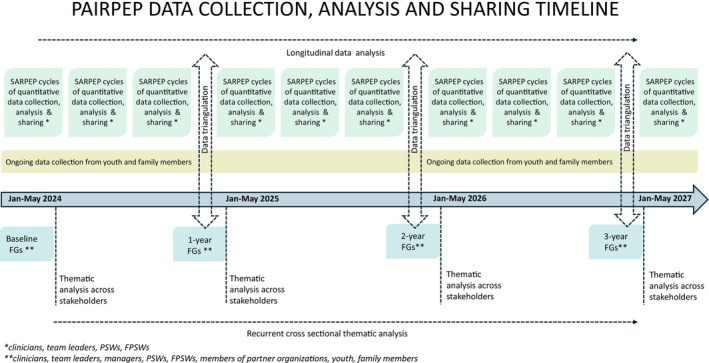 Figure 1
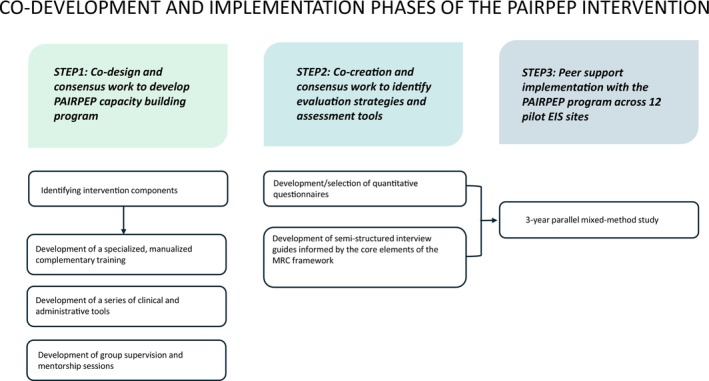 Figure 2
Peer Reviews
No public reviews on file for this paper yet. If you reviewed it on a platform where reviews are public (OpenReview, ICLR, NeurIPS, ICML), you can paste yours below so the community can read it here.
Videos
No videos yet. Explain this paper in a talk, walkthrough, or lecture? Add one.
Taxonomy
TopicsMental Health and Patient Involvement · Health Policy Implementation Science · Adolescent and Pediatric Healthcare