Migration–Gravity Sedimentation: An Effective Approach for Reducing Sperm DNA Fragmentation With Comparable Intracytoplasmic Sperm Injection Outcomes Compared to Density Gradient Centrifugation
Hideaki Yajima, Hiroki Takeuchi, Kanako Kishi, Kazuki Yamagami, Akane Kagohashi, Erina Takayama, Masahide Shiotani, Noritoshi Enatsu, Eiji Kondo

TL;DR
This study compares two sperm preparation methods for ICSI and finds that migration–gravity sedimentation reduces DNA fragmentation without compromising outcomes.
Contribution
MGS is introduced as a centrifuge-free, low-cost alternative to DGC with comparable ICSI outcomes and reduced DNA fragmentation.
Findings
MGS significantly reduced sperm DNA fragmentation compared to raw semen and DGC.
Fertilization and clinical outcomes, including blastocyst formation and pregnancy rates, were comparable between MGS and DGC.
MGS improved certain motility parameters like straightness and linearity but reduced others like curvilinear velocity.
Abstract
To compare the efficacy of migration–gravity sedimentation (MGS) and density gradient centrifugation (DGC) for sperm preparation in intracytoplasmic sperm injection (ICSI) cycles, focusing on sperm DNA fragmentation (SDF) and ICSI outcomes. In this prospective study, 32 patients who underwent ICSI using sibling oocytes were enrolled. Half of the oocytes were fertilized with DGC‐prepared sperm and the other half with MGS‐prepared sperm. Semen parameters were assessed using computer‐assisted sperm analysis (CASA), and SDF levels were measured using the terminal deoxynucleotidyl transferase dUTP nick end labeling assay before and after sperm preparation. Fertilization, blastocyst development, and clinical pregnancy rates were compared between the two groups. MGS significantly reduced SDF levels compared to raw semen and DGC. CASA demonstrated enhanced motility, straightness, and…
Genes, proteins, chemicals, diseases, species, mutations and cell lines named across the full text — each resolved to its canonical identifier and authoritative record.
Click any figure to enlarge with its caption.
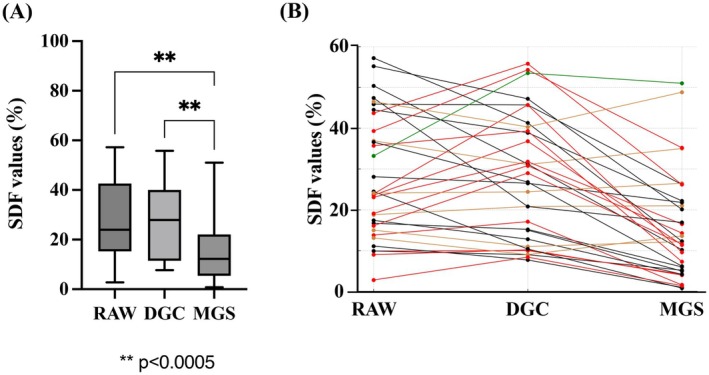 Figure 1
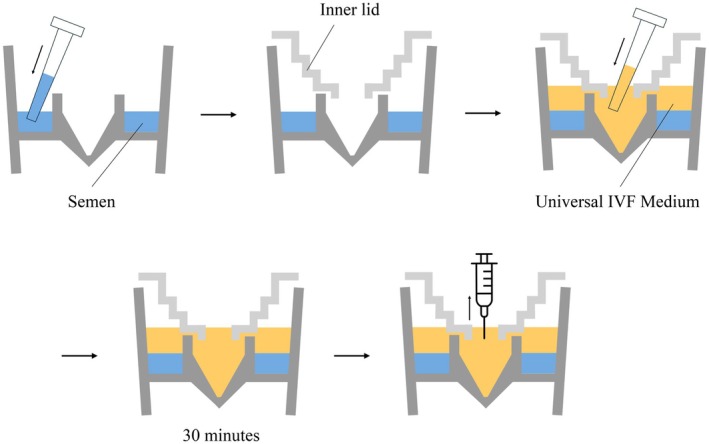 Figure 2
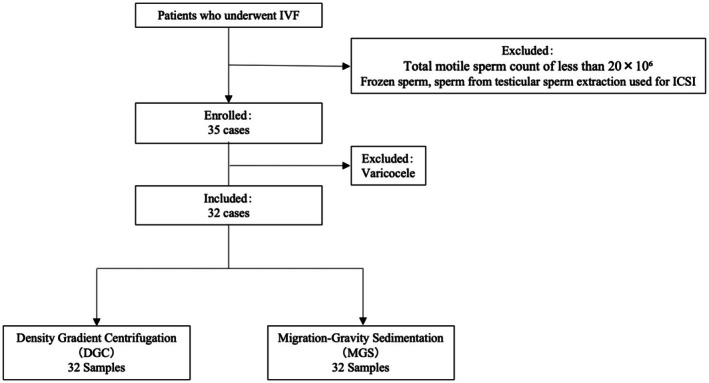 Figure 3
Peer Reviews
No public reviews on file for this paper yet. If you reviewed it on a platform where reviews are public (OpenReview, ICLR, NeurIPS, ICML), you can paste yours below so the community can read it here.
Videos
No videos yet. Explain this paper in a talk, walkthrough, or lecture? Add one.
Taxonomy
TopicsSperm and Testicular Function · Reproductive Biology and Fertility