Effects of manual carotid compression in endovascular thrombectomy for acute anterior circulation large-vessel occlusion: a multicenter, propensity score-matching study
Li Bao, Shuang He

TL;DR
This study found that manual carotid compression during stroke treatment improved recovery and reduced bleeding risks compared to standard methods.
Contribution
The study introduces manual carotid compression as a novel alternative to balloon guide catheters for flow control during stroke interventions.
Findings
Manual carotid compression increased the first pass reperfusion rate and improved early neurological outcomes.
It significantly reduced the incidence of intracranial hemorrhage and symptomatic intracranial hemorrhage.
Patients treated with manual carotid compression had better 90-day functional outcomes.
Abstract
Randomized controlled trials suggested that balloon guide catheters for proximal flow control (PFC) in endovascular thrombectomy (EVT) for acute anterior circulation large-vessel occlusion (LVO) have unsatisfactory results. Our study aimed to explore effects of manual carotid compression (MCC) achieving temporary PFC in EVT, without interfering with endovascular procedures. We retrospectively included 203 patients with acute occlusion of the intracranial internal carotid artery or the M1 or proximal M2 segments of the middle cerebral artery undergoing EVT from three independent centers (n = 80 in the MCC group and n = 123 in the non-MCC group). The primary outcome was the 90-day functional independence, defined as a modified Rankin Scale (mRS) score ≤ 2. Propensity score matching (PSM) analysis was conducted to compare outcomes. In the overall cohort, the median age was 71 years (IQR…
Genes, proteins, chemicals, diseases, species, mutations and cell lines named across the full text — each resolved to its canonical identifier and authoritative record.
Click any figure to enlarge with its caption.
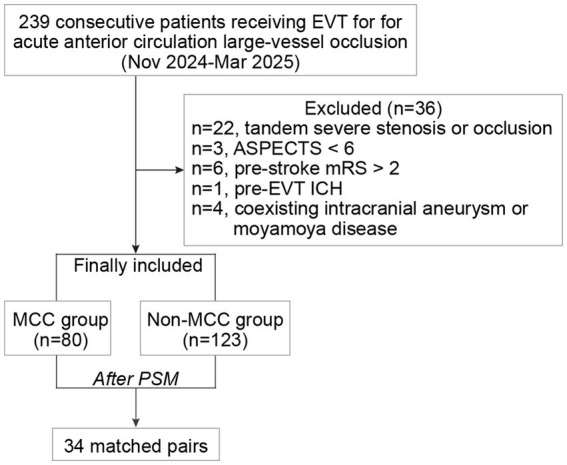 Figure 1
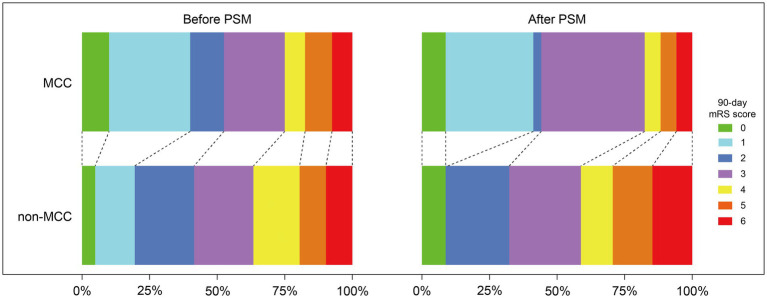 Figure 2
| Variables | Before PSM | After PSM | ||||||
|---|---|---|---|---|---|---|---|---|
| MCC ( | Non-MCC ( |
| SMD | MCC ( | Non-MCC ( |
| SMD | |
| Age (years) | 70.5 (56.3–76.8) | 71 (66–75) | 0.855 | 0.111 | 70 (58–74.3) | 71 (53–76) | 0.833 | 0.106 |
| Female | 30 (37.5%) | 54 (43.9%) | 0.448 | 0.131 | 14 (41.2%) | 10 (29.4%) | 0.446 | 0.248 |
| BMI (kg/m2) | 25.2 (21.1–27.3) | 23.9 (21.5–26.8) | 0.098 | 0.264 | 24.5 (21.2–26.5) | 24 (21.3–27.4) | 0.954 | 0.070 |
| Medical history | ||||||||
| Hypertension | 54 (67.5%) | 102 (82.9%) | 0.017* | 0.363 | 25 (73.5%) | 21 (61.8) | 0.437 | 0.253 |
| Diabetes | 24 (30.0%) | 30 (24.4%) | 0.471 | 0.126 | 10 (29.4) | 12 (35.3) | 0.795 | 0.126 |
| Atrial fibrillation | 36 (45.0%) | 45 (36.6%) | 0.294 | 0.172 | 14 (41.2%) | 9 (26.5%) | 0.305 | 0.315 |
| Coronary heart disease | 16 (20.0%) | 27 (22.0%) | 0.875 | 0.048 | 5 (14.7%) | 2 (5.9%) | 0.425 | 0.293 |
| Dyslipidemia | 26 (32.5%) | 30 (24.4%) | 0.270 | 0.180 | 8 (23.5%) | 7 (20.6%) | >0.999 | 0.071 |
| Previous stroke/TIA | 22 (27.5%) | 15 (12.2%) | 0.010* | 0.391 | 3 (8.8%) | 7 (20.6%) | 0.304 | 0.337 |
| Pre-stroke mRS | 0 (0–1) | 0 (0–0) | 0.003* | 0.365 | 0 (0–1) | 0 (0–0) | 0.399 | 0.143 |
| Stroke characteristics | ||||||||
| Baseline NHISS | 14 (12–18.8) | 17 (13–20) | 0.004* | 0.408 | 15 (12–18.5) | 15 (13–19) | 0.944 | 0.112 |
| Baseline ASPECTS | 9 (8–10) | 9 (8–10) | 0.493 | 0.092 | 10 (8–10) | 10 (9–10) | 0.565 | 0.233 |
| Etiology by TOAST | 0.301 | 0.223 | 0.415 | 0.326 | ||||
| Atherosclerosis | 26 (32.5%) | 51 (41.5%) | 13 (38.2%) | 15 (44.1%) | ||||
| Cardioembolism | 32 (40.0%) | 48 (39.0%) | 14 (41.2%) | 9 (26.5%) | ||||
| Undetermined or other reason | 22 (27.5%) | 24 (19.5%) | 7 (20.6%) | 10 (29.4%) | ||||
| Occlusion site | 0.798 | 0.097 | 0.931 | 0.092 | ||||
| Intracranial ICA | 20 (25.0%) | 36 (29.3%) | 9 (26.5%) | 10 (29.4%) | ||||
| M1 | 40 (62.5%) | 72 (58.54%) | 19 (55.9%) | 19 (55.9%) | ||||
| M2 | 10 (12.5%) | 15 (12.2%) | 6 (17.6%) | 5 (14.7%) | ||||
| Left occlusion | 60 (75%) | 54 (43.9%) | <0.001* | 0.668 | 22 (64.7%) | 20 (58.8%) | 0.803 | 0.121 |
| Treatment details | ||||||||
| IV tPA | 22 (27.5%) | 33 (26.8%) | >0.999 | 0.015 | 10 (29.4%) | 9 (26.5%) | >0.999 | 0.066 |
| Transfemoral access | 78 (97.5%) | 105 (85.4%) | 0.009* | 0.444 | 32 (94.1%) | 27 (79.4%) | 0.152 | 0.445 |
| General anesthesia | 74 (92.5%) | 111 (90.2%) | 0.764 | 0.080 | 30 (88.2%) | 31 (91.2%) | >0.999 | 0.097 |
| Symptom onset to puncture time (min) | 477.5 (312–570) | 454 (336–540) | 0.609 | 0.014 | 540 (337.3–585) | 454 (337–663.3) | 0.663 | 0.014 |
| Procedural time (min) | 75.5 (50.5–100) | 84 (48–97) | 0.890 | 0.019 | 67.5 (50–91) | 83 (49–90.3) | 0.458 | 0.200 |
| First-line technique | 0.972 | 0.026 | 0.467 | 0.237 | ||||
| DA | 38 (47.5%) | 60 (48.8%) | 15 (44.1%) | 19 (55.9%) | ||||
| Combined DA + SR | 42 (52.5%) | 63 (51.2%) | 19 (55.9%) | 15 (44.1%) | ||||
| Outcomes | Before PSM | After PSM | ||||||
|---|---|---|---|---|---|---|---|---|
| MCC ( | Non-MCC ( |
| SMD | MCC ( | Non-MCC ( |
| SMD | |
| Primary outcomes | ||||||||
| Functional independence at 90 d | 42 (52.5%) | 51 (41.5%) | 0.162 | 0.222 | 15 (44.1%) | 11 (32.4%) | 0.454 | 0.244 |
| Secondary outcomes | ||||||||
| Dichotomized mRS scores at 90 d | ||||||||
| mRS score at 90 d | 2 (1–3.8) | 3 (2–4) | 0.021* | 0.307 | 3 (1–3) | 3 (2–5) | 0.031* | 0.558 |
| 0–1 (vs 2–6) | 32 (40.0%) | 24 (19.5%) | 0.002* | 0.460 | 14 (41.2%) | 3 (8.8%) | 0.005* | 0.805 |
| 0–3 (vs 4–6) | 60 (75.0%) | 78 (63.4%) | 0.115 | 0.253 | 28 (82.4%) | 20 (58.8%) | 0.062 | 0.535 |
| 0–4 (vs 5–6) | 66 (82.5%) | 99 (80.5%) | 0.861 | 0.052 | 30 (88.2%) | 24 (70.6%) | 0.134 | 0.447 |
| 0–5 (vs 6) | 74 (92.5%) | 111 (90.2%) | 0.764 | 0.080 | 32 (94.1%) | 29 (85.3%) | 0.425 | 0.293 |
| Final mTICI ≥ 2b | 74 (92.5%) | 114 (92.7%) | >0.999 | 0.007 | 30 (88.2%) | 29 (85.3%) | >0.999 | 0.087 |
| Final mTICI = 3 | 58 (72.5%) | 78 (63.4%) | 0.233 | 0.196 | 21 (61.8%) | 19 (55.9%) | 0.805 | 0.120 |
| mTICI≥2b after the first pass | 48 (60.0%) | 45 (36.6%) | 0.002* | 0.482 | 24 (70.6%) | 14 (41.2%) | 0.028* | 0.620 |
| mTICI = 3 after the first pass (FPE) | 40 (50.0%) | 36 (29.3%) | 0.005* | 0.434 | 19 (55.9%) | 8 (23.5%) | 0.013* | 0.701 |
| No. of passes | 1 (1–3) | 2 (1–3) | 0.026* | 0.226 | 1 (1–2) | 2 (1–2) | 0.062 | 0.306 |
| Change of NIHSS score | ||||||||
| 24 h after recanalization | −3.5 (−5 to −2) | −2 (−5 to 0) | <0.001* | 0.312 | −4 (−5 to −2) | −1 (−4 to 4) | 0.002* | 0.780 |
| 7 days or at discharge | −7.5 (−10.8 to −4.3) | −7 (−10 to −3) | 0.383 | 0.136 | −9.5 (−12 to −6) | −6 (−8 to −3) | <0.001* | 0.677 |
| Emboli to new territory | 2 (2.5%) | 6 (4.9%) | 0.630 | 0.126 | 2 (5.9%) | 0 | 0.473 | 0.354 |
| Emboli to distal territory | 12 (15.0%) | 21 (17.1%) | 0.844 | 0.057 | 4 (11.8%) | 10 (29.4%) | 0.134 | 0.447 |
| Safety outcomes | ||||||||
| ICH | 22 (27.5%) | 72 (58.5%) | <0.001* | 0.660 | 5 (14.7%) | 16 (47.1%) | 0.009* | 0.748 |
| sICH | 4 (5.0%) | 27 (22.0%) | 0.002* | 0.512 | 0 | 6 (17.6%) | 0.033* | 0.655 |
| Mortality at 90 d | 6 (7.5%) | 12 (9.8%) | 0.764 | 0.080 | 2 (5.9%) | 5 (14.7%) | 0.425 | 0.293 |
Peer Reviews
No public reviews on file for this paper yet. If you reviewed it on a platform where reviews are public (OpenReview, ICLR, NeurIPS, ICML), you can paste yours below so the community can read it here.
Videos
No videos yet. Explain this paper in a talk, walkthrough, or lecture? Add one.
Taxonomy
TopicsAcute Ischemic Stroke Management · Cerebrovascular and Carotid Artery Diseases · Traumatic Brain Injury and Neurovascular Disturbances
Introduction
According to the estimated burden of stroke in China, among the population aged 40 and older, there were 3.4 million new stroke cases, 17.8 million individuals living with stroke, and 2.3 million stroke-related deaths in 2020 (1). Acute ischemic stroke (AIS) accounts for approximately 87% of strokes and has high rates of disability and mortality, bringing a huge burden to society (2, 3). Endovascular thrombectomy (EVT) has been proven effective in treating AIS caused by large vessel occlusion (LVO) in multiple randomized clinical trials (RCTs), establishing it as the standard treatment (4–7). The primary objective of EVT is to achieve rapid and complete reperfusion, ultimately resulting in favorable clinical outcomes. In this setting, several studies, including multicenter registry studies such as NASA and ROSSETTI, have found that transient proximal flow control (PFC) using a balloon guide catheter (BGC) was positively associated with improved EVT efficiency and better clinical outcomes in anterior circulation LVO (8–13). However, recent trials, including ProFATE and PROTECT-MT, have reported that the use of BGCs in EVT did not meet the expected results, and in some cases, led to poorer functional recovery (14–17). This may be related to challenges such as the incompatibility between BGCs and large-bore aspiration catheters, difficulties in achieving proper positioning of BGCs, and inadequate support for effective aspiration. Additionally, the advancements in first-line thrombectomy techniques and devices may also play a role (18). This raised the question: could extracorporeal PFC, when applied without interfering with endovascular procedures, improve EVT efficacy?
Manual carotid compression (MCC) is a non-invasive technique that effectively arrests anterior circulation blood flow. It has been recognized for its applications such as transcranial Doppler ultrasound, reducing brain embolism caused by arterial cannulation and aortic clamping, and treating arteriovenous fistulas (19–23). Given this, our multicenter study was aimed to investigate the impact of transient PFC via MCC on procedure and clinical outcomes in EVT-treated patients with anterior circulation LVO, focusing on functional independence at 90 days, the first-pass effect (FPE), the final recanalization quality, and distal/new region embolism. Propensity score matching (PSM) was employed to mitigate the confounding bias commonly encountered in observational studies.
Methods
Study design and patients
We retrospectively collected consecutive patients who underwent EVT treatment for acute occlusion of the intracranial internal carotid artery (ICA) or middle cerebral artery M1 or proximal M2 segments from November 2024 to March 2025 at three independent stroke centers. The exclusion criteria were as follows: (1) known or suspected pre-existing (chronic) large vessel occlusion in the symptomatic region; (2) intracranial hemorrhage (ICH) on CT prior to EVT; (3) tandem stenosis (70–99%) or occlusion; (4) coexisting intracranial tumors, aneurysms, intracranial infections, or arteriovenous malformations; (5) pre-stroke modified Rankin Scale (mRS) score > 2; (6) Alberta Stroke Program Early CT Score (ASPECTS) < 6; (7) Patients allergic to contrast agents. Patients were categorized into MCC or non-MCC group according to whether they received MCC in EVT. This study was conducted according to the Declaration of Helsinki with the approval of the Institutional Review Boards. Written informed consent was obtained from all patients or their legal representatives before inclusion.
Data collection and outcomes
Baseline characteristics of the patients were comprehensively assessed, including age, sex, body mass index (BMI), medical history, pre-stroke mRS score and stroke characteristics involving the National Institutes of Health Stroke Scale (NIHSS) score [at admission, 24 h after recanalization, and 7 days after recanalization or at hospital discharge (whichever occurred first)], the admission ASPECTS, stroke etiology by TOAST criteria (24), and the occlusion site. Treatment details comprised the use of intravenous tissue plasminogen activator (IV tPA), the access approach (femoral or radial), general anesthesia, symptom onset to puncture time, procedural time (puncture to final successful recanalization time), MT technique [direct aspiration (DA) or combined DA + stent retriever (SR)].
The primary outcome was functional independence (defined as mRS score ≤ 2) at 90 days. Secondary outcomes included mRS score at 90 days, other dichotomous analysis of score on the mRS at 90 days (0–1 vs. 2–6, 0–3 vs. 4–6, 0–4 vs. 5–6, and 0–5 vs. 6); change of the NHISS score from baseline to 24 h after recanalization, and to 7 days after treatment or at hospital discharge (whichever occurred first); the final recanalization quality assessed by the modified Thrombolysis in Cerebral Infarction (mTICI) score at the final intracranial angiogram; FPE (defined as an mTICI = 3 after the first pass); mTICI score ≥ 2b after the first pass; the number of passes attempts to achieve successful recanalization (no more than 4); occurrence of emboli in a new or distal territory. Safety outcomes included all-cause mortality at 90 days after treatment; all ICH and symptomatic intracranial hemorrhages (sICH) according to the Heidelberg criteria (25). Neurological improvement was defined as the reduction of the NHISS score.
Procedure
EVT was performed by experienced neurointerventionists following the current guidelines. DA or combined DA + SR were considered the first-line thrombectomy technique. The coaxial or exchange technique was used to advance a long sheath to the highest possible position in the internal carotid artery, with the aspiration catheter or distal access catheter positioned as close as possible to the site of occlusion. The selection of any endovascular devices, including the long sheath (Ballast, Balt, France), aspiration catheter (Ace, Penumbra, USA; React, Medtronic, USA), distal access catheter (Zenith, China; Soft, TONBRIDGE, China), microcatheter (rebar, Medtronic, USA), microguidewire (Synchro SELECT, Stryker, USA), and stent retrievers (Solitaire; Medtronic, USA; EmboTrap, Cerenovus, USA), was determined at the discretion of the operators. In the MCC group, the assistant synchronously acupressured the ipsilateral carotid artery during negative pressure aspiration or stent retraction, and in the non-MCC group, EVT was done conventionally without extra intervention. The assistant ensured the forward blood flow arrest by applying ultrasound at the compression site. The choice of anesthesia (general anesthesia or conscious sedation), the change of thrombectomy strategy or devices, and any resuscitation treatments, including intracranial angioplasty with or without stenting and intra-arterial drug therapy, were determined by the operator, considering the occlusion mechanism, the patient’s clinical condition, and other relevant factors. Strict systolic blood pressure management should be applied to all patients following EVT (≤160 mmHg for those without hemorrhagic transformation immediately post-procedure, ≤140 mmHg for those with hemorrhagic transformation, and all should not be lower than 120 mmHg). All patients should undergo Non-Contrast CT within 24 h after treatment; if necessary, additional imaging should be performed at any time in case of neurological deterioration.
Statistical analysis
All statistical analysis was conducted using RStudio software (version 4.4.3). Graphs were created using GraphPad version 10.1.2. The normality of continuous variables was assessed using the Kolmogorov–Smirnov test. Continuous variables with normal distribution were expressed as means (SD), while non-normally distributed variables were presented as medians (IQR). Categorical variables were reported as frequencies (proportions). Comparisons of continuous variables were performed using the t-test or Mann–Whitney U test. Categorical variables were compared using the χ^2^ test or Fisher’s exact test. PSM analysis was performed on primary and secondary outcomes using the nearest-neighbor method to adjust for potential confounders between MCC and non-MCC groups. A 1:1 matching without replacement was performed based on a caliper of 0.1. Covariate balance between matched groups was assessed using p-values and standardized mean differences (SMD). The factors adjusted for in the PSM analysis included age, sex, BMI, medical history, stroke characteristics, IV-tPA, transfemoral access, general anesthesia, symptom onset to puncture time, first-line technique. A two-tailed p value of <0.05 was considered statistically significant.
Results
Baseline characteristics and outcomes before PSM
Between November 2024 and March 2025, 239 AIS patients receiving MCC in EVT were assessed for eligibility, of whom 36 were excluded, and 203 were ultimately included (n = 80 in the MCC group and n = 123 in the non-MCC group) (Figure 1). In the overall cohort, the median age was 71 years (IQR 62–76), with 119 male patients (58.6%). The median baseline NHISS score was 15 (IQR 12–20), and the median baseline ASPECTS was 9 (IQR 8–10). The median time from symptom onset to puncture was 469 min (IQR 330–570). A total of 55patients (27.1%) received IV tPA prior to EVT. The occlusion sites were intracranial ICA [56 (27.6%)], M1 [122 (60.1%)], and M2 [25 (12.3%)]. According to the TOAST classification, 77 patients (37.9%) were identified as having atherosclerosis-related LVO, and 80 patients (39.4%) were judged to have cardiogenic embolism.
Flowchart. EVT, Endovascular thrombectomy; ASPECTS, Alberta Stroke Program Early CT Score; mRS, modified Rankin Scale; ICH, intracranial hemorrhage; MCC, manual carotid compression; PSM, propensity score matching.
There were significant differences between the two groups in terms of hypertension (p = 0.017), previous stroke/TIA (p = 0.01), pre-stroke mRS (p = 0.003), baseline NHISS (p = 0.004), left occlusion (p < 0.001), and transfemoral access (p = 0.009) (Table 1). No significant difference was observed between the groups regarding the first-line thrombectomy technique (p = 0.972). Four patients (5%) in the MCC group and five patients (4.1%) in the non-MCC group received intra-arterial 5% tirofiban injection. Additionally, 6 patients (7.5%) in the MCC group and 11 patients (8.9%) in the non-MCC group underwent stent implantation as a rescue measure.
There was no significant difference between the two groups in the primary outcome of functional independence at 90 days (52.5% vs. 41.5%, p = 0.162) (Table 2). There was significant difference between the two groups in the 90-day mRS score [2 (1–3.8) vs. 3 (2–4), p = 0.021] and the predefined binary comparison of 0–1 (vs 2–6) (40% vs. 19.5%, p = 0.002). The distribution of the 90-day mRS scores for both groups was shown in Figure 2. The MCC group had a significantly higher PFE rate (50% vs. 29.3%, p = 0.005) and mTICI≥2b after the first pass rate (60% vs. 36.6%, p = 0.002). The MCC group also demonstrated significantly better neurological improvement (change of NIHSS score) at 24 h post-reperfusion (p < 0.001), compared to the non-MCC group. However, there was no significant difference in neurological improvement between the two groups at 7 days or at discharge (p = 0.383). Regarding safety outcomes, patients who received MCC had a lower incidence of ICH (27.5% vs. 58.5%; p < 0.001) and sICH (5% vs. 22%; p = 0.002). There was no difference between the two groups in the mortality at 90 days and other secondary outcomes. The causes of death in the MCC group included three cases of large intracranial hematoma, one case of malignant brain edema, and two cases of severe infection. In the non-MCC group, the causes of death included nine cases of large intracranial hematoma, two cases of malignant brain edema and one case of post-discharge pulmonary infection.
Distribution of the modified Rankin Scale (mRS) at 90 days of patients with anterior circulation large-vessel occlusion treated with or without manual carotid compression (MCC) in endovascular thrombectomy before and after propensity score matching (PSM).
Propensity score matching analysis
After adjusting for differences in age, sex, BMI, hypertension, diabetes, atrial fibrillation, coronary heart disease, dyslipidemia, previous stroke/TIA, pre-stroke mRS score, NHISS at admission, baseline ASPECTS, etiology by TOAST, occlusion site, left occlusion, IV-tPA, transfemoral access, general anesthesia, symptom onset to puncture time, and first-line technique, 34 pairs of MCC and non-MCC treatments were successfully matched after PSM analysis. After matching, the baseline characteristics of the two groups were balanced (Table 1). After PSM analysis, there was no significant difference in functional independence at 90 days between the two groups (44.1% vs. 32.4%, p = 0.454). However, the MCC group had a significantly lower mRS score at 90 days (p = 0.031), primarily due to a higher proportion of patients with scores of 0–1 (41.2% vs. 8.8%, p = 0.005) (Table 2; Figure 2). Additionally, the MCC group showed significantly higher FPE rates (55.9% vs. 23.5%, p = 0.013) and first-pass mTICI ≥2b rates (70.6% vs. 41.2%, p = 0.028). Patients in the MCC group had significantly greater improvement in NHISS scores at 24 h after recanalization (p = 0.002) and at 7 days or discharge (p < 0.001) compared to the non-MCC group. In terms of safety outcomes, MCC significantly reduced the occurrence of ICH (14.7% vs. 47.1%, p = 0.009) and sICH (0% vs. 17.6%, p = 0.033).
Discussion
In this multicenter PSM study, we found that temporary PFC achieved by MCC in EVT did not significantly improve the primary outcome (90-day functional independence) in patients with acute anterior circulation LVO. The functional, imaging, and safety outcomes in the non-MCC group of our study were similar to the control groups in the ProFATE and PROTECT-MT studies (15, 16). However, in terms of secondary outcomes, after controlling for confounding factors with PSM analysis, we observed that MCC significantly improved the 90-day mRS score (mainly reflected in the higher proportion of 0–1 scores), PFE rate, first-pass mTICI ≥2b rate, early neurological improvement (change in NIHSS score), and the rates of ICH and sICH.
In recent years, there has been a focus on optimizing techniques and strategies to improve angiographic and clinical outcomes in EVT. Currently, the use of BGCs, which provide proximal flow arrest, has become a contentious issue in first-line thrombectomy approaches for AIS patients with anterior circulation LVO. Contrary to previous observational studies, the PROTECT-MT trial found that the use of BGCs was associated with poorer functional recovery and procedure results, as well as a higher rate of ICA vasospasm (15). As analyzed by Liu et al. (15) and Dhillon et al. (18), on one hand, the rapid advancement of thrombectomy techniques and devices has leveled out the benefits of BGCs in earlier years; on the other hand, BGCs has limitations such as restricting the use of large-bore aspiration catheters, affecting the stability of the access, and reducing collateral circulation flow. The disappointing results of BGCs in EVT led us to propose MCC, a technique that arrested anterior blood flow ex vivo without disrupting the endovascular procedure.
The MCC group had a significantly higher proportion of patients with minimal functional impairment (mRS scores 0–1), and early stroke severity (NHISS change) was significantly reduced with higher FPE rates and first-pass mTICI ≥2b rates, suggesting that MCC’s improvement in thrombectomy efficiency was more likely to facilitate the transition of patients from mild disability to complete independence. Studies have shown that PFE is associated with better clinical outcomes and is a key goal of EVT in achieving rapid and complete reperfusion (26, 27). Achieving FPE can effectively reduce the risks of thrombus rupture and distal migration, both of which are closely associated with poor outcomes (28–30), although the reduction in embolization rate in the new/distal territory did not reach statistical significance in our study. However, in this study, MCC did not significantly reduce the proportion of patients with an mRS score ≥2. This might be attributed to MCC’s more proximal blood flow arrest, which reduced more backpressure from ipsilateral collateral circulation that aided in thrombectomy (31) and limited the maintenance of the ischemic penumbra. Additionally, we observed that MCC led to a median improvement of 3 points in the early NHISS score compared to Non-MCC. The NHISS score reflects the severity of the stroke, and while a 3-point reduction may not significantly improve function in patients with more severe strokes (mRS ≥ 3), it can be sufficient to reverse functional impairments in those with mild deficits, improving the mRS score from 2 to 0 or 1. Therefore, the analysis of limited data from this exploratory study suggests that MCC has the potential for clinical benefits, as indicated by the improvement in secondary outcomes (proportion of patients with an mRS score of 0–1). Moreu et al. (32) found that positioning BGCs higher was associated with better reperfusion rates and improved clinical outcomes when used with SR technology alone. Therefore, expanding the sample size of the MCC study and further exploring the optimal site of PFC are valuable for optimizing EVT efficacy in treating anterior circulation LVO.
Regarding safety outcomes, the MCC group showed a significant reduction in the incidence of ICH and sICH before and after PSM analysis. Enhanced first-pass reperfusion efficiency minimized mechanical damage to the blood–brain barrier at the occlusion site and ischemic time. Additionally, in AIS patients with high blood pressure and significant blood pressure variability, the risk of ICH after EVT is increased (33, 34). Early control of hemodynamic impact after reperfusion can mitigate reperfusion injury and promote recovery of the ischemic penumbra tissue (35). Similarly, the study by Deng et al. (36) on rapid local ischemic postconditioning, which reduced reperfusion injury and promoted functional independence, is also based on this theory. During thrombectomy, MCC has the value of reducing transient blood flow impact upon reperfusion, thereby providing neuroprotection. Therefore, theoretically, regular MCC after reperfusion may also hold potential neuroprotective applications for ischemic postconditioning. Xu et al. (37) also highlighted the role of non-pharmacological therapies in improving the imbalance caused by hyperperfusion during the reperfusion phase. Our study considered MCC as an efficient and effective non-pharmacological approach. Therefore, our research suggested that MCC warrants further large-scale and in-depth studies to confirm its value in preventing hemorrhagic transformation associated with endovascular treatments.
MCC, a straightforward approach, offers the potential to significantly improve clinical outcomes through its benefits, including reduced costs, shorter procedure times, and minimal risks. The RCT by Hillebrand et al. (23) and the in vitro simulation by Isingoma et al. (19) showed that MCC could effectively reduce the rate of cerebral embolism during arterial catheterization and aortic clamping. Furthermore, MCC provides a safe and effective treatment alternative for patients with arteriovenous fistulas who are ineligible for endovascular therapy (22, 38). Our study aimed to investigate the effect of PFC without interfering with endovascular procedures, and MCC perfectly meeted this intervention requirement. A key advantage of this trial is its practicality and generalizability. Unlike RCTs involving BGCs, there were no specific requirements or limitations regarding the access and devices for both groups. Moreover, the intervention poses no cost and relatively less endothelial damage. Therefore, this study demonstrated the feasibility and effectiveness of MCC in EVT, offering potential for optimizing future thrombectomy strategies to improve outcomes. Furthermore, this study validated the benefits of temporary PFC and provided a foundation and insights for advancing PFC devices, including BGCs. In general, MCC or optimized BGC, through PFC, can serve as an adjunctive strategy in various scenarios, such as preventing plaque dislodgement during the treatment of atherosclerotic disease, reducing cyanoacrylates glue reflux during the treatment of arteriovenous malformations, and promptly reducing flow in cases of hemorrhagic complications following endovascular procedure.
This study has some limitations. First, despite our efforts to control for confounders using PSM, the retrospective nature of this study inherently introduced unavoidable selection bias and unmeasured confounders. Additionally, the relatively small number of matched pairs after PSM may affect the reliability of the exploratory research results. Thirdly, the lack of a detailed assessment of the impact of collateral circulation and the Willis compensation on the efficacy of MCC may undermine the stability of the positive outcome generalization. Fourthly, the whole trial cohort consisted of Chinese patients. A large proportion (37.9%) of AIS patients with an atherosclerotic etiology rely more on long-established collateral circulation. Fifthly, since the operators in this study inevitably knew the treatment intervention, this could have influenced the management of patients during and after EVT. Sixthly, our patients received either DA or combined DA + SR techniques, and our results may not be generalizable apply to patients who received SR alone.
Conclusion
In AIS patients with anterior circulation LVO in our cohort, the use of MCC during EVT to achieve transient PFC could improve the proportion of participants with a 90-day mRS score of 0–1, FPE rates, first-pass mTICI ≥2b rates, and change in NIHSS score, and decreased the incidence of ICH and sICH. To further confirm the efficacy and safety of MCC in EVT for AIS, larger-scale, multi-center RCTs are necessary.
The reference list from the paper itself. Each links out to its DOI / PubMed record.
- 1Tu WJ Zhao Z Yin P Cao L Zeng J Chen H. Estimated burden of stroke in China in 2020. JAMA Netw Open. (2023) 6:e 231455. doi: 10.1001/jamanetworkopen.2023.1455, PMID: 36862407 PMC 9982699 · doi ↗ · pubmed ↗
- 2Feigin VL Stark BA Johnson CO Roth GA Bisignano C Abady GG. Global, regional, and national burden of stroke and its risk factors, 1990–2019: a systematic analysis for the global burden of disease study 2019. Lancet Neurol. (2021) 20:795–820. doi: 10.1016/S 1474-4422(21)00252-0, PMID: 34487721 PMC 8443449 · doi ↗ · pubmed ↗
- 3Saini V Guada L Yavagal DR. Global epidemiology of stroke and access to acute ischemic stroke interventions. Neurology. (2021) 97:S 6–s 16. doi: 10.1212/WNL.0000000000012781, PMID: 34785599 · doi ↗ · pubmed ↗
- 4Powers WJ Rabinstein AA Ackerson T Adeoye OM Bambakidis NC Becker K. Guidelines for the early Management of Patients with Acute Ischemic Stroke: 2019 update to the 2018 guidelines for the early Management of Acute Ischemic Stroke: a guideline for healthcare professionals from the American Heart Association/American Stroke Association. Stroke. (2019) 50:e 344–418. doi: 10.1161/STR.0000000000000211, PMID: 31662037 · doi ↗ · pubmed ↗
- 5Goyal M Demchuk AM Menon BK Eesa M Rempel JL Thornton J. Randomized assessment of rapid endovascular treatment of ischemic stroke. N Engl J Med. (2015) 372:1019–30. doi: 10.1056/NEJ Moa 141490525671798 · doi ↗ · pubmed ↗
- 6Berkhemer OA Fransen PS Beumer Dvan den Berg LA Lingsma HF Yoo AJ. A randomized trial of intraarterial treatment for acute ischemic stroke. N Engl J Med. (2015) 372:11–20. doi: 10.1056/NEJ Moa 1411587, PMID: 25517348 · doi ↗ · pubmed ↗
- 7Campbell BC Hill MD Rubiera M Menon BK Demchuk A Donnan GA. Safety and efficacy of solitaire stent Thrombectomy: individual patient data meta-analysis of randomized trials. Stroke. (2016) 47:798–806. doi: 10.1161/STROKEAHA.115.012360, PMID: 26888532 PMC 4760381 · doi ↗ · pubmed ↗
- 8Nguyen TN Malisch T Castonguay AC Gupta R Sun CH Martin CO. Balloon guide catheter improves revascularization and clinical outcomes with the solitaire device: analysis of the North American solitaire acute stroke registry. Stroke. (2014) 45:141–5. doi: 10.1161/STROKEAHA.113.00240724302483 · doi ↗ · pubmed ↗