A Phase I open-label study to assess the pharmacokinetics, safety, and tolerability of capivasertib alone or in combination with paclitaxel in Chinese patients with advanced solid tumors
Jian Zhang, Xiaojun Liu, Yiqun Du, Yuxin Mu, Yanchun Meng, Yan Sun, Ling Zhang, Chris Chen, Marie Cullberg, Ethan Fan, Xichun Hu

TL;DR
This study evaluated the safety and absorption of capivasertib, alone or with paclitaxel, in Chinese patients with advanced tumors, finding it generally well-tolerated with manageable side effects.
Contribution
The study provides new pharmacokinetic and safety data for capivasertib in Chinese patients, supporting its further use in this population.
Findings
Capivasertib was rapidly absorbed with a half-life of about 10 hours.
Hyperglycemia, diarrhea, and rash were the most common adverse events, mostly mild to moderate.
25% of patients achieved partial response or stable disease, indicating some antitumor activity.
Abstract
Capivasertib is recommended, plus fulvestrant, for hormone receptor-positive/human epidermal growth factor receptor 2-negative advanced breast cancer with PIK3CA/AKT1/PTEN alterations and is under development for further breast and prostate cancer indications. Pharmacokinetics in Western and Japanese patients have been previously characterized. We conducted a Phase I trial assessing the pharmacokinetics and safety of capivasertib, alone or plus paclitaxel, in Chinese patients with advanced solid tumors. In this open-label, fixed-sequence Phase I trial, Chinese patients with advanced solid tumors refractory or resistant to standard therapy received capivasertib alone (Part A) and then plus paclitaxel (Part B). The primary endpoint comprised capivasertib pharmacokinetics after a single dose (480 mg), or multiple doses given alone (480 mg twice daily [4 days on, 3 days off]) or plus…
Genes, proteins, chemicals, diseases, species, mutations and cell lines named across the full text — each resolved to its canonical identifier and authoritative record.
Click any figure to enlarge with its caption.
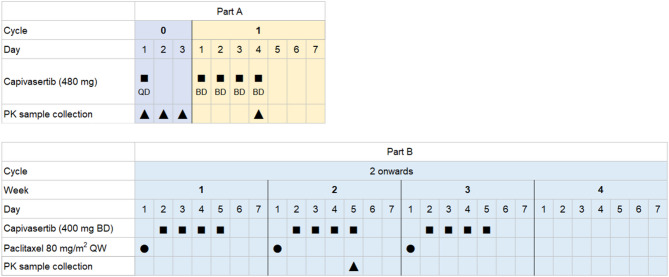 Figure 1
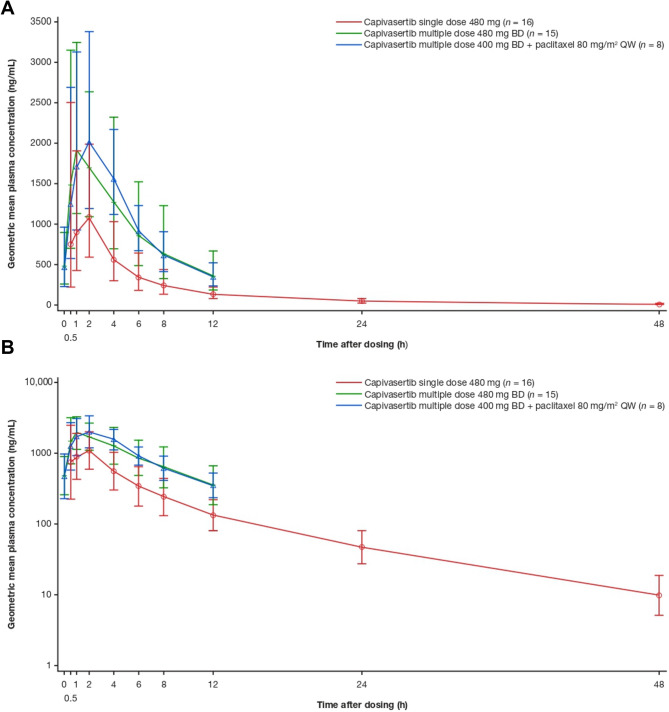 Figure 2
Peer Reviews
No public reviews on file for this paper yet. If you reviewed it on a platform where reviews are public (OpenReview, ICLR, NeurIPS, ICML), you can paste yours below so the community can read it here.
Videos
No videos yet. Explain this paper in a talk, walkthrough, or lecture? Add one.
Taxonomy
TopicsPI3K/AKT/mTOR signaling in cancer · Advanced Breast Cancer Therapies · Chronic Lymphocytic Leukemia Research