Assessment of intestinal barrier integrity and associations with innate immune activation and metabolic syndrome in acutely ill, antipsychotic-free schizophrenia patients
Kaushiki Mukherjee, Paul C. Guest, Madeleine Nussbaumer, Leon Dudeck, Leila Shokati Asl, Gabriela Meyer-Lotz, Henrik Dobrowolny, Katrin Borucki, Hans-Gert Bernstein, Alexander Link, Borna Relja, Kolja Schiltz, Thomas Nickl-Jockschat, Johann Steiner

TL;DR
This study examines gut barrier function in schizophrenia patients without antipsychotics, finding that gut markers differ from controls, with some changes linked to smoking and others suggesting unique gut damage.
Contribution
The study identifies distinct gut-related processes in antipsychotic-free schizophrenia patients, highlighting the importance of accounting for smoking in interpreting immune and gut barrier markers.
Findings
LBP levels were higher in schizophrenia patients but linked to smoking rather than schizophrenia itself.
I-FABP levels were lower in schizophrenia patients and not influenced by smoking, suggesting gut epithelial damage.
LBP and I-FABP showed distinct immune and metabolic associations, indicating separate gut dysfunction mechanisms.
Abstract
Schizophrenia (Sz), once seen solely as a brain disorder, is now recognised as a systemic illness involving immune and metabolic dysregulation. The intestinal barrier has emerged as a key player in gut–brain–immune interactions. However, studies in early, antipsychotic free stages remain scarce and often neglect confounding factors such as smoking and metabolic syndrome. We measured two complementary markers: lipopolysaccharide-binding protein (LBP), reflecting endotoxin exposure and systemic immune activation, and intestinal fatty acid-binding protein (I-FABP), indicating gut epithelial damage and permeability changes, in blood from 96 acutely ill, antipsychotic-free Sz patients (61 first-episode, 35 relapsed) and 96 matched controls. Associations with innate immunity, metabolic parameters, smoking, and clinical features were assessed using nonparametric statistics and random forest…
Genes, proteins, chemicals, diseases, species, mutations and cell lines named across the full text — each resolved to its canonical identifier and authoritative record.
Click any figure to enlarge with its caption.
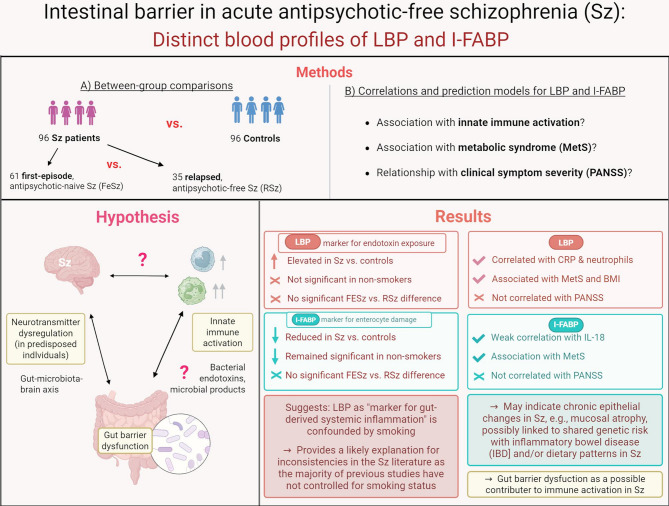 Figure 1
Peer Reviews
No public reviews on file for this paper yet. If you reviewed it on a platform where reviews are public (OpenReview, ICLR, NeurIPS, ICML), you can paste yours below so the community can read it here.
Videos
No videos yet. Explain this paper in a talk, walkthrough, or lecture? Add one.
Taxonomy
TopicsGut microbiota and health · Tryptophan and brain disorders · Gastrointestinal motility and disorders