Divergent Evolutionary Pressures Shape Olfactory Sensitivity of the Maxillary Palps in Tephritidae Fruit Flies
Chaymae Fennine, Sebastian Larsson Herrera, Tibebe Dejene Biasazin, Wittko Francke, Sergio Angeli, Teun Dekker

TL;DR
This study shows that the maxillary palps of Tephritidae fruit flies have evolved to detect pheromones and food odors under different evolutionary pressures.
Contribution
The study reveals that olfactory sensitivity to pheromones and food odors in Tephritidae is shaped by contrasting evolutionary forces.
Findings
Sensory responses to pheromones and parapheromones show strong phylogenetic clustering.
Sensitivities to food and fruit odors correlate more with ecological niche than phylogeny.
Olfactory sensitivities suggest stabilizing versus directional selection pressures.
Abstract
Olfaction is a rapidly evolving sense. Given its diverse functions, from finding ecological niches to selection of mates, we hypothesized that olfaction is subjected to divergent evolutionary pressures. We compared the olfactory sensitivity of five species of Tephritidae fruit flies to two broad classes of volatiles: general niche‐related volatiles (food and fruit odors) and volatiles used in sexual communication (pheromones and “parapheromones”). We then analyzed whether the differential sensitivities across species harbor “signals” of such contrasting evolutionary pressures. As recent studies highlight the maxillary palps as key auxiliary olfactory organs for detecting both classes of volatiles, we focused our sensory analysis on this auxiliary olfactory organ. Using gas chromatography coupled to electropalpographic detection (GC‐EPD), we recorded sensory responses from five species…
Genes, proteins, chemicals, diseases, species, mutations and cell lines named across the full text — each resolved to its canonical identifier and authoritative record.
Click any figure to enlarge with its caption.
 Figure 1
 Figure 2
 Figure 3
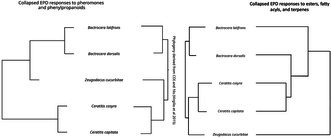 Figure 4
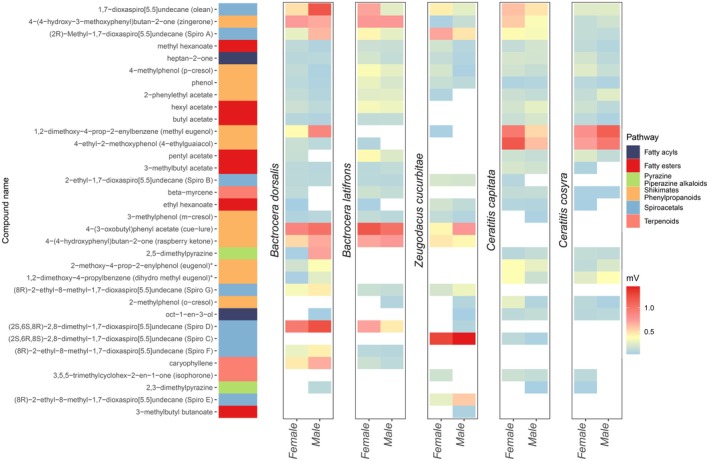 Figure 5
 Figure 6
 Figure 7
 Figure 8
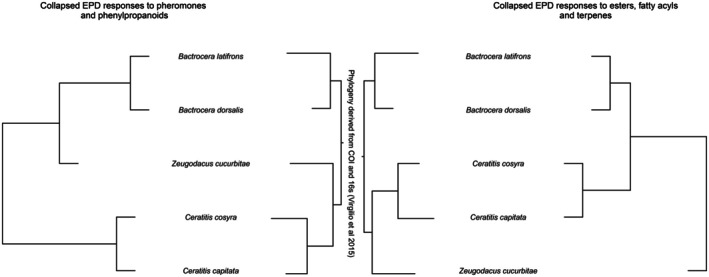 Figure 9
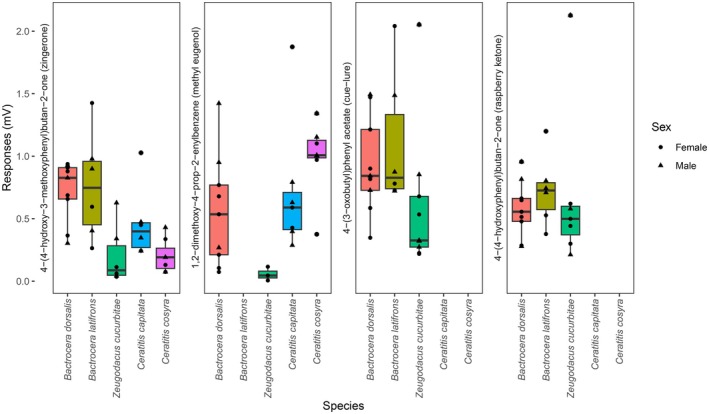 Figure 10
 Figure 11
 Figure 12
 Figure 13
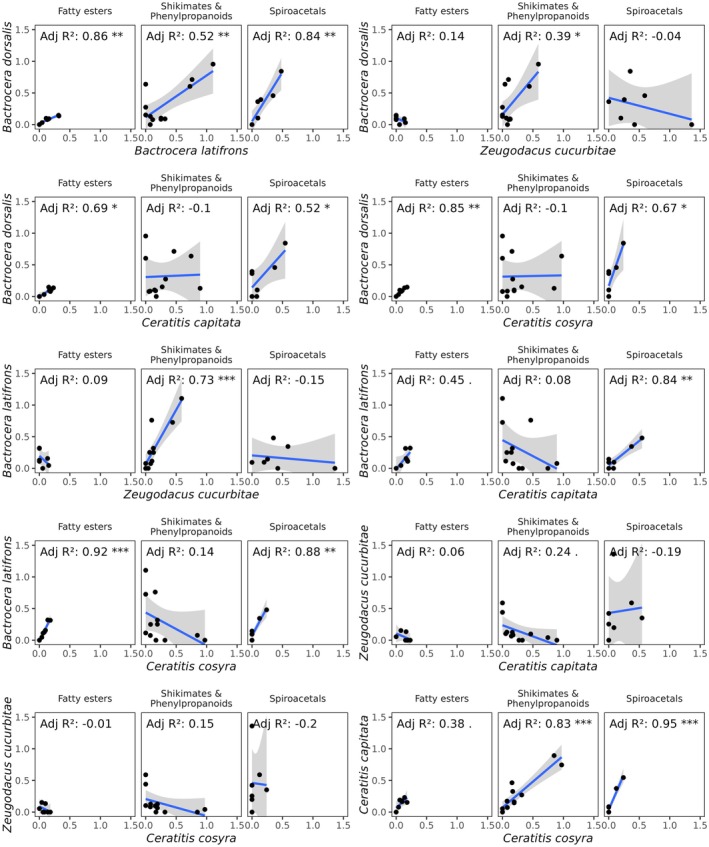 Figure 14
 Figure 15
 Figure 16
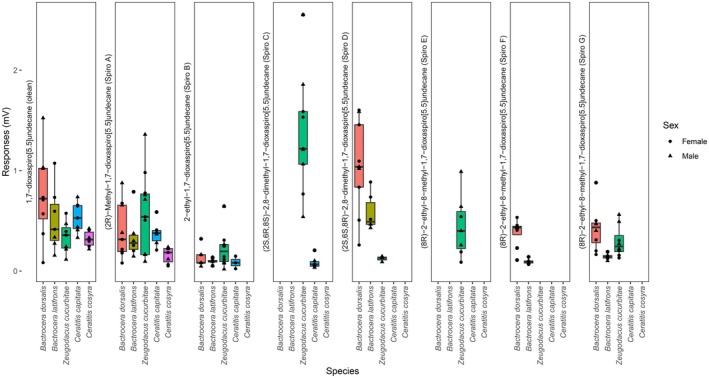 Figure 17
 Figure 18
Peer Reviews
No public reviews on file for this paper yet. If you reviewed it on a platform where reviews are public (OpenReview, ICLR, NeurIPS, ICML), you can paste yours below so the community can read it here.
Videos
No videos yet. Explain this paper in a talk, walkthrough, or lecture? Add one.
Taxonomy
TopicsInsect behavior and control techniques · Insect and Arachnid Ecology and Behavior · Plant and animal studies