Cross‐country variance in facial emotion recognition in presymptomatic and symptomatic behavioral variant frontotemporal dementia: Insights from the GENFI and ReDLat consortia
Liset de Boer, Lize C. Jiskoot, Harro Seelaar, John C. van Swieten, Agustin Ibanez, Marcelo Maito, Sol Fittipaldi, Julie F. H. De Houwer, Tine Swartenbroekx, Pam A. Boesjes, Rhian S. Convery, Eve Ferry‐Bolder, Phoebe Foster, Arabella Bouzigues, Lucy Chisman‐Russell

TL;DR
This study found that facial emotion recognition varies across countries in people with and without early signs of frontotemporal dementia, highlighting the need for culturally adapted tools.
Contribution
The study reveals cross-country differences in facial emotion recognition that interact with demographic factors and vary by disease stage.
Findings
Country accounted for 18-18.3% of FER variance in presymptomatic carriers and controls, and 9.9% in symptomatic bvFTD individuals.
Cross-country differences in FER interacted with sex, age, and education effects.
No cross-country differences were found in the neural correlates of FER in bvFTD individuals.
Abstract
We investigated international differences in facial emotion recognition (FER) across stages of frontotemporal dementia (FTD). Previous studies may have missed early decline by combining data and masking variations in FER across countries. An FER test was administered to 159 individuals with behavioral variant FTD, 521 presymptomatic pathogenic variant carriers, and 583 controls from 16 countries of residence. Linear mixed models assessed age, sex, education, and country effects on FER. Voxel‐based morphometry examined neural correlates across countries. Country accounted for 18%–18.3% of FER variance in presymptomatic carriers and controls and 9.9% in individuals with behavioral variant of FTD (bvFTD). Cross‐country differences interacted with the effects of sex, age, and education. Neural correlates involving the frontal lobe and basal ganglia were identified in individuals with…
Genes, proteins, chemicals, diseases, species, mutations and cell lines named across the full text — each resolved to its canonical identifier and authoritative record.
Click any figure to enlarge with its caption.
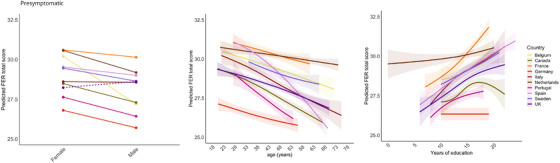 Figure 1
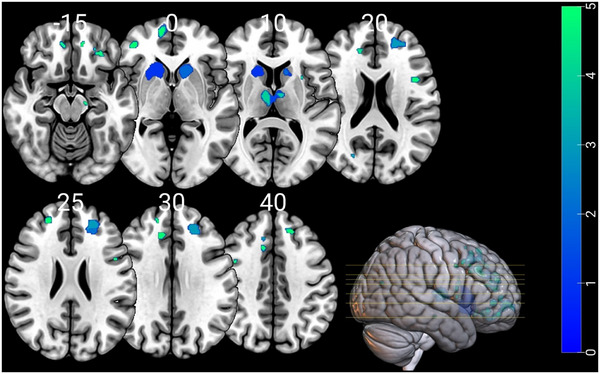 Figure 2
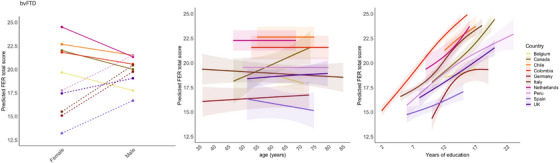 Figure 3
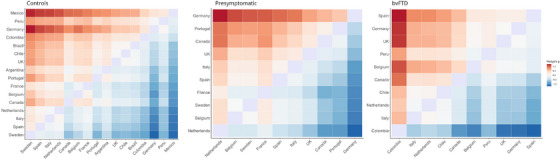 Figure 4
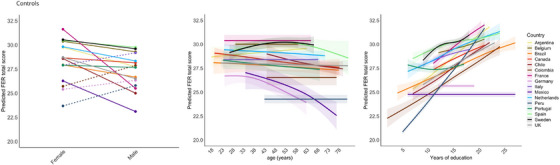 Figure 5
Peer Reviews
No public reviews on file for this paper yet. If you reviewed it on a platform where reviews are public (OpenReview, ICLR, NeurIPS, ICML), you can paste yours below so the community can read it here.
Videos
No videos yet. Explain this paper in a talk, walkthrough, or lecture? Add one.
Taxonomy
TopicsDementia and Cognitive Impairment Research · Alzheimer's disease research and treatments · Autism Spectrum Disorder Research