Cortical thickness subtypes in cognitively unimpaired individuals: Differential network and transcriptomic vulnerability to cortical thinning
Luigi Lorenzini, Mario Tranfa, Leonard Pieperhoff, Federico Masserini, Mara ten Kate, Lyduine E. Collij, Giuseppe Pontillo, Emma S. Luckett, Alle Meije Wink, Henk JMM Mutsaerts, Tiago Gil Oliveira, Daniele Altomare, Mercè Boada, Anouk den Braber, Cindy Birck, Christopher Buckley

TL;DR
This study identifies two stable brain subtypes in cognitively unimpaired individuals, showing different patterns of cortical thinning and clinical decline linked to Alzheimer's disease.
Contribution
The study introduces stable MRI-based subtypes of cortical thickness in preclinical Alzheimer's disease, linked to distinct network and transcriptomic mechanisms.
Findings
Two stable subtypes—limbic-predominant and hippocampal-sparing—were identified in cognitively unimpaired individuals.
Each subtype shows distinct clinical decline patterns and longitudinal cortical thinning linked to specific brain networks and gene expression.
Subtype assignments remain stable over time, suggesting potential for clinical trial stratification and early prognosis.
Abstract
The emergence, stability, and contributing factors of Alzheimer's disease (AD) gray matter subtypes remain unclear. We analyzed data from 1323 individuals without a diagnosis of dementia (CDR < 1) with T1w‐MRI and amyloid‐PET, including 622 with longitudinal data (3.66 ± 1.78 years). Cortical thickness subtypes were identified using a non‐negative matrix factorization (NMF) clustering algorithm. We examined clinical and demographic differences, subtype stability, and longitudinal thinning patterns using brain network models and imaging‐transcriptomic analysis. Replication was performed with an alternative clustering approach and a validation cohort. Two stable subtypes emerged: limbic‐predominant and hippocampal‐sparing. Limbic‐predominant participants were older, had higher amyloid burden, and faster memory decline, while hippocampal‐sparing individuals showed greater attention and…
Genes, proteins, chemicals, diseases, species, mutations and cell lines named across the full text — each resolved to its canonical identifier and authoritative record.
Click any figure to enlarge with its caption.
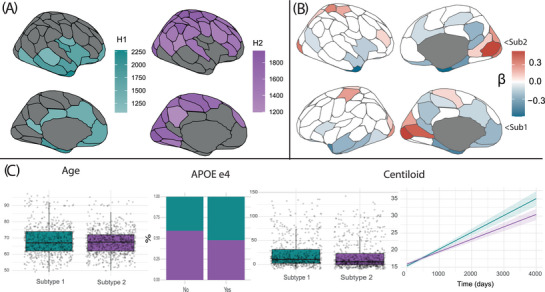 Figure 1
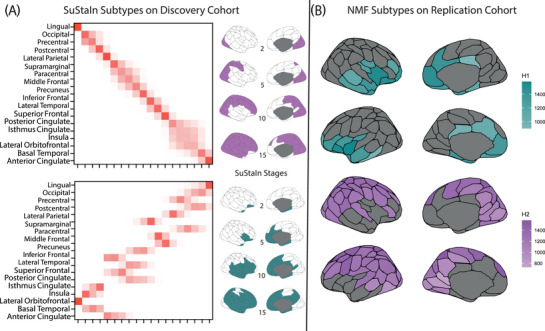 Figure 2
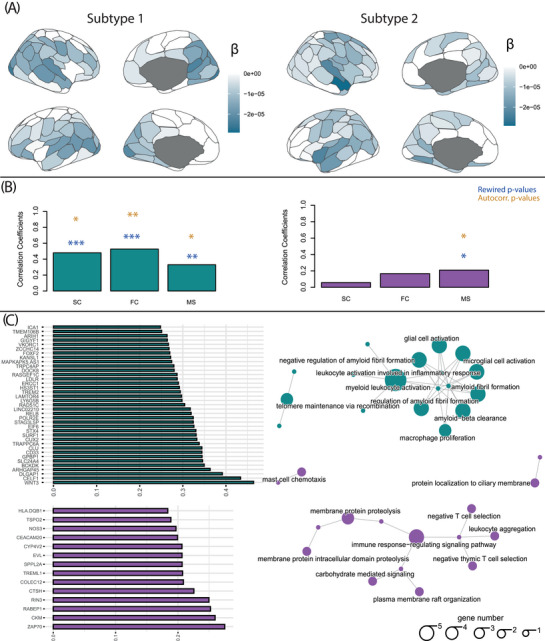 Figure 3
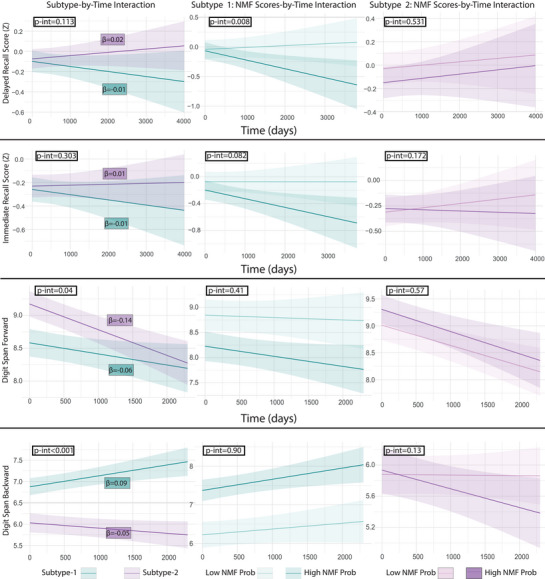 Figure 4
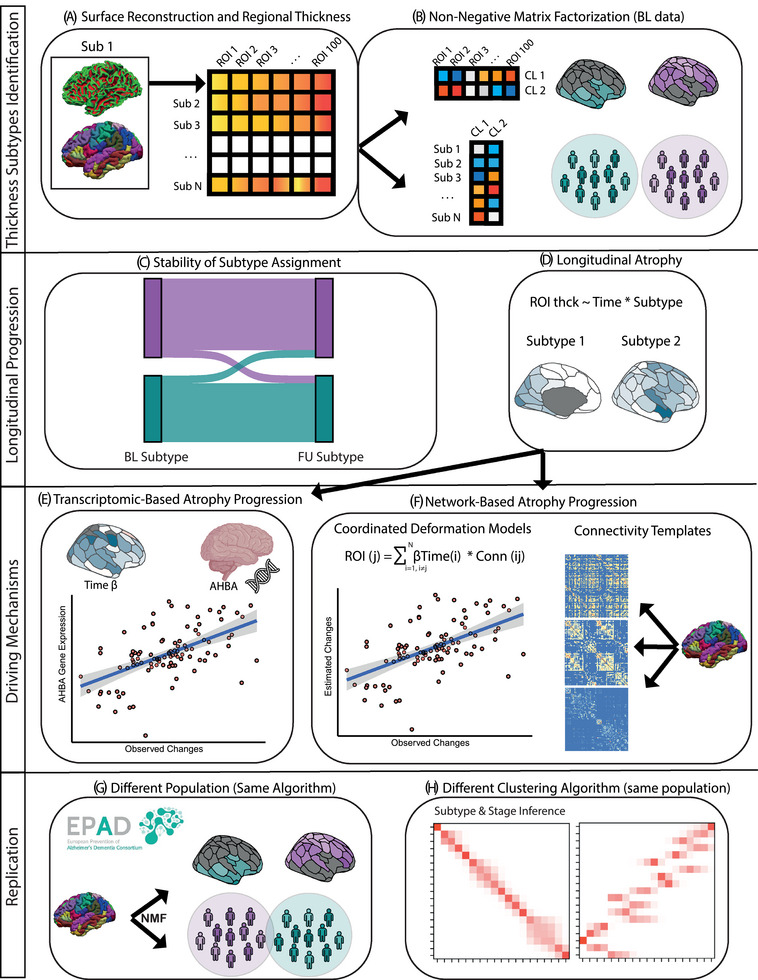 Figure 5
Peer Reviews
No public reviews on file for this paper yet. If you reviewed it on a platform where reviews are public (OpenReview, ICLR, NeurIPS, ICML), you can paste yours below so the community can read it here.
Videos
No videos yet. Explain this paper in a talk, walkthrough, or lecture? Add one.
Taxonomy
TopicsFunctional Brain Connectivity Studies · Dementia and Cognitive Impairment Research · Alzheimer's disease research and treatments